• → European Space Agency

      • Space for Europe
      • Space News
      • Space in Images
      • Space in Videos
    • About Us

      • Welcome to ESA
      • DG's News and Views
      • For Member State Delegations
      • Business with ESA
      • ESA Exhibitions
      • ESA Publications
      • Careers at ESA
    • Our Activities

      • Space News
      • Observing the Earth
      • Human Spaceflight
      • Launchers
      • Navigation
      • Space Science
      • Space Engineering
      • Operations
      • Technology
      • Telecommunications & Integrated Applications
    • For Public

    • For Media

      • Media
      • ESA TV
      • Videos for professionals
      • Photos
    • For Educators

    • For Kids

    • ESA

    • SMOS

    • Earth Explorers

    • Observing the Earth

    • Living Planet

    • SMOS at a glance
    • An Earth Explorer
    • Mapping soil moisture and ocean salinity
    • Improving our understanding of the water cycle
    • Introducing a novel use of technology
    • Facts and figures
    • About the satellite

      • Platform
      • Instrument
    • About the launch

      • Launch site
      • Launcher
    • SMOS in orbit

      • After liftoff
      • Data
    • Meet the team

      • Achim Hahne, Project Manager
      • Susanne Mecklenburg, Mission Manager
      • Matthias Drusch, Mission Scientist
      • Jordi Font, Co-Lead Investigator
      • Yann Kerr, Co-Lead Investigator
      • Manuel Martin-Neira, Instrument Principal Engineer
      • Guillermo Buenadicha, Payload Operations Engineer
      • Andrés Borges, EADS CASA Espacio Payload Project Manager
      • Roger Jegou, Launch Campaign Manager
      • Norrie Wright, Payload Data Ground Segment Manager
    • Multimedia
    • Image gallery
    • Videos
    • Online resources

    ESA > Our Activities > Observing the Earth > SMOS

    SMOS forms three-pointed star in the sky

    SMOS
    3 November 2009

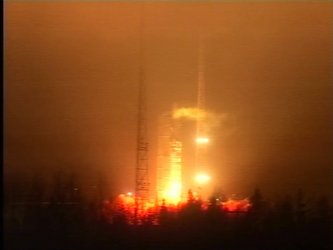
    Following the launch of ESA’s SMOS satellite on 2 November, the French space agency CNES, which is responsible for operating the satellite, has confirmed that the instrument’s three antenna arms have deployed as planned, and that the instrument is in good health.

    During launch and the first few orbits around Earth, the Soil Moisture and Ocean Salinity (SMOS) instrument’s antenna arms remained safely folded up. Today, these three arms folded-out and now form a large three-pointed star shape. With its unusual shape, measuring eight metres across, SMOS can be dubbed a ‘star in the sky’.

    The SMOS instrument is called MIRAS – short for Microwave Imaging Radiometer with Aperture Synthesis – and is actually bigger than the satellite platform. It consists of a central hub and the three arms that have just deployed. This deployment is crucial to the success of the mission as they carry the key measuring devices: most of the 69 small antenna receivers called LICEFs.

    MIRAS antenna deployment

    To acquire data on soil moisture and ocean salinity, each of the LICEF antenna-receivers measures radiation emitted from Earth’s surface within the ‘L-band’, around a frequency of 1.4 GHz. This frequency provides the best sensitivity to variations in moisture in the soil and changes in the salinity of the surface waters of the oceans. In addition, this frequency is not affected too much by the weather, atmosphere and vegetation cover.

    To achieve the spacial resolution required by the data users, the MIRAS instrument employs a novel use of technology. Under normal circumstances, measuring these two environmental variables using L-band would only work with a huge antenna – which would be too big to be carried by a satellite. To overcome this challenge, the SMOS mission has borrowed techniques used in radio astronomy.


    Mission Control at CNES
    Mission Control at CNES

    Radio astronomers, searching for celestial objects that are not detectable in optical astronomy, also faced the challenge of needing to detect small signals from point sources in space at a long wavelength, requiring a big antenna. Since signals are detected as waves, signals from different telescopes can be added to synthesise the pinpointing of a much larger telescope. To achieve this, radio astronomers combined 27 radio telescopes, each 25 m in diameter, and deployed them on a Y-shaped track that can be extended up to 35 km. This is known as the Very Large Array in New Mexico, US.

    Like the Very Large Array, the SMOS instrument also forms a Y-shape and through a process of interferometry the 69 small antenna receivers mimic a much larger antenna.

    SMOS mimics the 'Very Large Array'

    The deployment of the SMOS arms marks another significant milestone for ESA’s water mission. The satellite will now undergo a series of health checks within its six-month commissioning phase. So far, however, all the signs are good that this second of ESA’s Earth Explorer satellites in orbit is fit and healthy following launch and will be able to deliver the data to advance our understanding of Earth’s water cycle.

    Rate this

    Views

    Share

    • Currently 0 out of 5 Stars.
    • 1
    • 2
    • 3
    • 4
    • 5
    Rating: 0/5 (0 votes cast)

    Thank you for rating!

    You have already rated this page, you can only rate it once!

    Your rating has been changed, thanks for rating!

    140
    Tweet
    • SMOS in orbit
      SMOS in orbit
      SMOS launch
    • SMOS and Proba-2 liftoff
      SMOS and Proba-2 liftoff
      Replay the launch
    • Related news
      • Two new ESA satellites successfully lofted into orbit
        • SMOS and Proba-2 ready for launch
          • Operations teams ready for SMOS
            • SMOS opens arms
            • Related links
            • CNES
            • Thales Alenia Space
            • EADS-CASA
            • Eurockot Launch Services
            • ESA on Youtube
            • Earth Explorers

    Connect with us

    • RSS
    • Youtube
    • Twitter
    • Flickr
    • G+
    • Facebook
    • Livestream
    • Subscribe
    • App Store
    • LATEST ARTICLES
    • · Earth Explorers take centre stage …
    • · The fast winds of Venus are gettin…
    • · ExoMars 2016 set to complete const…
    • · Herschel ends operations as orbiti…
    • · Europe’s largest spaceship reache…
    • FAQ

    • Jobs at ESA

    • Site Map

    • Contacts

    • Terms and conditions