• → European Space Agency

      • Space for Europe
      • Space News
      • Space in Images
      • Space in Videos
    • About Us

      • Welcome to ESA
      • DG's News and Views
      • For Member State Delegations
      • Business with ESA
      • ESA Exhibitions
      • ESA Publications
      • Careers at ESA
    • Our Activities

      • Space News
      • Observing the Earth
      • Human Spaceflight
      • Launchers
      • Navigation
      • Space Science
      • Space Engineering
      • Operations
      • Technology
      • Telecommunications & Integrated Applications
    • For Public

    • For Media

    • For Educators

    • For Kids

    • ESA

    • Operations

    • Ground Systems Engineering

    • Space Debris

    • SSA

    • Operations
    • Operations home
    • Background
    • About Operations
    • The Right Stuff
    • Multimedia

      • Images
      • Videos
    • SSA programme
    • Space Situational Awareness
    • Teams on ground
    • Ground Systems Engineering
    • EGOS - Ground operation system
    • Missions in space
    • Solar and planetary
    • Astronomy & fundamental physics
    • Earth observation
    • Human spaceflight
    • Technology demonstration
    • Estrack operations
    • Past missions
    • ESA mission history
    • - Find a mission: A...Z
    • Mission control centres
    • ATV Control Centre (ATV-CC)
    • Columbus Control Centre (Col-CC)
    • Ground stations
    • Estrack tracking stations
    • ESTRACK Control Centre
    • - Find a station: A...Z
    • OPS Community
    • Advanced Operations Concepts Office
    • HSO Exchange
    • Knowledge Management at ESA's Operations team

    ESA > Our Activities > Operations

    CryoSat-2 installed in launch silo

    CryoSat in the Dnepr vehicle
    1 April 2010

    In readiness for launch on 8 April, ESA's CryoSat-2 ice satellite has now joined the rest of the Dnepr rocket in the launch silo at the Baikonur Cosmodrome in Kazakhstan.

    The 'space head module' was transported from the integration facilities to the underground launch silo this morning. Although it is only 7 km between the two sites, the specialised lorry, nicknamed the 'crocodile', takes well over an hour to complete the journey.

    The crocodile is equipped with a container that is positioned vertically and opens like 'jaws' to allow the space head module to be loaded. This procedure took place yesterday and marked the last time the team members from ESA and industry would see it. The launch silo is restricted to cosmodrome personnel only.

    On the way to the silo
    On the way to the silo

    Tomorrow, the satellite will be powered up to test that all is well after being integrated with launcher. Then, the last milestone before liftoff will be the launch dress rehearsal, planned for Tuesday. This simulation will ensure the communication sequences and procedures between the launch site and ESA's European Space Operations Centre in Germany are in place for launch on Thursday.

    The launch of CryoSat-2 will mark an important milestone for ESA because it will be the third Earth Explorer mission to be placed in orbit within just over 12 months. CryoSat-2 follows the Gravity field and steady-sate Ocean Circulation Explorer (GOCE) mission, launched in March 2009, and the Soil Moisture and Ocean Salinity (SMOS) mission, launched last November.


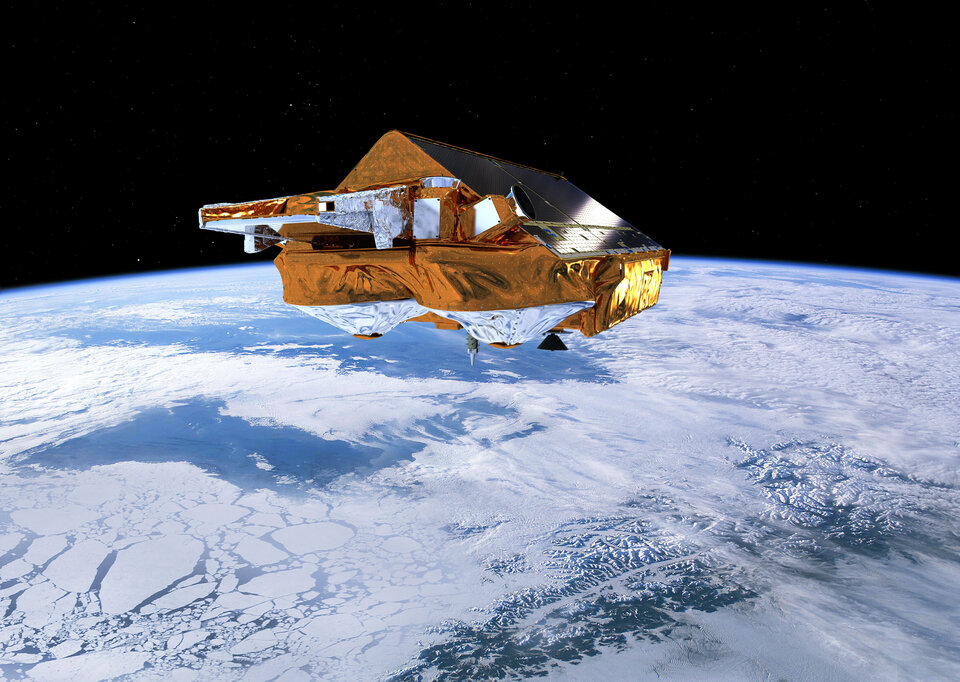
    As with all ESA's Earth Explorers, CryoSat has been developed to address a particular issue identified by the scientific community – in this case, to understand exactly how Earth’s ice fields are changing.

    For some years, satellites such as Envisat have been mapping the extent of ice cover. However, in order to understand how climate change is affecting these sensitive regions, there is an urgent need to determine how the thickness of the ice is changing.
    ESA's ice mission
    ESA's ice mission

    In response to this need, CryoSat is Europe's first mission dedicated to monitoring Earth's ice. The advanced observation techniques will provide precise measurements on variations in the thickness of floating marine ice as well as the vast ice sheets that overlie Antarctica and Greenland. This much-awaited information will lead to a better understanding of the relationship between ice and climate change.
    Rate this

    Views

    Share

    • Currently 0 out of 5 Stars.
    • 1
    • 2
    • 3
    • 4
    • 5
    Rating: 0/5 (0 votes cast)

    Thank you for rating!

    You have already rated this page, you can only rate it once!

    Your rating has been changed, thanks for rating!

    60
    Tweet
    • ESA's ice mission
      ESA's ice mission
      CryoSat launch
    • Related news
      • Invitation to the press for CryoSat-2 launch
        • New launch date for CryoSat-2 confirmed
          • CryoSat launch delayed
          • Related links
          • EADS-Astrium
          • Thales Alenia Space - SIRAL
          • Kosmotras
          • ESA on Youtube
          • Earth Explorers
          • CryoSat – ESA’s eye on Earth's ice

    Connect with us

    • RSS
    • Youtube
    • Twitter
    • Flickr
    • G+
    • Facebook
    • Livestream
    • Subscribe
    • App Store
    • ESA Operations Twitter

    Follow ESA operations

    • LATEST ARTICLES
    • · Proba-V opens its eyes
    • · First new Galileo satellite arrive…
    • · Next destination: space
    • · Leak repaired on International Spa…
    • · After Chelyabinsk: European expert…
    • FAQ

    • Jobs at ESA

    • Site Map

    • Contacts

    • Terms and conditions