GMES/Sentinels
The main objective of the GMES (Global Monitoring for Environment and Security) Programme is to provide data, information, services and knowledge that support Europe's goals regarding sustainable development and global governance of the environment.
GMES features several components, including In-Situ Measurement, Data Infrastructure, Service Provision and a Space Segment; this latter is responsible for the operational provision of Earth observation (EO) data, delivered by a series of 'Sentinel' spacecraft.
The missions
The ESA Sentinels constitute the first series of operational satellites for GMES; the GMES space component will use new as well as existing space assets. ESA is currently undertaking the development of three Sentinels mission families:
- Sentinel-1: Focusing on synthetic aperture radar (SAR) applications
- Sentinel-2: Providing high-resolution optical observation for GMES land and emergency services
- Sentinel-3: Providing optical and microwave observation for GMES operational marine and land services
Furthermore, the Sentinel-4, Sentinel-5 Precursor and Sentinel-5 missions are foreseen for later deployment to cover the atmospheric chemistry monitoring requirements.
The Sentinel-1, -2 and -3 missions are based on a constellation of two satellites in the same orbital plane, a configuration that fulfils GMES' revisit and coverage requirements and provides a robust and affordable operational service. Individual satellite lifetimes are specified as seven years, with consumables allowing mission extension up to 12 years. The life-cycle of the space segment is planned to be in the order of 15-20 years.
The GMES Sentinels Flight Operations Segment (FOS) is being established at ESOC, Darmstadt, Germany.
Sentinel-1 C-band SAR
| ROLE | Earth observation (EO) |
| LAUNCH DATE | 2013 |
| LAUNCHER/LOCATION | Soyuz/Kourou, French Guiana |
| LAUNCH MASS | ~2300 kg |
| ORBIT | Sun-synchronous dawn-dusk; 693 km |
| CYCLE | ~96 minutes |
| NOMINAL MISSION | 7 years |
|
+ C-band radar mission providing imageryin all weather and light conditions + |
|
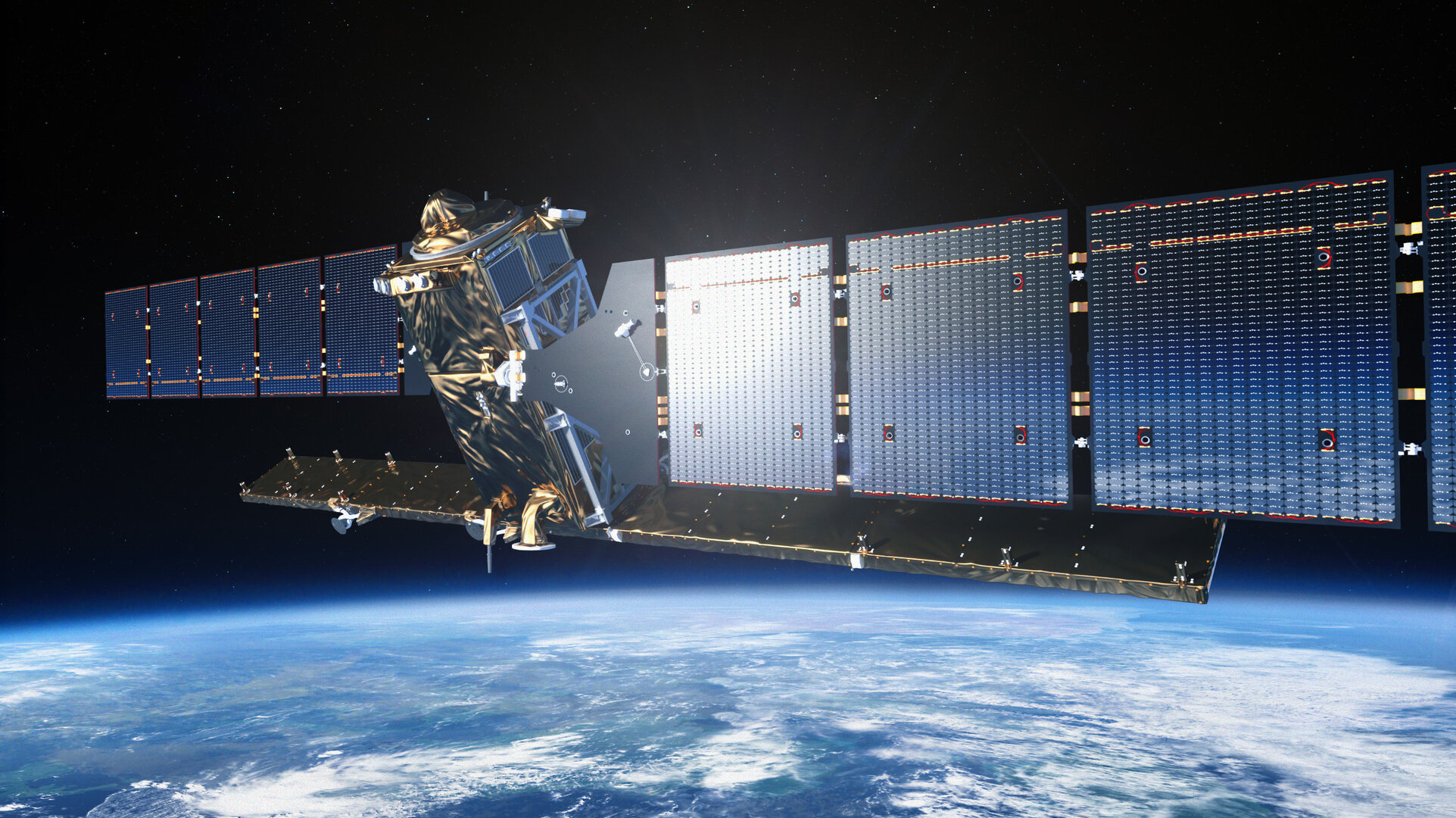
Sentinel-1 is an imaging radar mission at C-band aimed at providing continuous all-weather, day-and-night imagery for user services. These cover applications such as:
- Monitoring sea ice zones and the arctic environment, and surveillance of marine environment
- Monitoring land surface motion risks
- Mapping of land surfaces: forest, water and soil
- Mapping in support of humanitarian aid in crisis situations
The definition of the Sentinel-1 system is driven by the need for continuity of ERS/Envisat data provision with further enhancements in terms of revisit, coverage, timeliness and reliability of service. The final constellation of two satellites will provide at least a six-day revisit time, while achieving full European and global coverage in two and 12 days, respectively.
Sentinel-1 spacecraft design is characterised by a single Synthetic Aperture Radar (SAR) instrument with selectable dual polarisation, a deployable solar array, large on-board science data storage, a very high X-band downlink rate, and stringent requirements on attitude accuracy and data-take timing. In addition, the spacecraft will embark an Optical Communication Payload (OCP) unit allowing downlink of recorded data via the European Data Relay Satellite (EDRS) system (also now in development).
Sentinel-2 'Superspectral'
| ROLE | Earth observation (EO) |
| LAUNCH DATE | 2013 |
| LAUNCHER/LOCATION | To be confirmed - can be any small-capacity launch vehicle such as Vega or Rockot |
| LAUNCH MASS | ~1100 kg |
| ORBIT | Sun-synchronous; 786 km |
| CYCLE | ~100 minutes |
| NOMINAL MISSION | 7 years |
|
+ Multi-spectral imagery providing strategic and economic benefits + |
|
Sentinel-2 will provide a multi-spectral Earth observation system, allowing continuation of Landsat- and SPOT-type observations. The resulting imagery is vital for:
- Land cover, usage and change-detection maps
- Risk mapping
- Fast images for disaster relief
The mission will provide coverage of land surfaces between -56° and +84° latitude with the aim of delivering cloud-free imagery with a revisit frequency of 15 to 30 days. The final constellation of two satellites will allow a 5-day geometric revisit time. The spacecraft design is characterised by a single multi-spectral instrument featuring a 285-km swath and 13 spectral bands, a deployable solar array, on-board science data storage of two Terabits and stringent requirements on attitude accuracy. In addition, the spacecraft will embark an Optical Communication Payload (OCP) unit allowing downlink of recorded data via the European Data Relay Satellite (EDRS) system.
Sentinel-3 'Ocean'
| ROLE | Earth observation (EO) |
| LAUNCH DATE | 2013 |
| LAUNCHER/LOCATION | To be confirmed - can be any small-capacity launch vehicle such as Vega or Rockot |
| LAUNCH MASS | ~1250 kg |
| ORBIT | Sun-synchronous; 800 km |
| CYCLE | ~100 minutes |
| NOMINAL MISSION | 7 years |
|
+ Near-real-time orbit determination and improved land & sea data + |
|
Sentinel-3 is an Earth observation mission comprising a medium-size platform having large swath/medium spatial-resolution optical instruments and a radar altimeter delivering:
- Sea and land colour data
- Sea and land surface temperature
- Sea surface topography data
Sentinel-3 will also deliver additional land data applicable to ice topography and hydrology products.
The spacecraft carries a set of four main instruments: an Ocean and Land Colour Instrument, a Sea and Land Surface Temperature Instrument, a Radar Altimeter and a Microwave Radiometer. These are complemented by a GNSS (Global Navigation Satellite Systems) receiver and a Laser Retroreflector.
The mission definition is driven by the need for continuity of ERS/Envisat data provision with improvements in instrument performance and coverage. The final constellation of two satellites provides a worst-case two-day revisit time. The design is characterised by a deployable solar array, stringent requirements on attitude accuracy and the necessity to perform near-real time precise orbit determination to support data processing.
The Flight Control Team
The Sentinels Flight Control Team will operate the missions from a Dedicated Control Room located at ESOC.
The Sentinels FOS System Manager, Pier Bargellini, supported by Ian Shurmer (Sentinel-1), Franco Marchese (Sentinel-2), Jose Morales (Sentinel-3) and Daniel Mesples (Sentinel-5 Precursor), will coordinate a team of spacecraft operations engineers dedicated to the Sentinels. The team will be responsible for command and control, on-board software maintenance and mission planning, as well as interfacing with other ground segment teams. As with all satellites operated from ESOC, specialists from other support teams including Flight Dynamics, Ground Facilities and Software Support will contribute to the mission on a daily basis.
The Sentinels Flight Operations Segment is progressing on schedule with several major milestones already achieved. Definition of the flight control procedures and operational database and assembling of the Flight Control Team are also being initiated. Training will begin some 12 months prior to the launch of the first spacecraft.
Mission operations overview & ground station
All Sentinels will fly in low Sun-synchronous orbits at altitudes ranging from 700 to 800 km. An important factor in the satellite layout is the desire to minimise drag at those altitudes, so as to minimise fuel consumption for orbit maintenance.
The concept for control of the Sentinel missions is based on the use of a single ground control centre in conjunction with ESA's ESTRACK ground station in Kiruna. The Launch and Early Orbit Phase (LEOP) and Commissioning Phase will be supported for tracking, telemetry and command by additional ESTRACK ground stations.
All routine payload operations will be preplanned and executed according to the Flight Operations Plan (FOP). Payload operations as well as measurement data downlink activities will be scheduled autonomously on-board based on the spacecraft position along the orbit. There are no real-time platform operations foreseen other than near real-time activities at the time of commissioning (initial equipment turn-on, calibration), upload of regular orbit maintenance manoeuvres or during contingency situations.
Ground segment & mission control system
It is expected that the GMES Sentinels ground segment at ESOC will use the latest version of the SCOS-2000 mission control system infrastructure.
For the complete mission duration (launch up to the end of mission, when ground contact with the spacecraft is terminated), facilities and services will be provided to the Payload Data Ground Segment (PDGS) for planning of measurement data acquisition. This will include the uplink of instrument operation timelines as well as the provision of recorded data downlink schedules based on the predicted spacecraft orbit.
The PDGS will be responsible for acquisition, processing a distribution of measurement data to the GMES Service Providers and final users. Data products will be available for distribution in near-real time, i.e. between one and three hours from sensing.
Rate this
Views
Share
- Currently 0 out of 5 Stars.
- 1
- 2
- 3
- 4
- 5
Rating: 0/5 (0 votes cast)Thank you for rating!
You have already rated this page, you can only rate it once!
Your rating has been changed, thanks for rating!