• → European Space Agency

      • Space for Europe
      • Space News
      • Space in Images
      • Space in Videos
    • About Us

      • Welcome to ESA
      • DG's News and Views
      • For Member State Delegations
      • Business with ESA
      • ESA Exhibitions
      • ESA Publications
      • Careers at ESA
    • Our Activities

      • Space News
      • Observing the Earth
      • Human Spaceflight
      • Launchers
      • Navigation
      • Space Science
      • Space Engineering
      • Operations
      • Technology
      • Telecommunications & Integrated Applications
    • For Public

    • For Media

      • Media
      • ESA TV
      • Videos for professionals
      • Photos
    • For Educators

    • For Kids

    • ESA

    • Operations

    • Ground Systems Engineering

    • Space Debris

    • SSA

    • Operations
    • Operations home
    • Background
    • About Operations
    • The Right Stuff
    • Multimedia

      • Images
      • Videos
    • SSA programme
    • Space Situational Awareness
    • Teams on ground
    • Ground Systems Engineering
    • EGOS - Ground operation system
    • Missions in space
    • Solar and planetary
    • Astronomy & fundamental physics
    • Earth observation
    • Human spaceflight
    • Technology demonstration
    • Estrack operations
    • Past missions
    • ESA mission history
    • - Find a mission: A...Z
    • Mission control centres
    • ATV Control Centre (ATV-CC)
    • Columbus Control Centre (Col-CC)
    • Ground stations
    • Estrack tracking stations
    • ESTRACK Control Centre
    • - Find a station: A...Z
    • OPS Community
    • Advanced Operations Concepts Office
    • HSO Exchange
    • Knowledge Management at ESA's Operations team

    ESA > Our Activities > Operations

    Solar flare seen by SOHO

    Solar storm heading toward Earth

    24 January 2012

    A large solar flare yesterday triggered a coronal mass ejection travelling at 1400 km/s that will reach Earth today. An energetic eruption of this level can disrupt satellites, so operation teams at ESA and other organisations are closely monitoring the storm.

    A coronal mass ejection (CME) is a huge cloud of magnetised plasma from the Sun's atmosphere – the corona – thrown into interplanetary space. They often occur in association with a solar flare. This ejection was detected by the ESA/NASA SOHO and NASA Stereo spaceborne solar observatories.

    CMEs can produce geomagnetic storms when they reach Earth, between two and six days after leaving the Sun.


    The solar flare, at 03:59 GMT on Monday, also triggered the strongest stream of protons seen since 2005.
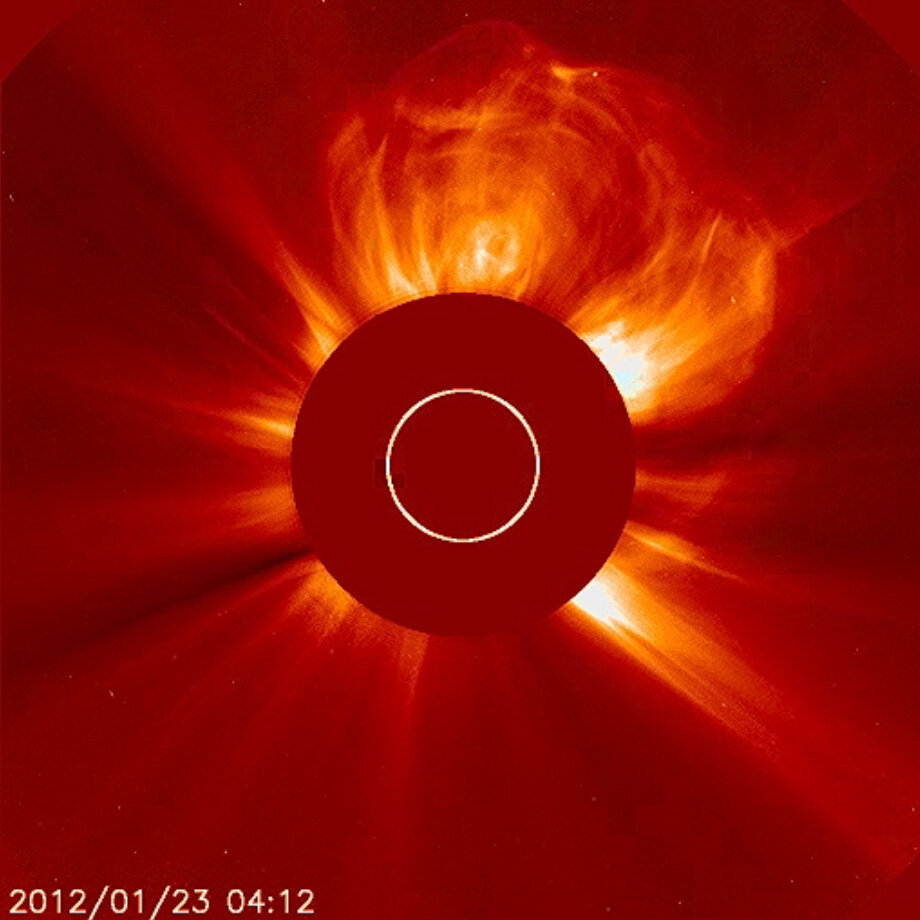
    Sun seen shortly after the flare occurred

    It is likely to cause a minor geomagnetic storm that is not expected to have any serious effect on ground infrastructure such as phone networks, but it might trigger auroral displays at high latitudes.

    While the flare was stronger than average and the proton storm is the first strong one in seven years, no visible effects on the ground are expected.

    Images of the Sun, the source of the flare and the CME are available via the SOHO mission page (see link at right). ESA's Proba-2 satellite is also returning images.

    Further information

    Contact for media queries

    Rate this

    Views

    Share

    • Currently 5 out of 5 Stars.
    • 1
    • 2
    • 3
    • 4
    • 5
    Rating: 5/5 (2 votes cast)

    Thank you for rating!

    You have already rated this page, you can only rate it once!

    Your rating has been changed, thanks for rating!

    589
    Tweet
    • ESA/NASA SOHO homepage
    • Proba
    • Space Situational Awareness

    Connect with us

    • RSS
    • Youtube
    • Twitter
    • Flickr
    • G+
    • Facebook
    • Livestream
    • Subscribe
    • App Store
    • ESA Operations Twitter

    Follow ESA operations

    • LATEST ARTICLES
    • · The fast winds of Venus are gettin…
    • · ExoMars 2016 set to complete const…
    • · Herschel ends operations as orbiti…
    • · Europe’s largest spaceship reache…
    • · ATV ready to nose up to Station
    • FAQ

    • Jobs at ESA

    • Site Map

    • Contacts

    • Terms and conditions