• → European Space Agency

      • Space for Europe
      • Space News
      • Space in Images
      • Space in Videos
    • About Us

      • Welcome to ESA
      • DG's News and Views
      • For Member State Delegations
      • Business with ESA
      • ESA Exhibitions
      • ESA Publications
      • Careers at ESA
    • Our Activities

      • Space News
      • Observing the Earth
      • Human Spaceflight
      • Launchers
      • Navigation
      • Space Science
      • Space Engineering
      • Operations
      • Technology
      • Telecommunications & Integrated Applications
    • For Public

    • For Media

      • Media
      • ESA TV
      • Videos for professionals
      • Photos
    • For Educators

    • For Kids

    • ESA

    • Operations

    • Ground Systems Engineering

    • Space Debris

    • SSA

    • Operations
    • Operations home
    • Background
    • About Operations
    • The Right Stuff
    • Multimedia

      • Images
      • Videos
    • SSA programme
    • Space Situational Awareness
    • Teams on ground
    • Ground Systems Engineering
    • EGOS - Ground operation system
    • Missions in space
    • Solar and planetary
    • Astronomy & fundamental physics
    • Earth observation
    • Human spaceflight
    • Technology demonstration
    • Estrack operations
    • Past missions
    • ESA mission history
    • - Find a mission: A...Z
    • Mission control centres
    • ATV Control Centre (ATV-CC)
    • Columbus Control Centre (Col-CC)
    • Ground stations
    • Estrack tracking stations
    • ESTRACK Control Centre
    • - Find a station: A...Z
    • OPS Community
    • Advanced Operations Concepts Office
    • HSO Exchange
    • Knowledge Management at ESA's Operations team

    ESA > Our Activities > Operations

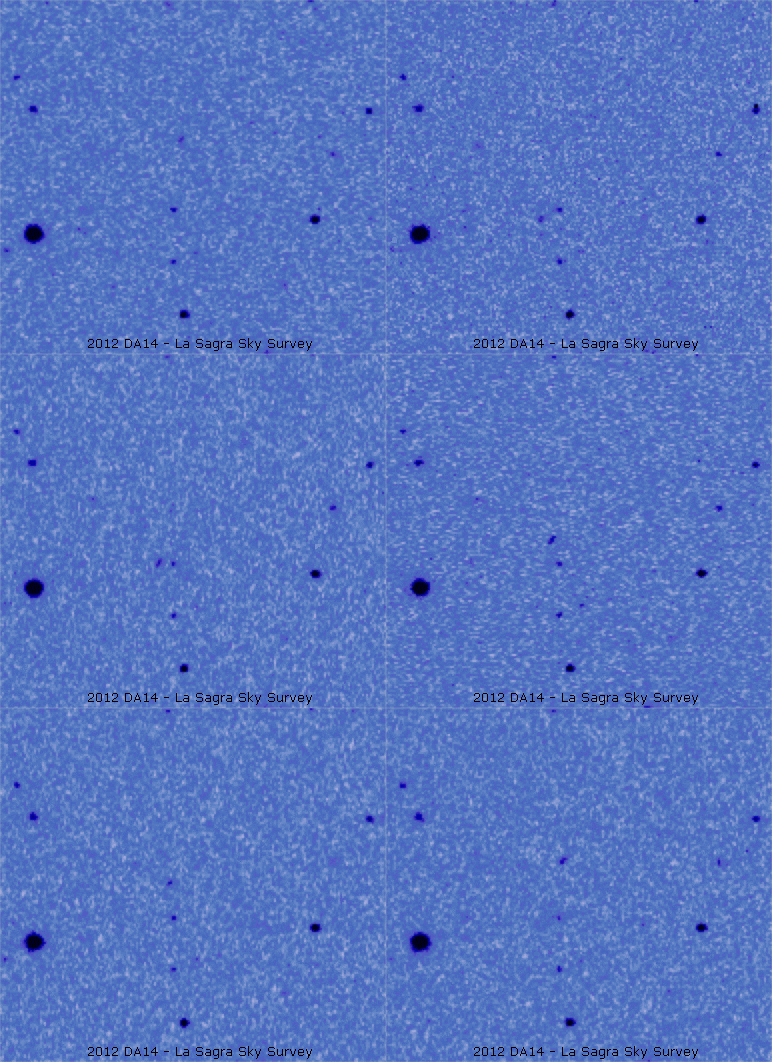
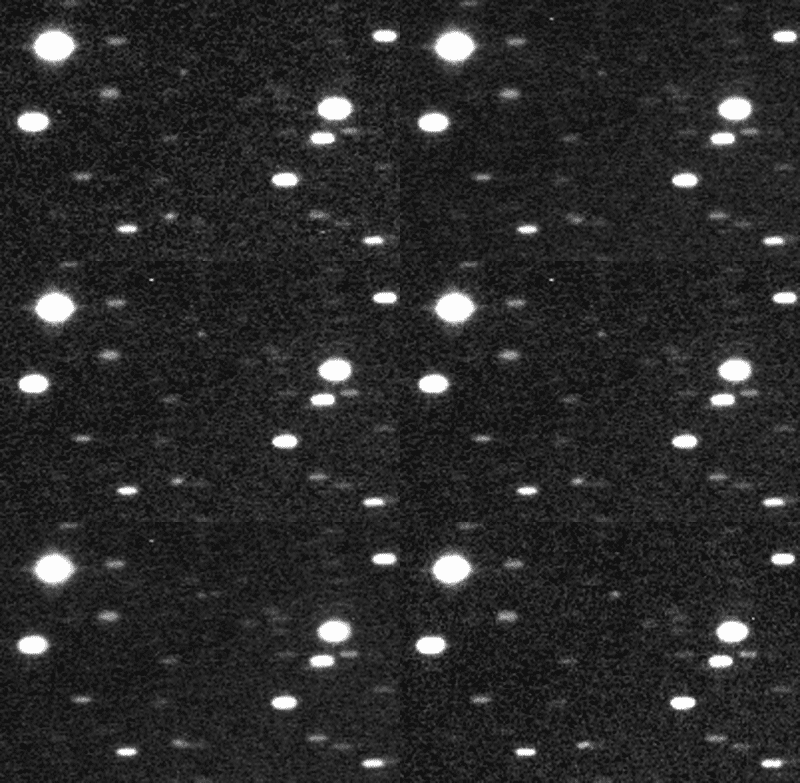
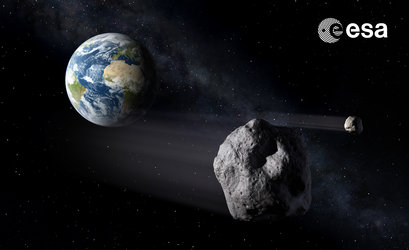
    Spotting an ancient asteroid

    How to see 2012 DA 14 on 15 February

    Asteroid 2012 DA14 will reach its maximum brightness of about 8 stellar magnitudes when rising above the horizon. This means that it will be too faint to be visible to the naked eye, but it can be picked up with a good pair of binoculars. It will approach Earth from the south, becoming visible in northern Europe in the evening, a couple of hours after sunset. 

    The precise time depends on the location of the observer. 

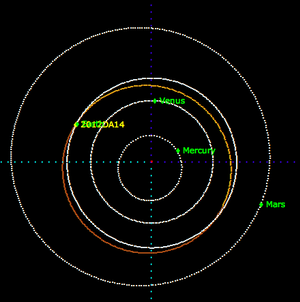
    Asteroid 2012 DA14 orbit
    Asteroid 2012 DA14 orbit

    • For example, at ESA’s ESTEC Establishment in the Netherlands, 2012 DA14 will rise above the eastern horizon at 19:40 GMT (20:40 CET).
    • It will move at about 0.7 degrees per minute. This means it will need only 40 seconds to move the apparent diameter of the Moon.
    • It will rise above the horizon in the constellation Virgo, moving northwards left of the constellation Leo. It will move in the direction of the north celestial pole, reaching about 10th magnitude approximately two hours later in the Little Dipper.
    • In the morning hours, it will have crossed half of the sky, moving slowly close to the Pole Star at a magnitude of 13. At this brightness, it will require a typical amateur telescope to see it.

    Finding the object may not be easy because it is moving quickly. If you wish to see this once-in-a-lifetime passage, contact your local astronomy club.
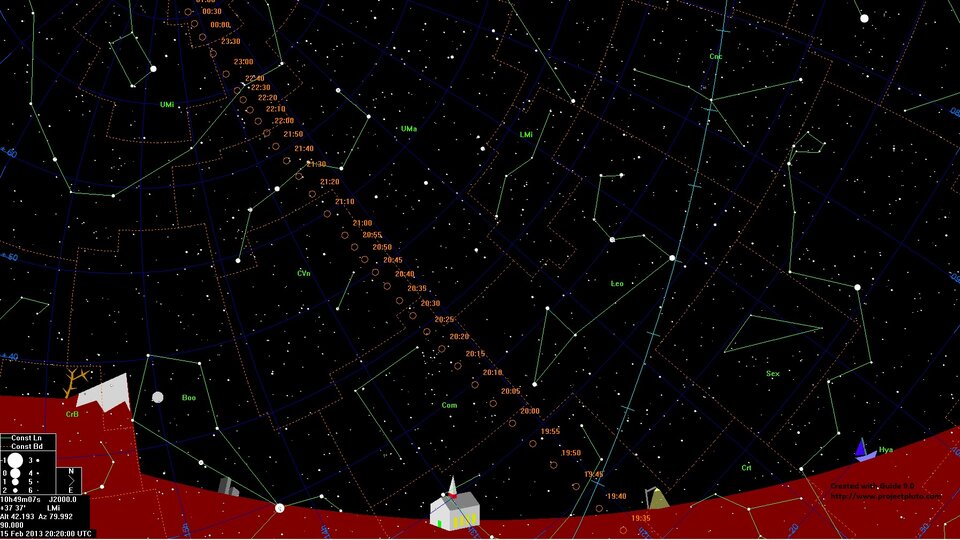
    Finder chart for the Netherlands - 2012 DA14
    Finder chart for the Netherlands - 2012 DA14

    For those who are familiar with the night sky, the figure above shows a finder chart for the location of ESTEC; from ESOC in Germany it would still be roughly in the same area.

    For ESRIN, close to Rome in Italy, the asteroid would appear about three lunar diameters to the left. 

    Zoomed section of finder chart - in constellation Coma Berenices

    Finder chart for the Netherlands - 2012 DA14 - zoom
    Finder chart for the Netherlands - 2012 DA14 - zoom

    This chart shows the position of the asteroid about 15 min after it rises above the horizon. The blue circles are the position as seen from ESRIN (Frascati, Italy); the white circles from ESOC (Darmstadt, Germany); the orange circles from ESTEC (Noordwijk, The Netherlands). Times are given in UTC. 

    Last update: 8 February 2013

    Rate this

    Views

    Share

    • Currently 4.5 out of 5 Stars.
    • 1
    • 2
    • 3
    • 4
    • 5
    Rating: 4.64/5 (17 votes cast)

    Thank you for rating!

    You have already rated this page, you can only rate it once!

    Your rating has been changed, thanks for rating!

    18532
    Tweet

    Related articles

    Asteroid deflection mission seeks smashing ideas 15 January 2013

    Asteroid deflection mission seeks smashing ideas 15 January 2013 A space rock several hundred metres across is heading towards our planet and the last-ditch attempt to avert a disaster – an untested mission to deflect it – fails. This fictional scene of films and novels could well be a reality one day. But what can...

    Near-miss asteroid will return next year15 March 2012

    Near-miss asteroid will return next year15 March 2012 When it whizzes past Earth in 2013, a newly discovered asteroid is going to miss our planet – but not by much. The 50 m space rock is expected to come closer than many satellites, highlighting the growing need to keep watch on hazards from above.

    NEO found by amateur skywatchers as part of ESA's SSA programme

    Amateur skywatchers help space hazards team12 October 2011

    NEO found by amateur skywatchers as part of ESA's SSA programme

    Amateur skywatchers help space hazards team12 October 2011 For the first time, observations coordinated by ESA's space hazards team have found an asteroid that comes close enough to Earth to pose an impact threat. The space rock was found by amateur astronomers, highlighting the value of 'crowd-sourcing' to s...

    • Space Situational Awareness
      • Stranger in the night: space rock to make close Earth flyby
        • Spotting an ancient asteroid
        • SSA NEO Data Centre
        • More information
        • Asteroid 2012 DA14 - Details at LSSS website
        • Near Earth Objects - Dynamic Site
        • NEODys risk assessment for 2012 DA14

    Connect with us

    • RSS
    • Youtube
    • Twitter
    • Flickr
    • G+
    • Facebook
    • Livestream
    • Subscribe
    • App Store
    • ESA Operations Twitter

    Follow ESA operations

    • LATEST ARTICLES
    • · Rare merger reveals secrets of gal…
    • · Watching for hazards: ESA opens as…
    • · ESA astronaut Timothy Peake set fo…
    • · Space drives e-mobility
    • · Proba-V opens its eyes
    • FAQ

    • Jobs at ESA

    • Site Map

    • Contacts

    • Terms and conditions