• → European Space Agency

      • Space for Europe
      • Space News
      • Space in Images
      • Space in Videos
    • About Us

      • Welcome to ESA
      • DG's News and Views
      • For Member State Delegations
      • Business with ESA
      • ESA Exhibitions
      • ESA Publications
      • Careers at ESA
    • Our Activities

      • Space News
      • Observing the Earth
      • Human Spaceflight
      • Launchers
      • Navigation
      • Space Science
      • Space Engineering
      • Operations
      • Technology
      • Telecommunications & Integrated Applications
    • For Public

    • For Media

      • Media
      • ESA TV
      • Videos for professionals
      • Photos
    • For Educators

    • For Kids

    • ESA

    • Operations

    • Ground Systems Engineering

    • Space Debris

    • SSA

    • Operations
    • Operations home
    • Background
    • About Operations
    • The Right Stuff
    • Multimedia

      • Images
      • Videos
    • SSA programme
    • Space Situational Awareness
    • Teams on ground
    • Ground Systems Engineering
    • EGOS - Ground operation system
    • Missions in space
    • Solar and planetary
    • Astronomy & fundamental physics
    • Earth observation
    • Human spaceflight
    • Technology demonstration
    • Estrack operations
    • Past missions
    • ESA mission history
    • - Find a mission: A...Z
    • Mission control centres
    • ATV Control Centre (ATV-CC)
    • Columbus Control Centre (Col-CC)
    • Ground stations
    • Estrack tracking stations
    • ESTRACK Control Centre
    • - Find a station: A...Z
    • OPS Community
    • Advanced Operations Concepts Office
    • HSO Exchange
    • Knowledge Management at ESA's Operations team

    ESA > Our Activities > Operations

    Stranger in the night: space rock to make close Earth flyby

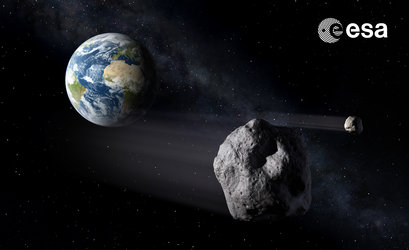
    Artist's impression of NEO asteroids passing Earth ESA SSA
    Artist's impression of asteroids passing Earth
    7 February 2013

    A little-known asteroid will skim past Earth on 15 February, passing just 28 000 km from our planet. The 50 m-diameter chunk of space rock was discovered last year by ESA-sponsored amateur astronomers in Spain.

    Details of the ancient asteroid, 2012 DA14, are sketchy – no direct measurements of its size are available. From its brightness, scientists estimate its diameter at 50–80 m. Its composition is unknown and its mass is thought to be of the order of 130 000 tonnes.

    What is known is that it will not impact Earth anytime soon.

    “Its orbit can be computed quite accurately using Europe’s NEODyS asteroid database,” says Detlef Koschny, responsible for near-Earth objects at ESA’s Space Situational Awareness office.

    “These computations show that a collision with Earth can be excluded quite safely at least for this century.”
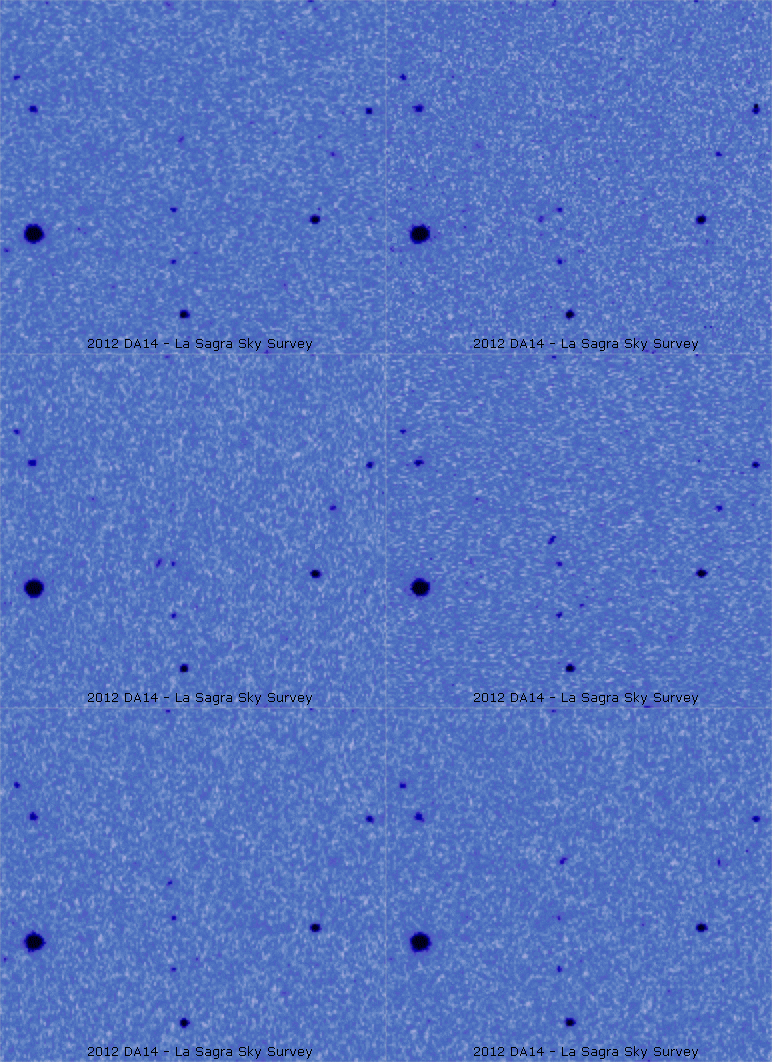
    Asteroid 2012 DA14

    On 15 February, the asteroid will make its closest pass to our planet this century when it flies by at 7.8 km/s at a distance of just within 28 000 km.

    “This is well inside the geostationary ring, where many communication satellites are located,” says Detlef. “There is no danger to these satellites, however, as the asteroid will come ‘from below’ and not intersect the geostationary belt.”

    The asteroid will make its closest approach at around 19:40 GMT (20:40 CET) on Friday evening next week. While tiny against the vastness of our Solar System, it should be visible in Europe to anyone with a good pair of binoculars and an idea of where to look (see link to details below).

    Amateur discovery

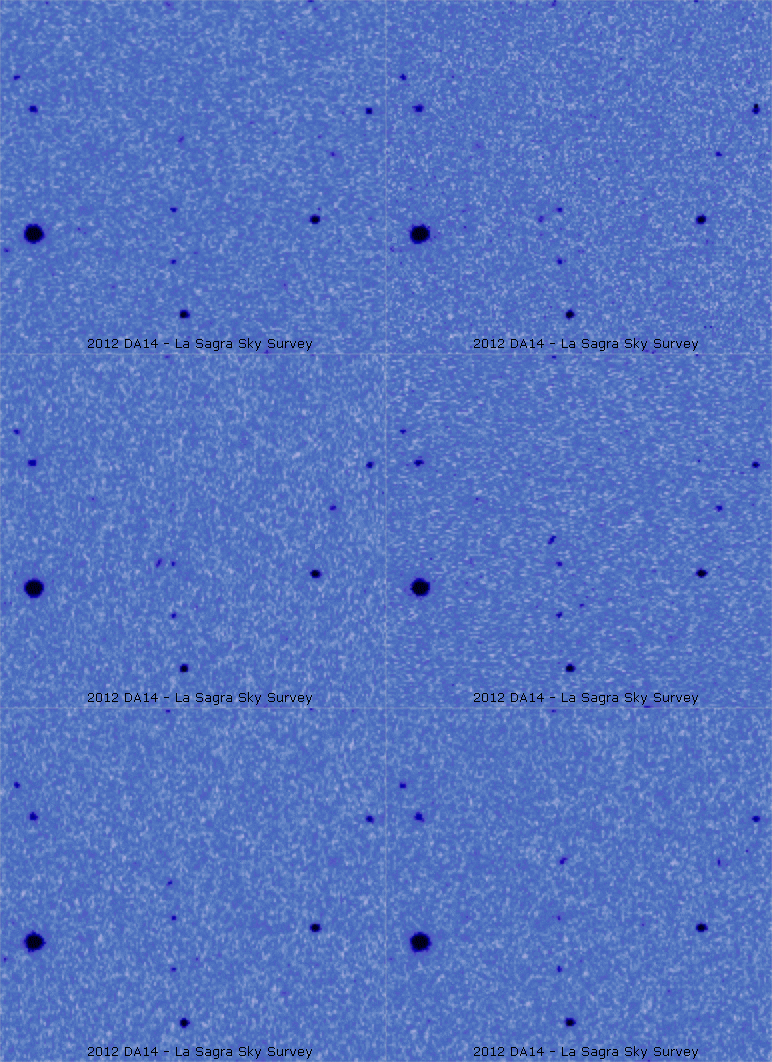
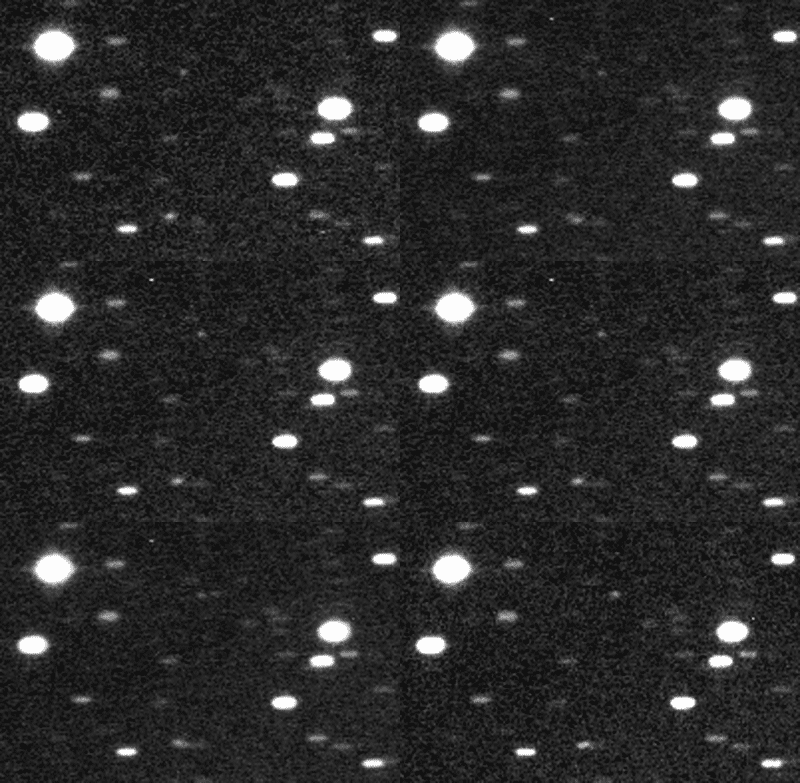
    The asteroid was discovered by the La Sagra Sky Survey, which is supported by ESA’s Space Situational Awareness programme, on 22 February 2012. The observatory is in southeast Spain, near Granada, at an altitude of 1700 m, one of the darkest, least light-polluted locations on the European mainland.

    The small size and previously unknown orbit of 2012 DA14 meant that it was spotted only after it had flown past Earth at about seven times the distance of the Moon.

    “If this object were made of iron and it were to hit our planet, it could create a crater comparable to the 1.5 km Meteor Crater near Flagstaff, Arizona, for example,” says Detlef. ”However, it won’t.”


    Crowdsourcing rocky visitors

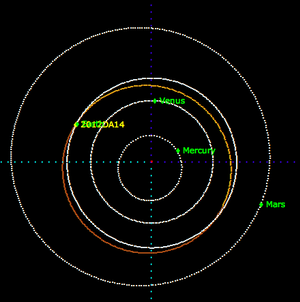
    Asteroid 2012 DA14 orbit
    Asteroid 2012 DA14 orbit

    Finding near-Earth objects (NEOs) like these – passing close to our planet and large enough to do damage if they were to enter our atmosphere – is a major goal of ESA’s Space Situational Awareness (SSA) programme.

    The SSA office sponsors a number of astronomer groups in Europe, supporting their local surveys or allocating observation time at ESA’s own telescope on Tenerife, Spain. The office also provides access to orbit predictions, close flyby details and related data via its technical web site at http://neo.ssa.esa.int.

    The discovery of 2012 DA14 was particularly significant for the Agency’s SSA office because it is typical of the estimated half a million undiscovered NEOs up to 30 m across.

    “Our SSA programme is developing a system of automated optical telescopes that can detect asteroids just like this one,” says ESA’s Nicolas Bobrinsky, SSA programme manager.

    “In cooperation with survey efforts worldwide, our goal is to spot NEOs larger than 40 m in size at least three weeks before closest approach to Earth.”

    To achieve this, ESA teams supported by European industry are developing a system of automated 1 m-diameter telescopes capable of imaging the complete sky in one night.

    For further information, please contact:

    Detlef Koschny
    Head NEO Segment, SSA Programme Office
    ESA/ESTEC, Noordwijk, The Netherlands
    Tel: +31 71 565 4828
    detlef.koschny @ esa.int

    Gerhard Drolshagen
    NEO Segment, SSA Programme Office
    ESA/ESTEC, Noordwijk, The Netherlands
    Tel: +31 71 565 4316
    gerhard.drolshagen @ esa.int

    Jaime Nomen
    La Sagra Sky Survey
    jnomen@oam.es

    Spotting an ancient asteroid

    How to see 2012 DA 14 on 15 February - information for back-yard astronomers

    Rate this

    Views

    Share

    • Currently 4.5 out of 5 Stars.
    • 1
    • 2
    • 3
    • 4
    • 5
    Rating: 4.71/5 (53 votes cast)

    Thank you for rating!

    You have already rated this page, you can only rate it once!

    Your rating has been changed, thanks for rating!

    15723
    Tweet

    Related articles

    Asteroid deflection mission seeks smashing ideas 15 January 2013

    Asteroid deflection mission seeks smashing ideas 15 January 2013 A space rock several hundred metres across is heading towards our planet and the last-ditch attempt to avert a disaster – an untested mission to deflect it – fails. This fictional scene of films and novels could well be a reality one day. But what can...

    Asteroid 2012 DA14 will pass within 24000km of Earth

    Near-miss asteroid will return next year15 March 2012

    Asteroid 2012 DA14 will pass within 24000km of Earth

    Near-miss asteroid will return next year15 March 2012 When it whizzes past Earth in 2013, a newly discovered asteroid is going to miss our planet – but not by much. The 50 m space rock is expected to come closer than many satellites, highlighting the growing need to keep watch on hazards from above.

    NEO found by amateur skywatchers as part of ESA's SSA programme

    Amateur skywatchers help space hazards team12 October 2011

    NEO found by amateur skywatchers as part of ESA's SSA programme

    Amateur skywatchers help space hazards team12 October 2011 For the first time, observations coordinated by ESA's space hazards team have found an asteroid that comes close enough to Earth to pose an impact threat. The space rock was found by amateur astronomers, highlighting the value of 'crowd-sourcing' to s...

    • Space Situational Awareness
      • Stranger in the night: space rock to make close Earth flyby
        • Spotting an ancient asteroid
        • SSA NEO Data Centre
        • More information
        • Asteroid 2012 DA14 - Details at LSSS website
        • Near Earth Objects - Dynamic Site
        • NEODys risk assessment for 2012 DA14

    Connect with us

    • RSS
    • Youtube
    • Twitter
    • Flickr
    • G+
    • Facebook
    • Livestream
    • Subscribe
    • App Store
    • ESA Operations Twitter

    Follow ESA operations

    • LATEST ARTICLES
    • · ExoMars 2016 set to complete const…
    • · Herschel ends operations as orbiti…
    • · Europe’s largest spaceship reache…
    • · ATV ready to nose up to Station
    • · A helping hand from above for The …
    • FAQ

    • Jobs at ESA

    • Site Map

    • Contacts

    • Terms and conditions