Ulysses operations
Editor's note: This page is no longer being updated, but will be preserved as a record. Click here for the latest information on Ulysses.
| ROLE | Solar observatory |
| LAUNCH DATE | 6 Oct 1990/STS-41 Discovery |
| LAUNCHER/LOCATION | Shuttle/Kennedy Space Center |
| LAUNCH MASS | 367 kg |
|
PERIHELION APHELION |
208.4 million km (1.4 AU) 809.5 million km (5.4 AU) |
| ORBIT | 6.2 year, solar-polar, heliocentric |
| NOMINAL MISSION | 5 years; final shutdown 30 June 2009 (18 years, 8 months, 24 days) |
|
+ First-ever mission to explore space above and below Sun's poles - Longest-ever ESA-operated mission+ |
|
The mission
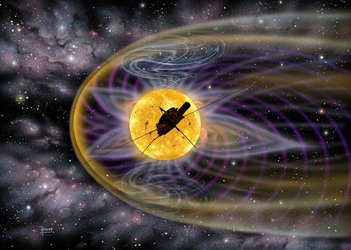
Ulysses's instruments studied the solar wind that streams non-stop from the Sun and produces a huge bubble in space called the heliosphere. Ulysses provided the first-ever map of the heliosphere from the equator to the poles.
The mission was a cooperative programme between ESA and NASA. The science instruments for Ulysses were provided by US and European science teams. The spacecraft was built for ESA by Germany's Dornier Systems. NASA provided the Space Shuttle Discovery for launch, the upper stages and the radioisotope thermoelectric generator, which was built by General Electric Co. Ulysses tracking and data reception were provided by NASA's Deep Space Network, which is operated by the Jet Propulsion Laboratory (JPL); spacecraft operations and data analysis were performed at JPL by a joint ESA/JPL team.
The Ulysses Mission Support Area (MSA) was located at JPL, Pasadena, California.
After over 18 years in space and defying several earlier expectations of its demise due to a weakened power supply, Ulysses conducted its final communication pass with a ground station on 30 June 2009, starting at 17:35 CEST via DSS-63 (NASA's 70-m station at Madrid). The final command switched the satellite's radio communications into 'monitor only' mode. No further contact with Ulysses is planned.
The Flight Control Team

The joint ESA-NASA Mission Operations Team (MOT) works at JPL. The Flight Control Team is provided by ESA, and comprises 11 engineers, headed by Nigel Angold, the Mission Operations Manager, and Fernando Castro, the Spacecraft Operations Manager.
The Ground Operations Team is provided by NASA, and comprises five engineers headed by the Ground Operations Manager, Bruce Brymer. Additional support from JPL resources is provided by experts for navigation and other technical functions.
Mission operations overview
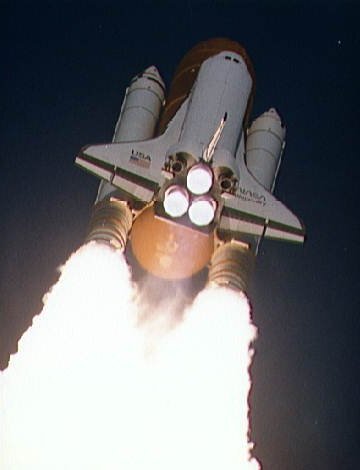
Ulysses was scheduled for launch onboard a space shuttle in May 1986, and was shipped to NASA's Kennedy Space Center (KSC) in January 1986.
On 28 January 1986, the Space Shuttle Challenger disaster put an immediate stop to all Shuttle launches and therefore the Ulysses Mission; the spacecraft had to be dismantled and shipped back to Europe. After shuttle operations were restarted in 1989, Ulysses was launched successfully on 6 October 1990 from KSC's Pad 39.
Launch and transfer to solar orbit
The spacecraft was successfully deployed from the Space Shuttle Discovery into low earth orbit, and was then boosted by two solid-fuel motor upper stages, the Inertial Upper Stage (IUS) and Payload Assist Module (PAM-S), into an outbound trajectory for Jupiter. Earth departure speed was 15.3 kilometres per second, one of the fastest ever and surpassed only by NASA's New Horizons mission, at 16 km/s, in January 2006.
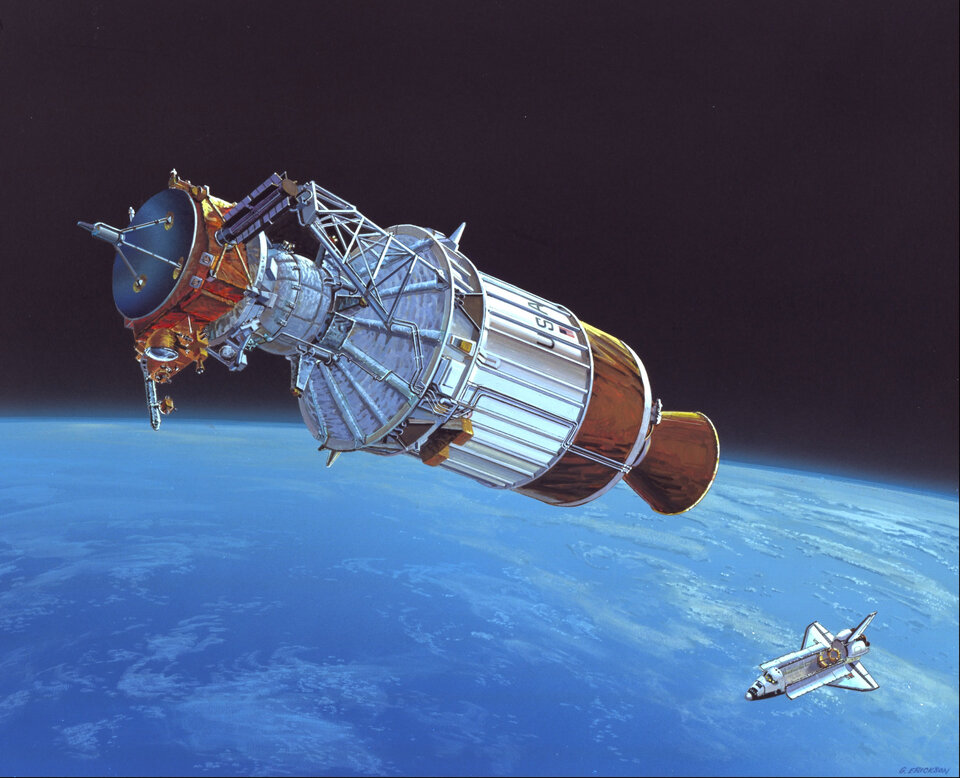
It arrived at Jupiter in February 1992, and the effect of the giant planet's gravity assist was to swing Ulysses out of the ecliptic plane and into its unique Sun-polar orbit.
The first south solar pole pass ended in November 1994, and the spacecraft swung up to complete its first north polar pass in September 1995.
Routine phase
The spacecraft has now completed 2-1/2 solar orbits, and will start the third north polar pass in November 2007, reaching maximum north solar latitude (79.8°) on 14 January 2008 and ending in March 2008.
In 2007, a typical spacecraft-to-Earth distance was 284,948,700 km (1.905 AU), on 20 May 2007, the closest approach to Earth occurred on 26 August 2007, at approximately 62,200 km (0.42 AU), and the closest approach to Mars came on 20 July 2007, at approximately 133,700 km (0.89 AU).
End of mission
The mission had been predicted to end in July 2008, when the satellite's weakened power supply was expected to fall below the minimum required to keep fuel lines from freezing, without which Ulysses would be uncontrollable. At that time, the ESA/NASA operations team planned to continue operating the spacecraft in a reduced capacity for a few more weeks.
However, through smart engineering and realtime innovation, controllers determined they could keep the lines from freezing by briefly firing the thrusters every few hours. In fact, Ulysses continued gathering valuable scientific data throughout 2008 and into the first half of 2009. However, with higher priority missions requiring access to NASA's Deep Space network, and with the overall science data return falling, a joint decision by ESA and NASA was taken to end the mission on 30 June 2009.

The ground stations
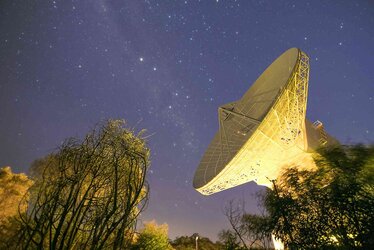
NASA DSN, New Norcia DSA 1

Routine telecommanding and data download for Ulysses are provided by NASA's Deep Space Network (DSN) using antennas located at Madrid (Spain), Canberra (Australia) and Goldstone (California); DSN antennas range in size from 26 to 70 metres.
In addition, ESA's deep-space antenna DSA 1, in New Norcia (Australia), the ESTRACK station in Kourou and non-DSN NASA stations are used, as well as other agencies' stations including the German Aerospace Center's Weilheim station and Chile's Santiago station.
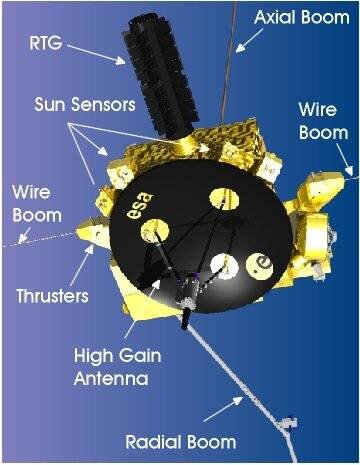
Ulysses downloads data primarily using X-band wavelengths via the on-board High Gain Antenna. Ulysses occasionally uses an S-band downlink in addition to the prime X-band downlink; this extra signal is used to gather radio science data. In radio science, scientists learn about any matter (typically, dust, plasma and other particles) through which radio waves transmitted from the spacecraft must pass by studying how the originally transmitted signal is affected by the matter.
Ground segment & mission control system
A flight control system supplied by ESA/ESOC supports spacecraft monitoring and control.
The system, known as the Ulysses Mission Control System (UMCS), was last updated in 2005 and presently runs on HP Alphas servers and Digital workstations; the software is coded in HP Fortran.
The platform and payload
The platform
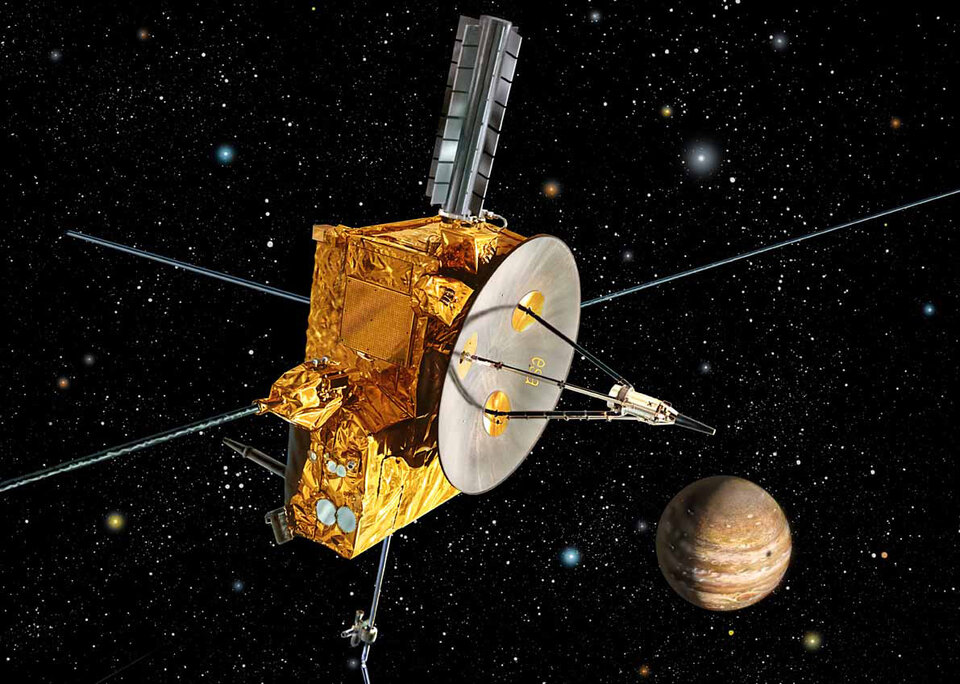
The spin-stabilised Ulysses spacecraft has a box-type structure with two overhanging balconies and a single aluminium honeycomb equipment platform. It is 3.2 m X 3.3 m X 2.1 m (LXWXH) and had a mass of 366.7 kg at launch.
Payload
The scientific payload consists of nine experiments. Three of the experiments have Principal Investigators from European institutes and four from US institutes. The remaining three experiments have joint principal investigators from both Europe and the United States.
In addition, there are two radio science experiments that are concerned with coronal plasma sounding and the search for gravitational waves.
| Instrument | Name |
| VHM/FGM | Magnetometer - determine the features and gradients of magnetic fields |
| SWOOPS | Solar Wind Plasma Experiment - characterise interplanetary plasma in three dimensions out to Jupiter |
| SWICS | Solar Wind Ion Composition Instrument - determine uniquely the elemental and ionic-charge composition, temperatures and mean speeds of all major solar-wind ions |
| URAP | Unified Radio and Plasma Wave Instrument - determine the direction, angular size and polarisation of radio sources |
| EPAC | Energetic Particle Instrument - measure the fluxes, angular distributions, energy spectra and composition of ions |
| GAS | Interstellar Neutral-Gas Experiment - measure in-situ the properties of the local interstellar gas |
| HISCALE | Low-Energy Ion and Electron Experiment - make measurements of interplanetary ions and electrons |
| COSPIN | Cosmic Ray and Solar Particle Instrument - measure the three-dimensional anisotropies of protons and helium at low energies |
| GRB | Solar X-ray and Cosmic Gamma-Ray Burst Instrument - study gamma-ray bursts, soft gamma repeaters and solar flares |
| DUST | Dust Experiment - provide direct observations of dust grains in interplanetary space and investigate their physical and dynamic properties |
| SCE | Coronal-Sounding Experiment - study the solar atmosphere using established coronal-sounding techniques |
| GWE | Gravitational Wave Experiment - detect gravitational waves |