ATLLAS II - Project summary
Aerodynamic and Thermal Load Interactions with Lightweight Advanced Materials for High Speed Flight
ATLLAS-II is a logical continuation project built upon the experience and technology development gained within ATLLAS-I. Once again, the focus is on advanced light-weight, high-temperature material development – strongly linked to a high-speed vehicle design.
The previous study concluded that the optimal cruising Mach number is around Mach 5 to 6. In line with the reviewers’ comments, our detailed design and feasibility study aims at a globally optimized vehicle with respect to aerodynamic, propulsive, structural and thermal layout but nevertheless complying with restrictions imposed by emissions regulations and sonic boom mitigation. The validated tools developed previously, along with the lessons learnt, will allow the consortium to further address and improve the multi-disciplinary design process.
In parallel, a lot of effort is still foreseen to extend the precious built-up material database with durability characterization both for the airframe and combustor related structures. Also new materials and material compounds are addressed to cope with previously encountered limitations.
Design of a Mach 5-6 Vehicle

The driver to set the requirements for the material manufacturing, processing and testing is a Mach 5-6 vehicle. A fully integrated design taking into account several disciplines in the trade-off and optimization is foreseen, fully in line with the reviewers’ comments. The points to be addressed are:
A. Integrated Aerodynamic and Propulsive Flowpath Layout
The envisaged vehicle must operate over a wide Mach number range

B. Conceptual Structural and Thermal Design
Hypersonic vehicles are exposed to temperatures that are beyond the limits of classical aircraft materials. In order to handle this problem the latest developments of new materials and composite structures suitable for high temperature application need to be taken into account. Besides the aero-thermal loads, the unsteady loadings on the structure and control surfaces originating from shock-wave boundary layer interactions are also included. Their impact on control effectiveness and flutter is evaluated too.
Despite the usage of high-temperature resistant structural materials, the passengers and cargo require a stable thermal environment throughout the full vehicle’s route. The presence of onboard cryogenic fuels (e.g. CH4) enables the study of alternative designs for air conditioning to those used in subsonic aircraft. Both open and closed cycles for the cabin air are addressed.
C. Environmental Restrictions onto the Design Process
Sonic boom prediction for the studied vehicles in ATLLAS-I revealed similar levels as for Concorde but could eventually be alleviated by increasing the rise time, which transforms the boom into more of a puff. This encouraging path will be embedded into the above-mentioned design.
Aside from the cruise-induced sonic boom, the acceleration from subsonic speed (M < 1.0) to cruise speed (M = 5 to 6) also leads to the creation of a zone of sonic boom amplification due to ray convergence. And atmospheric turbulence is known to strongly modify the shock fronts of the sonic boom. Both effects on the sonic boom has never been evaluated before from a hypersonic configuration.
Emission goals set by the EC could be achieved by the use of alternative fuels, such as methane or a CH4/H2-mix, having the potential to reduce carbon dioxide and particle emissions and thereby limiting the influence of supersonic aircraft on atmospheric composition. On the other hand the essential high-combustion temperatures (regardless of fuel type) still make a reduction in NOx emission a challenge. Nevertheless, some guidelines formulated during ATLLAS-I will reduce it considerably.
D. Overall Vehicle Optimization and Final Assessment
The integration of the different subsystems, each optimised individually with preset restrictions, into a single vehicle system design does not necessarily ensure a globally optimised vehicle. Due to the complexity of interdisciplinary interaction, numerically steered improvement and optimisation tools are applied here to ascertain a global optimum.
As a powerful precursor to the multi-disciplinary optimisation (MDO) a stochastic multidisciplinary improvement (SMDI) is proposed. SMDI makes use of techniques based on the Monte Carlo method. As an ultimate verification, the optimized vehicle design will be tested for subsonic, transonic and supersonic speed to see how the design, mainly driven by cruise conditions, is able to cope with take-off and transonic acceleration.
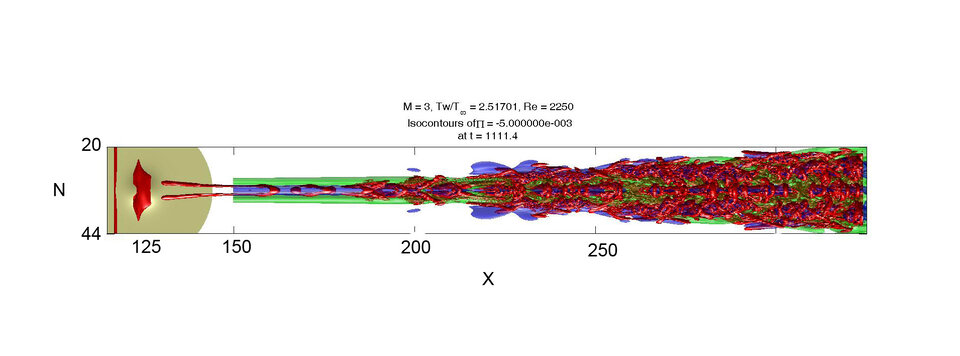
The effect of boundary layer transition has a large effect on the vehicle drag and heat load. Dedicated experiments and LES simulations shall assess the start and extent of the boundary layer transition taking important effects such as compressibility, wall temperature and roughness into account.
The highly loaded structure requires the implementation of advanced metallic and non-metallic materials which need to be lightweight and high-temperature resistant. Since ATLLAS-1, a unique material database is now available, listing these properties as useful engineering correlations as a function of temperature up to 1800 K. Characterisation of the material’s durability is a priority in
| This article continues... |
|
Next  |
|