


Achievements obtained within the European LAPCAT program
General outline
The baseline mission requirement of LAPCAT is to reduce travelling time of long-distance flights, e.g. Brussels to Sydney, in about 2 to 4 hours. This requires a new flight regime with Mach numbers ranging from 4 to 8. At these high speeds, classical turbo-jet engines need to be replaced by advanced airbreathing propulsion concepts and hence related technologies need to be developed.
Key objectives are the definition and evaluation of different propulsion cycles and concepts, enhancement of integrated engine/aircraft performance, mass-efficient turbines and heat exchangers and finally high-pressure & supersonic combustion experiments and modelling.
Though the project is mainly technology driven, operational conditions and constraints are defined by several conceptual vehicle designs of which three are highlighted in our Experiments and modelling webpage which can be seen from the right hand navigation bar.
Conceptual Designs
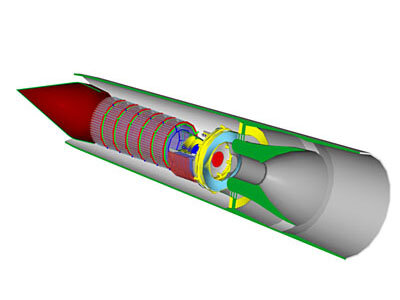
The LAPCAT A2 vehicle flying at Mach 5 was carried out by Reaction Engines. The vehicle study indicates that a 400ton, 300 passenger vehicle could achieve antipodal range without marginality. The concept is particularly interesting for this mission requirements as a trajectory optimization allowed to fly almost continuously over sea and avoiding sonic boom impact when flying over land. The vehicle relies on pre-cooled turbo-based engines employing a cycle based on the Reaction Engines SABRE spaceplane engine.
B. Kerosene Mach 4.5 Cruiser
A parallel study carried out by DLR-Sart focused on kerosene as a fuel in order to explore the performance of this fuel in preference to hydrogen since its supply infrastructure is well established. In order to keep the wing loading in an acceptable range, the new supersonic cruise airplane has a wing size of 1600m2. The total length reaches 102.78m which is only slightly longer. The LAPCAT-M4 employs a blended wing-body with a modified nose, a highly swept in-board wing panel, and a moderately swept outboard wing panel. The four advanced turbo-RAM-jet Variable Cycle Engines (VCE) are mounted in two nacelles on the wing lower surface adjacent to the fuselage.

C. Hydrogen Mach 8 Cruiser
The vehicle-propulsion integration proved to be a difficult exercise for the higher flight Mach numbers. The aim was to ensure a good aerodynamic performance for both subsonic and hypersonic speeds along with a large volume for hydrogen fuel, an efficient propulsion unit for the acceleration phase with enough thrust and finally, realistic dry and gross take-off weights. An air turbo-rocket is used for the acceleration phase until M=4 while a dual mode ramjet propulsion unit was used for the final acceleration and cruising at Mach 8. This optimization loop resulted into the LAPCAT-MR1 vehicle with a dorsal placement of the propulsion unit, including the large intake ramp and nozzle. The aerodynamic performance was realized by using a blend of a waverider and a delta wing previously developed by DLR-Braunschweig. The aircraft turned out to be a versatile and operationally flexible vehicle. The GTOW was fixed at 600tons which corresponds to the present achievement in classical aircraft, e.g. the Antonov-225 with a 600 to 640tons GTOW and a 170tons of empty mass.



