

Experiments and Modelling
For high-speed transportation vehicles powered by air-breathing engines achieving a positive aero-propulsive balance is crucial for the success of the whole system. No ground facility in the world allows testing a real sized vehicle under flight conditions including operating engines. The potential of the CFD tools for ground to flight extrapolations is coming on request. However, dedicated experiments are clearly needed to evaluate and check the validity of the CFD-tools for combustion and aerothermodynamics.
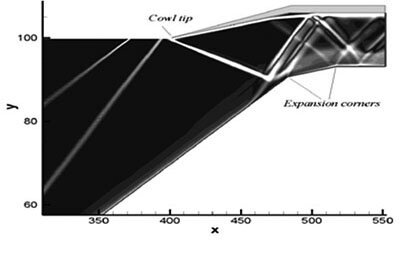
An air inlet representative of the LAPCAT Mach 8 vehicle has been designed in accordance to geometric constraints driven by the vehicle and to requirements of the flow at the inlet exit stemming from the combustion chamber. The intake has been studied experimentally and by using large-eddy simulations.
The supersonic combustion experiments of a complete scramjet configuration consisting of intake, combustor and nozzle were performed in the DLR High Enthalpy Shock Tunnel Göttingen (HEG). The tests concentrated on the scramjet configurations used during the HyShot flight experiments
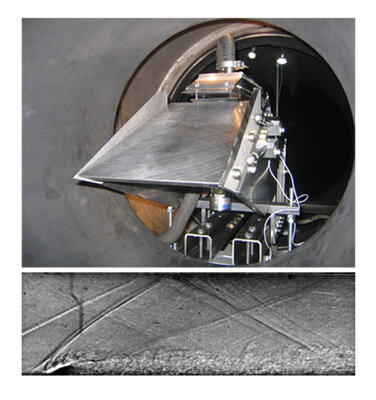
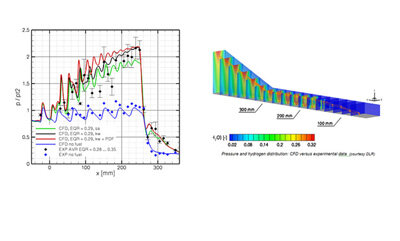
A generic wind tunnel model for the SERN nozzle of the LAPCAT M8 vehicle has been tested to study the interaction of the nozzle flow with the base and the external flow. CFD results for the complete SERN nozzle including external flow are performed.

The need of engines operating at high pressure required studying hydrocarbon fluid disintegration in the subcritical and supercritical regimes through simplified and systematic experiments. Also ignition and flame anchoring of a coaxial gaseous methane-oxygen jet has been studied using high speed visualization techniques. Especially the latter is challenging for modeling and simulation.


Two precooler modules of the Scimitar engine for the A2 aircraft configuration have been built for this program. They are the correct flow length and tube dimensions, but shorter than a full engine module. They were used to demonstrate the manufacturing technology for these items. A stator-less counter rotating turbine has been designed, built and tested which is aerodynamically similar to the real turbine driving the turbocompressor of the Scimitar engine concept.
Conclusions
LAPCAT evaluated the potential of antipodal hypersonic transportation and to go beyond the present state of airbreathing engines allowing speeds 4 to 8 times the speed of sound. Based on realistic aerodynamic and propulsive achievable efficiencies for high-speed vehicles, antipodal range seems feasible. The vehicle systems defined during the project allowed the setting of working conditions of interest for detailed experimental, modelling and numerical work. Windtunnel models revealed particular physical phenomena and justified the use of certain parameters.
More detailed investigations will be performed in the follow-on program LAPCAT II which started in October 2008. To go beyond material’s limit imposed for Concorde, a parallel and related program ATLLAS is on-going by exploring light-weight advanced materials such as Ceramics, UHTC and Ni-based hollow sphere packings.


