• → European Space Agency

      • Space for Europe
      • Space News
      • Space in Images
      • Space in Videos
    • About Us

      • Welcome to ESA
      • DG's News and Views
      • For Member State Delegations
      • Business with ESA
      • ESA Exhibitions
      • ESA Publications
      • Careers at ESA
    • Our Activities

      • Space News
      • Observing the Earth
      • Human Spaceflight
      • Launchers
      • Navigation
      • Space Science
      • Space Engineering
      • Operations
      • Technology
      • Telecommunications & Integrated Applications
    • For Public

    • For Media

      • Media
      • ESA TV
      • Videos for professionals
      • Photos
    • For Educators

    • For Kids

    • ESA

    • Space Engineering

    • What we do
    • Directorate of Technical and Quality Management (TEC)
    • Electrical
    • Electrical engineering
    • Control Systems
    • Data Systems
    • Radio Frequency Payload Systems
    • Electromagnetics and Space Environment
    • Power and Energy Conversion
    • Mechanical
    • Mechanical engineering
    • Thermal Control
    • Structures and Mechanisms
    • Mechatronics and Optics, incl. robotics and life support
    • Propulsion and Aerothermodynamics
    • Systems
    • Systems and software engineering
    • Software Systems
    • Systems Engineering, incl. cost engineering
    • Technology programmes
    • Product Assurance
    • Product Assurance
    • Flight Safety
    • Dependability
    • Quality Management and Assurance
    • Materials and Processes
    • Electronic Components
    • Software Product Assurance
    • Standards
    • Requirements and standards
    • European Cooperation for Space Standardization (ECSS)
    • European Space Components Coordination (ESCC)
    • Services
    • ESA calendar of events
    • Subscribe

    ESA > Our Activities > Space Engineering

    How is the Power Systems Laboratory equipped?

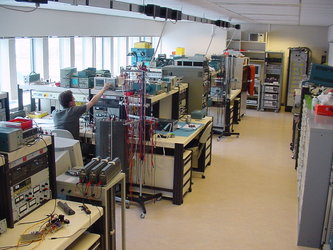
    The Power System Laboratory is made up of two separate work areas, the Power Electronics Laboratory and High Voltage Laboratory. The Power Electronics Laboratory includes the following facilities:


    • Ten electronic work benches all individually equipped with tools including meters, analogue oscilloscopes. Each has an independent power supply linked to solar array and battery simulators for testing representative of space conditions.
    • Specialised Elgar-made solar array simulators for verification of maximum power point tracking systems (MPPTs), which are electronic controllers used to optimise solar array output, storing surplus power in the spacecraft batteries until needed.
    • General purpose solar array simulators for verification of regulators used to limit voltage oscillations and solar array drive mechanisms (SADMs) which steer solar arrays to maintain an optimal pointing direction towards the Sun.
    • Measurement bridge used for measuring electrical resistance, for the characterisation and testing of capacitors, inductors and transformers
    • Thermal camera to evaluate thermal stress on breadboards and small electrical units while in operation

    The High Voltage Laboratory includes the following facilities:

    • High voltage power sources: up to 60,000 volts for DC, up to 40,000 volts for AC and high current power available.
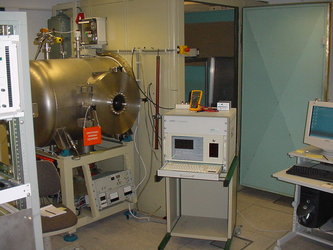
    • Combined thermal vacuum chamber and Faraday cage for high voltage testing in a range of environments from ambient to partial pressure to deep vacuum conditions.
    • Thermal and thermal-vacuum chambers to assess the performance of 'breadboard' engineering models and small electrical units in vacuum conditions and temperature extremes.
    • Insulation testers and protected high voltage workspaces.
    • High voltage partial protection measurement down to a noise level of 0.2 picoCoulomb.

    The Power System Laboratory also has access to a range of specialised software tools used for circuit analysis, system simulation and power/energy budgeting purposes.
    Last update: 27 September 2012

    Rate this

    Views

    Share

    • Currently 0 out of 5 Stars.
    • 1
    • 2
    • 3
    • 4
    • 5
    Rating: 0/5 (0 votes cast)

    Thank you for rating!

    You have already rated this page, you can only rate it once!

    Your rating has been changed, thanks for rating!

    63
    Tweet
    • More information
      • Power Systems laboratory
        • What kind of testing does the power laboratory carry out?
          • How is the Power Systems Laboratory equipped?
            • What benefits does the Power Systems Laboratory deliver?
              • What services does the Power Systems Laboratory offer?
                • Contact the Power Systems Laboratory
                • Related information
                  • Power and Energy Conversion
                  • Systems
                  • Electrical
                  • Mechanical
                  • Materials and Electrical Components
                  • ESTEC - ESA's technical heart

    Connect with us

    • RSS
    • Youtube
    • Twitter
    • Flickr
    • G+
    • Facebook
    • Livestream
    • Subscribe
    • App Store
    • LATEST ARTICLES
    • · Earth Explorers take centre stage …
    • · The fast winds of Venus are gettin…
    • · ExoMars 2016 set to complete const…
    • · Herschel ends operations as orbiti…
    • · Europe’s largest spaceship reache…
    • FAQ

    • Jobs at ESA

    • Site Map

    • Contacts

    • Terms and conditions