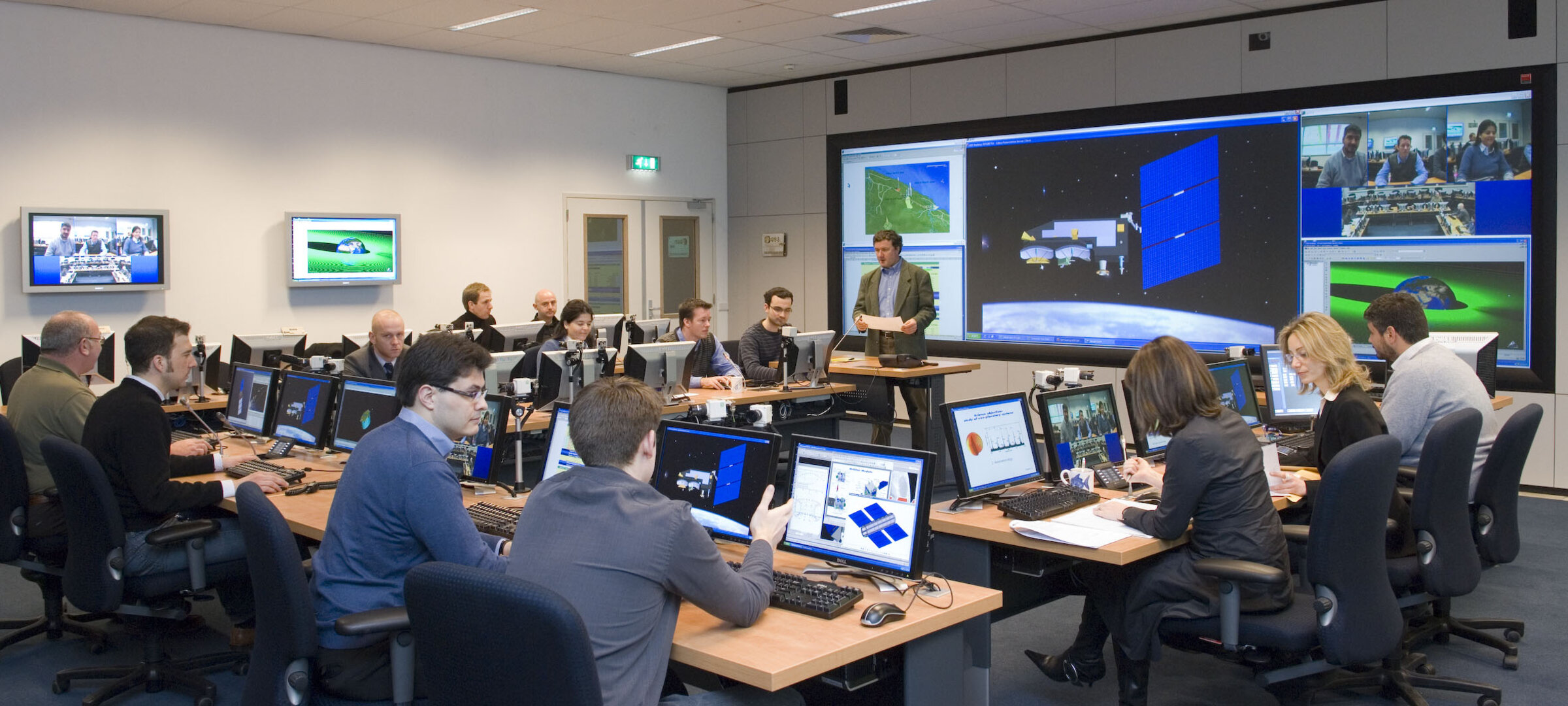
Systems Engineering, incl. cost engineering
Many separate elements go into making a space system, with individual subsystems developed by specialist teams. System engineers, however, focus on the space system as a whole. They translate the needs from the users, design its architecture, define its building strategy and oversee the integration of subsystems to form the final result.
What is the Systems Engineering domain?
Systems engineering is the process of designing, developing and verifying a space system as an integrated system able to fulfil the objectives of a mission within acceptable technical and programmatic frames.
The step-by-step design process is guided by considering what the space system seeks to achieve. What orbit will the mission need as a consequence? What kind of instruments and how large a payload? What will be the payload's optimum operating temperature, and how much power will it require? How stable and steerable does the spacecraft platform have to be? What kind of communications infrastructure and associated ground segment will the mission need? Which launcher will be best suited to deliver it into space?
There can be many potential solutions to each question so system engineering is as much an art as a science, with trade-offs made between the different options in terms of performance, risk, cost, reliability and turnaround time, among other factors. The design team includes experts on the various technical disciplines involved to advise on their integration into the overall design.
At the end of these feasibility and preliminary design studies – known as 'Phase A' studies – a baseline space system plan is in existence, defining necessary elements and including initial programmatic estimates. Follow-up 'Phase B' studies turn the preliminary design into a full system design which can then be developed further.
Among the most important factors in deciding whether to proceed to further stage is a mission's likely cost. The process of putting accurate price tag onto space projects is an associated discipline within the Systems Engineering domain called 'Cost Engineering'.
Why is Systems Engineering important?
Systems engineering effectively 'gives birth' to missions, turning an initial idea into a full system description, with all necessary elements integrated into a complete whole. These blueprints can then become the basis of subsequent decision-making, ultimately by ESA's Member States as they judge which future missions should gain their support.
Systems engineering also follows the development and the operation of the space system to ensure that the space system will fulfill this initial idea as well as possible and as efficiently as possible.
Systems engineers maintain the focus on the space system as a whole rather than a collection of functional elements through regular project reviews occurring during subsequent 'Phase C/D' development, production and testing. These serve to ensure the mission remains on track. Systems engineering also guides technology development and assesses the impact of new technologies.
In addition, the linked discipline of Cost engineering delivers early awareness of costs associated with engineering decisions as a project first gets underway, giving knowledge of the likely expenses associated with different potential solutions and allowing decisions to be made on a cost/benefit basis. In an interactive process, Cost engineering narrows the error band of the cost estimates as Systems engineering improves the system technical definition.