• → European Space Agency

      • Space for Europe
      • Space News
      • Space in Images
      • Space in Videos
    • About Us

      • Welcome to ESA
      • DG's News and Views
      • For Member State Delegations
      • Business with ESA
      • ESA Exhibitions
      • ESA Publications
      • Careers at ESA
    • Our Activities

      • Space News
      • Observing the Earth
      • Human Spaceflight
      • Launchers
      • Navigation
      • Space Science
      • Space Engineering
      • Operations
      • Technology
      • Telecommunications & Integrated Applications
    • For Public

    • For Media

    • For Educators

    • For Kids

    • ESA

    • Space Engineering

    • What we do
    • Directorate of Technical and Quality Management (TEC)
    • Electrical
    • Electrical engineering
    • Control Systems
    • Data Systems
    • Radio Frequency Payload Systems
    • Electromagnetics and Space Environment
    • Power and Energy Conversion
    • Mechanical
    • Mechanical engineering
    • Thermal Control
    • Structures and Mechanisms
    • Mechatronics and Optics, incl. robotics and life support
    • Propulsion and Aerothermodynamics
    • Systems
    • Systems and software engineering
    • Software Systems
    • Systems Engineering, incl. cost engineering
    • Technology programmes
    • Product Assurance
    • Product Assurance
    • Flight Safety
    • Dependability
    • Quality Management and Assurance
    • Materials and Processes
    • Electronic Components
    • Software Product Assurance
    • Standards
    • Requirements and standards
    • European Cooperation for Space Standardization (ECSS)
    • European Space Components Coordination (ESCC)
    • Services
    • ESA calendar of events
    • Subscribe

    ESA > Our Activities > Space Engineering

    What benefits does the Opto-Electronics Laboratory deliver?

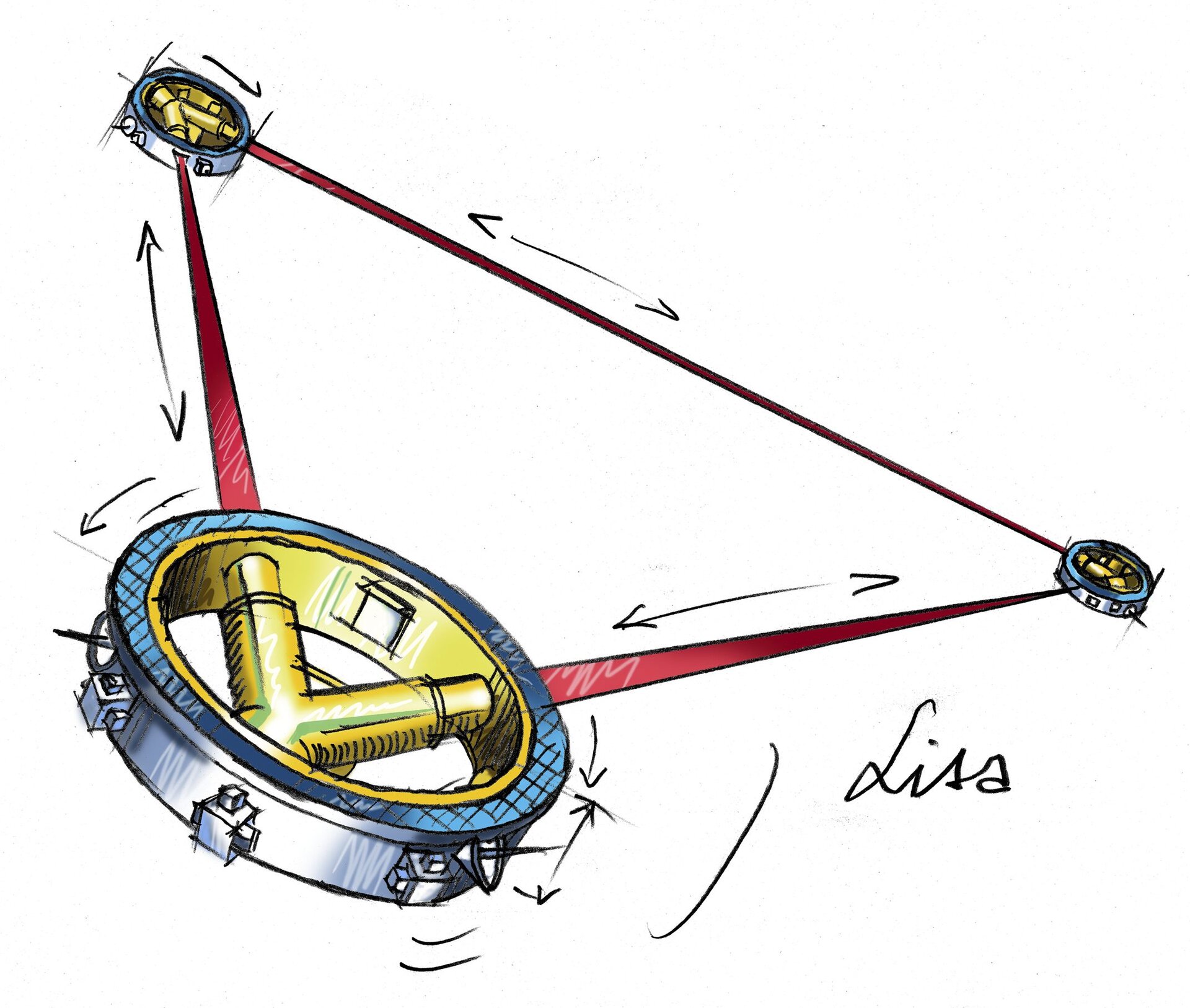
    LISA (Laser Interferometer Space Antenna) line drawing

    The Laboratory provides independent assessment and verification of opto-electronic components in support of ESA projects and R&D activies as well as industry.

    Missions being supported include two Earth-observing Earth Explorer missions: ADM-Aeolus will fly the first doppler lidar into orbit to measure atmospheric wind speeds. EarthCARE will use a lidar to acquire three-dimensional measurements of cloud cover and aerosol distribution.

    Laser technology will also be crucial for the Laser Interferometer Space Antenna (LISA), a major future mission to detect gravitational waves for the first time. LISA involves a trio of spacecraft connected by laser beams across five million km, collectively forming the largest man-made structure ever made in space. The interlinked lasers will reveal tiny movements in spacecraft position due to gravitational waves, previously undetectable ripples in spacetime first predicted by Albert Einstein.

    Laser research also brings benefit to the next generation of Galileo navigation satellites. Lasers are a key component of the atomic clocks at the heart of Galileo satellites. Higher-performance laser diodes will lead to more accurate clocks, delivering improved navigational accuracy to Galileo users. Enhanced atomic clocks in orbit can also be used to test general relativity and other fundamental laws of physics to a higher level of precision than ever before.

    The Laboratory's work also supports progress in optical communications. Fibre optic cabling within satellites offers broader signal bandwidth at a reduced cable mass while lasers are also increasingly used for communications between satellites. Fibre optic sensor networks meanwhile can pick up internal environmental data such as temperature, pressure and tension, and are being evaluated for use on Ariane launchers.

    Last update: 27 April 2010

    Rate this

    Views

    Share

    • Currently 0 out of 5 Stars.
    • 1
    • 2
    • 3
    • 4
    • 5
    Rating: 0/5 (0 votes cast)

    Thank you for rating!

    You have already rated this page, you can only rate it once!

    Your rating has been changed, thanks for rating!

    44
    Tweet
    • More information
      • Opto-Electronics Laboratory
        • What kind of testing does the Opto-Electronics laboratory carry out?
          • How is the Opto-Electronics laboratory equipped?
            • What benefits does the Opto-Electronics Laboratory deliver?
              • What services does the Opto-Electronics Laboratory offer?
                • Contact Optics-Electronics Laboratory
                • Related information
                  • Mechatronics and Optics, incl. robotics and life support
                  • Work with light
                  • Electrical
                  • Mechanical
                  • Systems
                  • Materials and Electrical Components
                  • ESTEC - ESA's technical heart

    Connect with us

    • RSS
    • Youtube
    • Twitter
    • Flickr
    • G+
    • Facebook
    • Livestream
    • Subscribe
    • App Store
    • LATEST ARTICLES
    • · ESA astronaut Timothy Peake set fo…
    • · Space drives e-mobility
    • · Proba-V opens its eyes
    • · First new Galileo satellite arrive…
    • · Next destination: space
    • FAQ

    • Jobs at ESA

    • Site Map

    • Contacts

    • Terms and conditions