• → European Space Agency

      • Space for Europe
      • Space News
      • Space in Images
      • Space in Videos
    • About Us

      • Welcome to ESA
      • DG's News and Views
      • For Member State Delegations
      • Business with ESA
      • ESA Exhibitions
      • ESA Publications
      • Careers at ESA
    • Our Activities

      • Space News
      • Observing the Earth
      • Human Spaceflight
      • Launchers
      • Navigation
      • Space Science
      • Space Engineering
      • Operations
      • Technology
      • Telecommunications & Integrated Applications
    • For Public

    • For Media

      • Media
      • ESA TV
      • Videos for professionals
      • Photos
    • For Educators

    • For Kids

    • ESA

    • Space Engineering

    • What we do
    • Directorate of Technical and Quality Management (TEC)
    • Electrical
    • Electrical engineering
    • Control Systems
    • Data Systems
    • Radio Frequency Payload Systems
    • Electromagnetics and Space Environment
    • Power and Energy Conversion
    • Mechanical
    • Mechanical engineering
    • Thermal Control
    • Structures and Mechanisms
    • Mechatronics and Optics, incl. robotics and life support
    • Propulsion and Aerothermodynamics
    • Systems
    • Systems and software engineering
    • Software Systems
    • Systems Engineering, incl. cost engineering
    • Technology programmes
    • Product Assurance
    • Product Assurance
    • Flight Safety
    • Dependability
    • Quality Management and Assurance
    • Materials and Processes
    • Electronic Components
    • Software Product Assurance
    • Standards
    • Requirements and standards
    • European Cooperation for Space Standardization (ECSS)
    • European Space Components Coordination (ESCC)
    • Services
    • ESA calendar of events
    • Subscribe

    ESA > Our Activities > Space Engineering

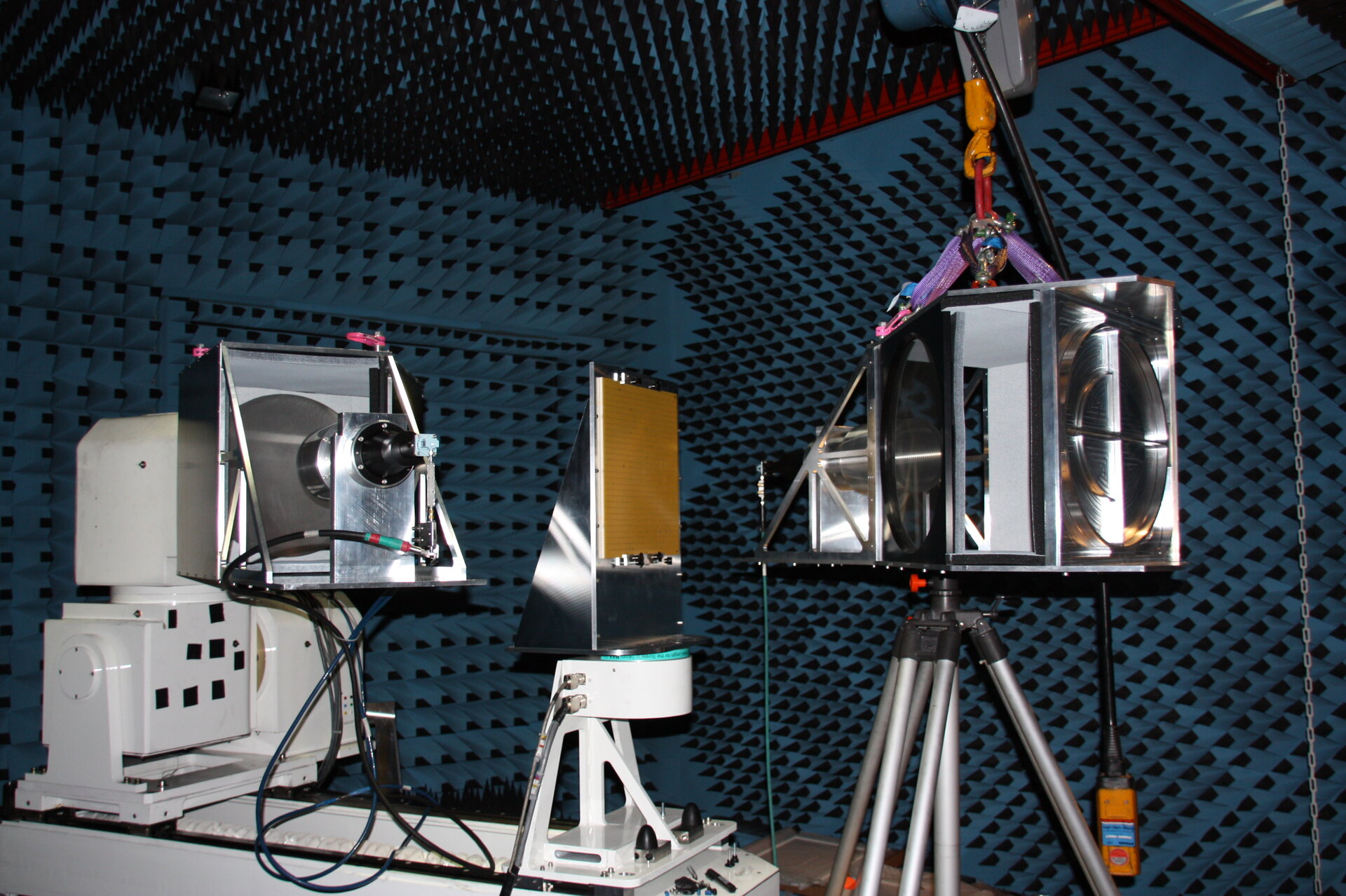
    Large CPTR

    What kind of testing does the Antenna Test Facilities do?

    The two Facilities perform the same kind of testing and tests are set up on the similar basis. A feed horn linked to a set of parabolic and hyperbolic reflectors is used to illuminate the object under test with a uniform test field .

    By varying the feed horn position relative to the test chamber's focal zone the signal wave front shifts from its standard alignment. This means the test item's uplink/downlink performance can be measured in terms of satellite communication with ground stations in different locations on Earth's surface.

    Key measurements include checking an antenna's main beam alignment. Radio waves are EM radiation just like visible light, and they behave in the same way. An antenna is designed to focus radiation into a main beam in the same way as a flashlight does. The main beam must achieve the designed concentration and pointing direction.

    Tests also characterise an antenna's side lobes. Not all the light from a flashlight goes into the main beam, a small amount radiates to the side. The same is true of antenna radio waves, but the amount must be compliant with design requirements otherwise it can lead to interference.

    The antenna should work over a certain minimum and maximum frequency range and should not be sensitive to other frequencies beyond it.

    The antenna efficiency is also a key concern: testing involves measuring how much power goes into the system and how goes in the desired direction.

    Tests are performed on individual antennas as well as antennas integrated with other antennas or subystems because typically their resulting EM response will have been altered by this integration process.

    Radio reflectivity tests are performed in some cases, measuring EM reflections of test items in different directions – often referred to as radar cross section (RCS) testing. This can be a useful test for assessing candidate materials for lightweight antenna construction.

    As well as testing antennas and payloads, the Facilities are also used for assessing the feasibility of new types of measurement tools and techniques, often liaising with external industrial antenna laboratories as they perform tests related to ESA projects.

    Last update: 29 September 2009

    Rate this

    Views

    Share

    • Currently 0 out of 5 Stars.
    • 1
    • 2
    • 3
    • 4
    • 5
    Rating: 0/5 (0 votes cast)

    Thank you for rating!

    You have already rated this page, you can only rate it once!

    Your rating has been changed, thanks for rating!

    27
    Tweet
    • More information
      • Antenna Test Facilities
        • What kind of testing does the Antenna Test Facilities do?
          • How are the Antenna Test Facilities equipped?
            • What benefits do the Antenna Test Facilities deliver?
              • What services does the Antenna Test Facilities offer?
                • Contact Antenna Test Facilities
                • Electrical
                • Mechanical
                • Systems
                • Materials and Electrical Components
                • Test Centre
                • ESTEC - ESA's technical heart

    Connect with us

    • RSS
    • Youtube
    • Twitter
    • Flickr
    • G+
    • Facebook
    • Livestream
    • Subscribe
    • App Store
    • LATEST ARTICLES
    • · Rare merger reveals secrets of gal…
    • · Watching for hazards: ESA opens as…
    • · ESA astronaut Timothy Peake set fo…
    • · Space drives e-mobility
    • · Proba-V opens its eyes
    • FAQ

    • Jobs at ESA

    • Site Map

    • Contacts

    • Terms and conditions
