• → European Space Agency

      • Space for Europe
      • Space News
      • Space in Images
      • Space in Videos
    • About Us

      • Welcome to ESA
      • DG's News and Views
      • For Member State Delegations
      • Business with ESA
      • ESA Exhibitions
      • ESA Publications
      • Careers at ESA
    • Our Activities

      • Space News
      • Observing the Earth
      • Human Spaceflight
      • Launchers
      • Navigation
      • Space Science
      • Space Engineering
      • Operations
      • Technology
      • Telecommunications & Integrated Applications
    • For Public

    • For Media

    • For Educators

    • For Kids

    • ESA

    • COROT

    • ESA Science

    • About COROT
    • COROT objectives
    • COROT mission strategy
    • COROT spacecraft
    • COROT instruments
    • International collaboration
    • Multimedia
    • COROT images
    • COROT animations
    • COROT videos

    ESA > Our Activities > Space Science > COROT

    COROT instruments

    COROT's telescope

    The payload of the COROT satellite consists of a telescope, a wide-field two-part camera - one for each of the two mission objectives (exoplanet search and asteroseismology) operating in the visible, and the on-board computer processors, provided by ESA.

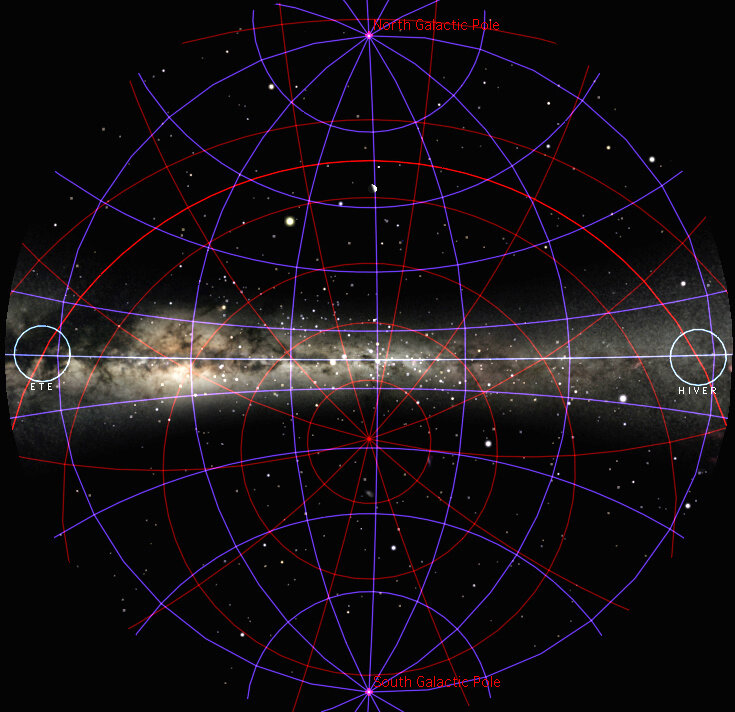
    The sky observed by COROT
    The sky observed by COROT

    The telescope itself contains a primary mirror of 30 centimetres in diameter. It consists of two parabolic mirrors, and has a 1.1-metre focal length. The field of view is a square of 2.8 x 2.8 degrees, half for the seismology mission, the other half for the exoplanet mission. A prism, used by the telescope for certain aspects of the mission, will separate colours, enabling scientists to study stellar activity during a planetary transit.
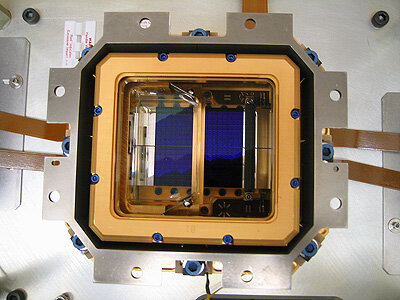

    COROT camera's focal unit
    COROT camera's focal unit

    During the mission, the telescope will collect the light from thousands of stars and feed it into a special two-part camera. One half of the camera is designed to look for planets; the other half is optimised to detect the subtle variation in a star's light, caused by sound waves rippling across the surface. These waves are the equivalent of seismic waves on the Earth.
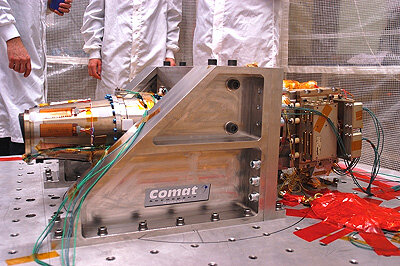
    The COROT camera
    The COROT camera

    Both mission goals require the camera to be sensitive to changes in a star's light of just one part in one hundred thousand. To help reach this sensitivity, a design team at ESA came up with a highly successful baffle, external to the telescope, that prevents stray light from entering the telescope. In practice, the baffle is a device for shielding the camera from 'light pollution' coming from sources other than those objects at which the telescope is looking.
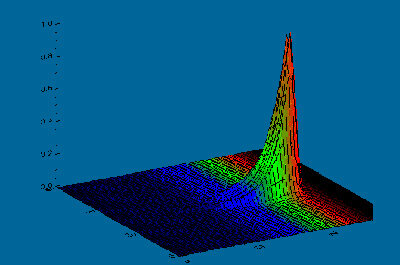
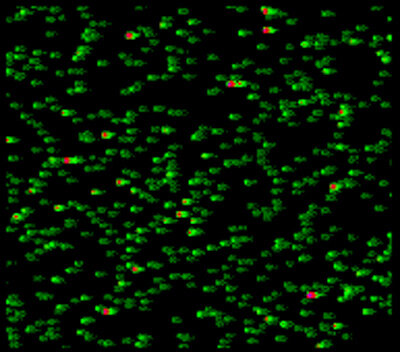
    COROT image spot
    COROT image spot

    The analysis of the 3-colour light curves that COROT will gather thanks to a prism mounted in front of the exoplanet channel camera detectors (CCD's), will make it possible to distinguish between the different families of detected events (transits, stellar activity, eclipsing binaries). Planetary transits are achromatic events, while stellar activity – even though still poorly understood – is expected to be highly chromatic due to temperature variations. More than 120 000 stars, with magnitudes between 12 and 15.5, will be surveyed.

    COROT exoplanet field
    COROT exoplanet field

    Last update: 29 November 2006

    Rate this

    Views

    Share

    • Currently 0 out of 5 Stars.
    • 1
    • 2
    • 3
    • 4
    • 5
    Rating: 0/5 (0 votes cast)

    Thank you for rating!

    You have already rated this page, you can only rate it once!

    Your rating has been changed, thanks for rating!

    29
    facebook
    twitter
    reddit
    google plus
    digg
    tumbler
    digg
    blogger
    myspace
    • More about...
    • COROT overview
    • COROT factsheet
    • Related articles
    • How to find an extrasolar planet
    • How many planets are outside our Solar System?
    • How do waterworlds form?
    • Searching for planets with life
    • Related links
    • COROT at CNES
    • Extrasolar Planets Encyclopedia
    • Hubble's exoplanets search

    Connect with us

    • RSS
    • Youtube
    • Twitter
    • Flickr
    • Google Buzz
    • Subscribe
    • App Store
    • LATEST ARTICLES
    • · CryoSat hits land
    • · Ariane 5 completes seven launches …
    • · Measuring skull pressure without t…
    • · Malargüe station inauguration
    • · The solar wind is swirly
    • FAQ

    • Jobs at ESA

    • Site Map

    • Contacts

    • Terms and conditions