• → European Space Agency

      • Space for Europe
      • Space News
      • Space in Images
      • Space in Videos
    • About Us

      • Welcome to ESA
      • DG's News and Views
      • For Member State Delegations
      • Business with ESA
      • ESA Exhibitions
      • ESA Publications
      • Careers at ESA
    • Our Activities

      • Space News
      • Observing the Earth
      • Human Spaceflight
      • Launchers
      • Navigation
      • Space Science
      • Space Engineering
      • Operations
      • Technology
      • Telecommunications & Integrated Applications
    • For Public

    • For Media

    • For Educators

    • For Kids

    • ESA

    • Cluster

    • ESA Science

    • About Cluster

      • Cluster at a glance
    • Vital Stats

      • Spacecraft
      • Wave Experiment Consortium
      • Other Instruments
    • The Sun-Earth Connection

      • The Sun
      • Space Weather
    • Cluster Science

      • Science objectives
      • Science highlight - Black Auroras
      • Science highlight - Wagging Earth's Magnetotail
      • Science highlight - Joining Forces
      • Science highlight - Whirlpools at the Edge of Space
      • Science highlight - Rise of the Killer Electrons
    • Multimedia
    • Cluster images
    • Cluster videos
    • Services
    • Comments

    ESA > Our Activities > Space Science > Cluster

    Other Instruments

    16 July 2010

    Each of the four spacecraft carries an identical set of 11 instruments to investigate charged particles, electrical and magnetic fields. These were built by European and American instrument teams led by Principal Investigators.

    ASPOC - Active Spacecraft Potential Control experiment

    Principal Investigator: Klaus Torkar, Austria
    Electrical charging of a Cluster spacecraft in orbit can have a severe impact on the performance of the scientific instruments. ASPOC emits charged particles that cancel out the electrical charge that the satellite acquires. The number of particles needed to do this is determined by other onboard instruments (EFW and PEACE), which record the spacecraft's electrical potential.


    CIS - Cluster Ion Spectrometry experiment

    Principal Investigator: Iannis Dandouras, France/Greece
    Analyses the composition, mass and distribution of particles captured by the spacecraft. CIS consists of two different instruments, a Hot Ion Analyser (HIA) and a time-of-flight COmposition and DIstribution Function analyser (CODIF), plus a sophisticated instrument control and data processing system, which permits extensive onboard data processing.

    EDI - Electron Drift Instrument

    Principal Investigator: Roy B. Torbert, USA
    EDI fires two beams of electrons into space around each spacecraft. The electrons travel in orbits of 10 km or more before returning to receivers on the opposite side of the spacecraft. From the firing directions and the round-trip travel time, scientists can determine the strength of the electric and magnetic fields around each Cluster spacecraft.

    FGM - Fluxgate Magnetometer

    Principal Investigator: Elizabeth Lucek, UK
    FGM is composed of two magnetometers that measure the magnetic fields encountered by Cluster. Located on a five-metre-long boom to avoid interference from the spacecraft, FGM can record measurements up to 67 times per second.

    PEACE - Plasma Electron And Current Experiment

    Principal Investigator: Andrew Fazakerley, UK
    Like CIS, this experiment also sifts incoming particles. PEACE looks at electrons in the plasma that have low to medium energies, counts them and measures their direction of travel and speed.

    RAPID - Research with Adaptive Particle Imaging Detectors

    Principal Investigator: Patrick Daly, Germany
    An advanced particle detector that records the highest energy electrons and charged particles entering it from space. The particles pass through pinholes to reach the detector, enabling it to build up a picture of where the particles came from.
    Rate this

    Views

    Share

    • Currently 0 out of 5 Stars.
    • 1
    • 2
    • 3
    • 4
    • 5
    Rating: 0/5 (0 votes cast)

    Thank you for rating!

    You have already rated this page, you can only rate it once!

    Your rating has been changed, thanks for rating!

    5
    facebook
    twitter
    reddit
    google plus
    digg
    tumbler
    digg
    blogger
    myspace
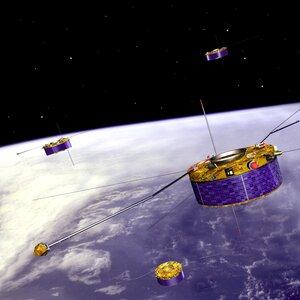
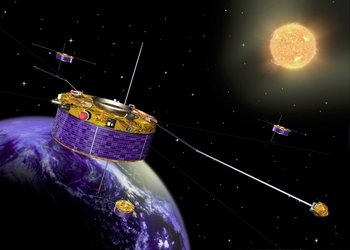
    • An artist's impression of the Cluster quartet
      An artist's impression of the Cluster quartet
      Exploring the Sun-Earth connection
    • More about...
    • Chinese National Space Administration (CNSA)
    • ESA at the IAC
    • International Academy of Astronautics (IAA)
      • Cluster overview
        • Double Star overview
          • SOHO overview
            • Solar Orbiter
              • Space weather
              • Related articles
                • Laurels for Cluster-Double Star teams
                  • Cluster turns the invisible into the visible
                    • Cluster's decade of discovery
                      • Shocking recipe for making killer electrons
                        • Watching solar activity muddle Earth’s magnetic field
                          • ESA extends missions studying Mars, Venus and Earth’s magnetosphere
                            • Cluster watches Earth’s leaky atmosphere
                              • Cluster listens to the sounds of Earth
                                • Solitary waves in translation
                                  • New discovery on magnetic reconnection to impact future space missions
                                    • High-speed beams of charged particles accelerate towards Earth
                                      • Solar outburst pulls a magnetic slingshot

    Connect with us

    • RSS
    • Youtube
    • Twitter
    • Flickr
    • Google Buzz
    • Subscribe
    • App Store
    • LATEST ARTICLES
    • · CryoSat hits land
    • · Ariane 5 completes seven launches …
    • · Measuring skull pressure without t…
    • · Malargüe station inauguration
    • · The solar wind is swirly
    • FAQ

    • Jobs at ESA

    • Site Map

    • Contacts

    • Terms and conditions