• → European Space Agency

      • Space for Europe
      • Space News
      • Space in Images
      • Space in Videos
    • About Us

      • Welcome to ESA
      • DG's News and Views
      • For Member State Delegations
      • Business with ESA
      • ESA Exhibitions
      • ESA Publications
      • Careers at ESA
    • Our Activities

      • Space News
      • Observing the Earth
      • Human Spaceflight
      • Launchers
      • Navigation
      • Space Science
      • Space Engineering
      • Operations
      • Technology
      • Telecommunications & Integrated Applications
    • For Public

    • For Media

    • For Educators

    • For Kids

    • ESA

    • Cluster

    • ESA Science

    • About Cluster

      • Cluster at a glance
    • Vital Stats

      • Spacecraft
      • Wave Experiment Consortium
      • Other Instruments
    • The Sun-Earth Connection

      • The Sun
      • Space Weather
    • Cluster Science

      • Science objectives
      • Science highlight - Black Auroras
      • Science highlight - Wagging Earth's Magnetotail
      • Science highlight - Joining Forces
      • Science highlight - Whirlpools at the Edge of Space
      • Science highlight - Rise of the Killer Electrons
    • Multimedia
    • Cluster images
    • Cluster videos
    • Services
    • Comments

    ESA > Our Activities > Space Science > Cluster

    Spacecraft

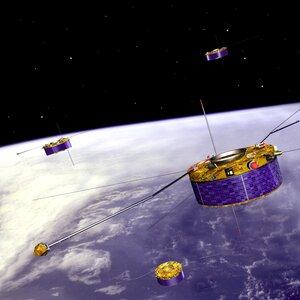
    Cluster fly in a triangular pyramid formation
    16 July 2010

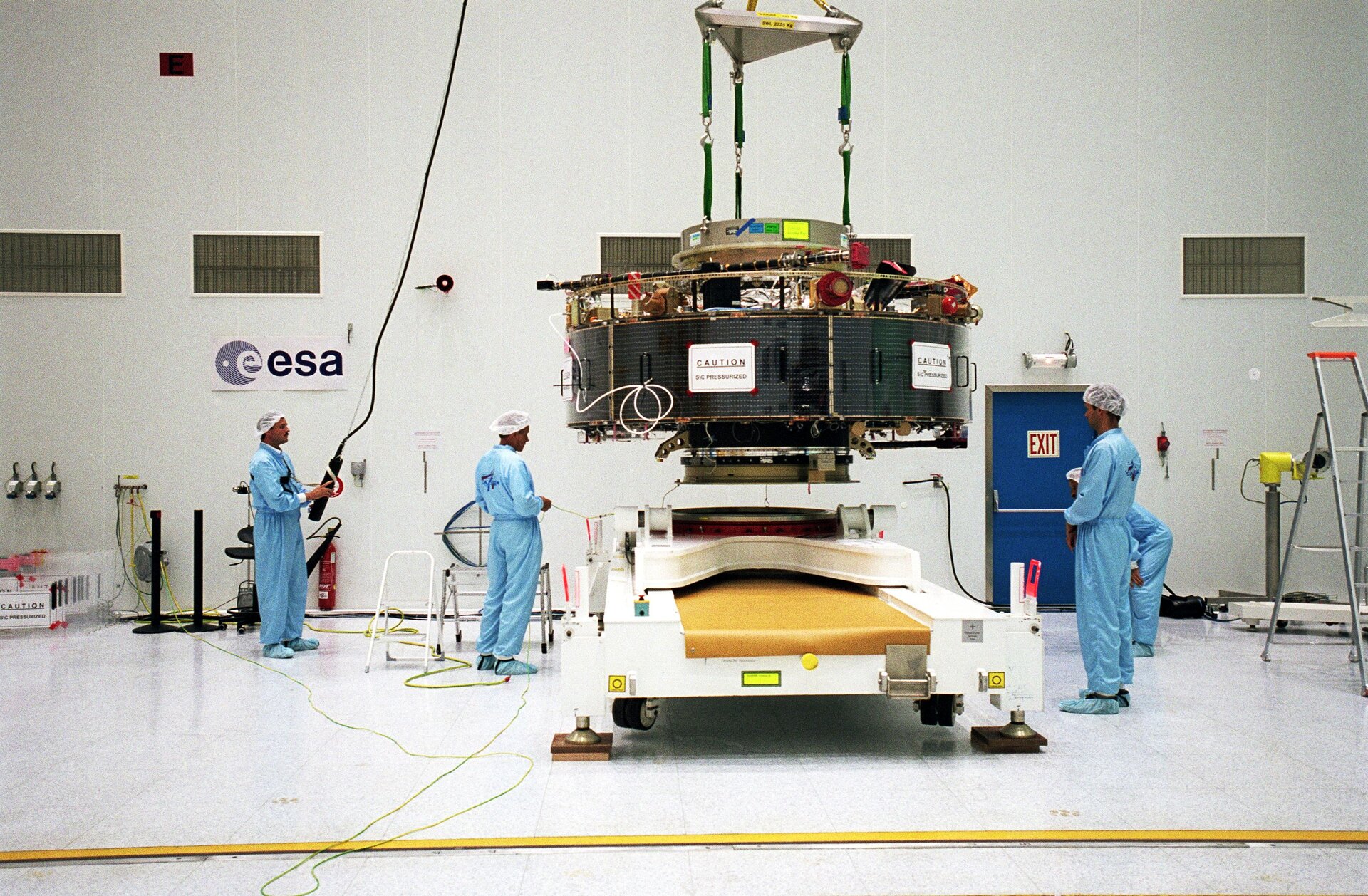
    The name Cluster was chosen because of the way the four spacecraft fly in a group around Earth. When studies demonstrated that it would be possible to reuse some parts and to fly four spacecraft almost identical to those lost in the first launch, the replacement mission was initially named Cluster II, but now it is generally referred to as Cluster. Flying in a tetrahedral (triangular pyramid) formation, the four spacecraft are collecting the most detailed data yet on small-scale changes in near-Earth space, and the interaction between the charged particles of the solar wind and Earth's atmosphere. These enable scientists to build a three-dimensional model of the magnetosphere and to better understand the processes taking place inside it.

    Diameter 2.9 m
    Height 1.3 m
    Mass 1200 kg
    (of which) Propellant 650 kg
    (of which) Scientific payload 71 kg
    Spin rate 15 rpm
    Launch date 16 July, 9 August 2000
    2 spacecraft per launch
    Operational lifetime 2 years (nominal)
    extended to 2005, then to 2009, and then 2012

    Orbit

    Cluster rounds Earth in an elliptical polar orbit. The closest it comes to Earth is a few hundred kilometres. The furthest is 125 000 km. The time to complete a single orbit is 54 hours 35 minutes.


    Instruments

    Each of the four spacecraft carries an identical set of 11 instruments to investigate charged particles, electrical and magnetic fields. These were built by European and American instrument teams led by Principal Investigators.

    Operations

    Spacecraft operations centre: European Space Operations Centre (ESOC), Germany.

    Ground stations: Villafranca and Maspalomas, Spain; Perth, Australia; Panska Ves, Czech Republic; along with NASA DSN and other ESA ESTRACK stations.

    Science operations centre: Joint Science Operations Centre at the Rutherford Appleton Laboratory, Didcot, UK.
    Rate this

    Views

    Share

    • Currently 2 out of 5 Stars.
    • 1
    • 2
    • 3
    • 4
    • 5
    Rating: 2/5 (1 votes cast)

    Thank you for rating!

    You have already rated this page, you can only rate it once!

    Your rating has been changed, thanks for rating!

    11
    facebook
    twitter
    reddit
    google plus
    digg
    tumbler
    digg
    blogger
    myspace
    • An artist's impression of the Cluster quartet
      An artist's impression of the Cluster quartet
      Exploring the Sun-Earth connection
    • More about...
    • Chinese National Space Administration (CNSA)
    • ESA at the IAC
    • International Academy of Astronautics (IAA)
      • Cluster overview
        • Double Star overview
          • SOHO overview
            • Solar Orbiter
              • Space weather
              • Related articles
                • Laurels for Cluster-Double Star teams
                  • Cluster turns the invisible into the visible
                    • Cluster's decade of discovery
                      • Shocking recipe for making killer electrons
                        • Watching solar activity muddle Earth’s magnetic field
                          • ESA extends missions studying Mars, Venus and Earth’s magnetosphere
                            • Cluster watches Earth’s leaky atmosphere
                              • Cluster listens to the sounds of Earth
                                • Solitary waves in translation
                                  • New discovery on magnetic reconnection to impact future space missions
                                    • High-speed beams of charged particles accelerate towards Earth
                                      • Solar outburst pulls a magnetic slingshot

    Connect with us

    • RSS
    • Youtube
    • Twitter
    • Flickr
    • Google Buzz
    • Subscribe
    • App Store
    • LATEST ARTICLES
    • · CryoSat hits land
    • · Ariane 5 completes seven launches …
    • · Measuring skull pressure without t…
    • · Malargüe station inauguration
    • · The solar wind is swirly
    • FAQ

    • Jobs at ESA

    • Site Map

    • Contacts

    • Terms and conditions