• → European Space Agency

      • Space for Europe
      • Space News
      • Space in Images
      • Space in Videos
    • About Us

      • Welcome to ESA
      • DG's News and Views
      • For Member State Delegations
      • Business with ESA
      • ESA Exhibitions
      • ESA Publications
      • Careers at ESA
    • Our Activities

      • Space News
      • Observing the Earth
      • Human Spaceflight
      • Launchers
      • Navigation
      • Space Science
      • Space Engineering
      • Operations
      • Technology
      • Telecommunications & Integrated Applications
    • For Public

    • For Media

    • For Educators

    • For Kids

    • ESA

    • Space Science

    • Our Universe
    • About Space Science
    • ESA's 'Cosmic Vision'
    • Science missions
    • Mission navigator
    • Target groups
    • For Media
    • For Scientists
    • For Kids
    • Multimedia
    • Science images
    • Science videos
    • Animations
    • Downloads
    • Sounds from space
    • Resources
    • Reference section
    • Services
    • FAQs
    • Glossary
    • Help
    • Portal terms of use
    • Comments
    • Follow us
    • RSS feeds
    • ESA Sci on Twitter
    • ESA Space Science Images on Flickr
    • ESA 3D on Flickr

    ESA > Our Activities > Space Science

    Comets: 'Sungrazer' comets

    Comet 750
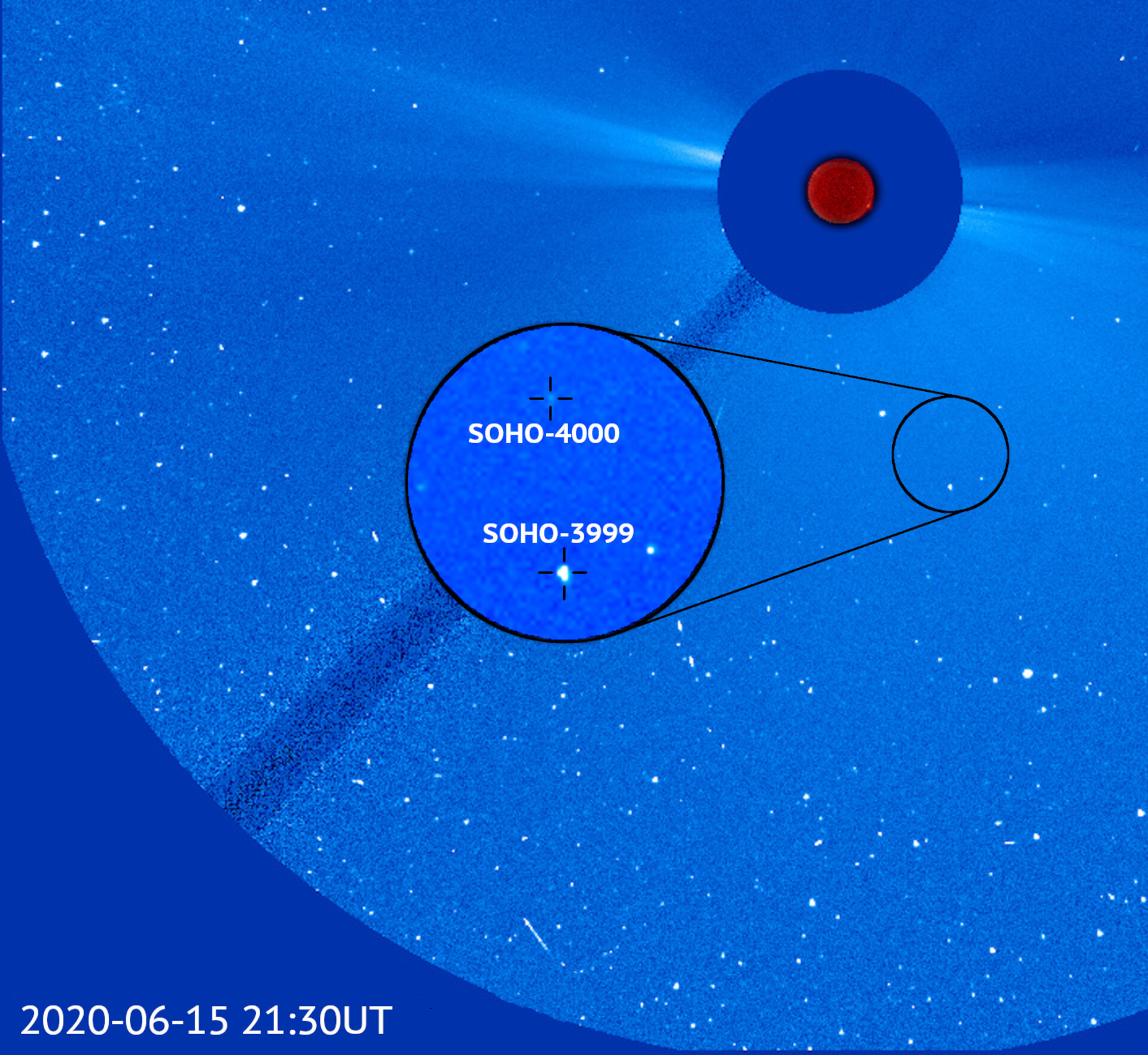
    SOHO comet 750 seen by LASCO C3

    'Sungrazing' comets have been observed for many hundreds of years. These are comets which travel very close to the Sun (if they were to hit it, they would become 'sunstrikers').

    In the late 1880s and 1890s, Heinrich Kreutz studied the comets which had been observed until then and determined that some were sungrazers and some were not. He also found that those which were indeed sungrazers all followed the same orbit.

    That is, they were all fragments of a single comet which had broken up. It is probable that the original comet, and its fragments, had broken up repeatedly as they orbited the Sun with a period of about 800 years. In honour of his work, this group of comets was named the Kreutz sungrazers.

    As far as is known, no comets have ever actually been seen to hit the solar surface, or the photosphere. The Kreutz sungrazers get to within about 50 000 kilometres of the surface, just passing through the lower regions of the solar atmosphere (the corona). Most usually evaporate in the hot solar atmosphere.

    Sungrazing comets have been observed possibly as far back as the year 371 BC. A comet seen by Aristotle and Ephorus may have been a Kreutz sungrazer. However, until 1979, only nine sungrazing comets had been seen, all from ground-based observations.

    Then, beginning in 1979, space-based observatories began to detect sungrazing comets. These observatories use instruments known as coronagraphs. A coronagraph is designed to look at the solar atmosphere, using a mask to create an artificial eclipse which hides the bright disk of the sun.

    The CP coronagraph on the NASA Solar Maximum Mission (SMM) discovered 10 sungrazing comets between 1987 and 1989. There is another coronagraph (actually three in one instrument) in space right now - the Large Angle Spectrometric Coronagraph (LASCO) on the ESA/NASA SOHO observatory.

    Since the LASCO instrument was switched on, on 30 December 1995, it has discovered over 700 new comets, of which over 500 belong to the Kreutz sungrazing group. The majority of the remaining comets belong to three new groups (the Meyer, Marsden and Kracht groups) that were discovered based solely on SOHO's LASCO observations. Kreutz comets approach the Sun ten times closer than comets from the three new groups.

    Last update: 2 November 2004

    Rate this

    Views

    Share

    • Currently 0 out of 5 Stars.
    • 1
    • 2
    • 3
    • 4
    • 5
    Rating: 0/5 (0 votes cast)

    Thank you for rating!

    You have already rated this page, you can only rate it once!

    Your rating has been changed, thanks for rating!

    57
    Tweet
    • More about...
      • SOHO overview
        • Rosetta overview
        • Related articles
          • What are solar flares?
            • Massive sunspot faces Earth
              • Space weather
                • How the Sun affects us on Earth
                  • Comets - an introduction
                    • Life of a comet
                      • Watch a comet passing near the Sun
                        • SOHO's 500th comet: An interview with Bernhard Fleck
                          • SOHO sees its 750th comet
                          • Related links
                          • SOHO comets

    Connect with us

    • RSS
    • Youtube
    • Twitter
    • Flickr
    • G+
    • Facebook
    • Livestream
    • Subscribe
    • App Store
    • ESA Science Twitter

    Follow ESA science

    • LATEST ARTICLES
    • · Proba-V opens its eyes
    • · First new Galileo satellite arrive…
    • · Next destination: space
    • · Leak repaired on International Spa…
    • · After Chelyabinsk: European expert…
    • FAQ

    • Jobs at ESA

    • Site Map

    • Contacts

    • Terms and conditions