D
Dark matter
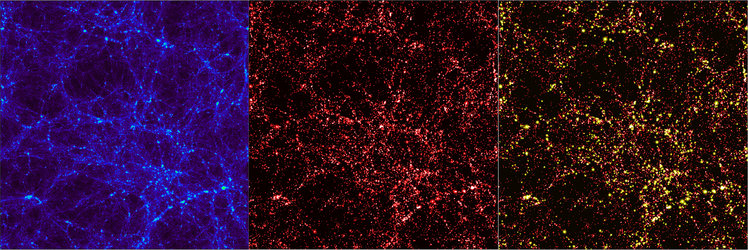
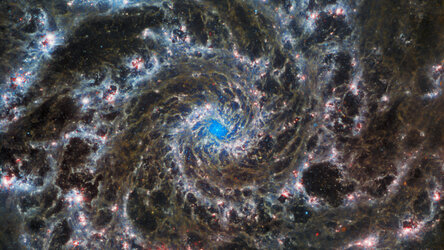
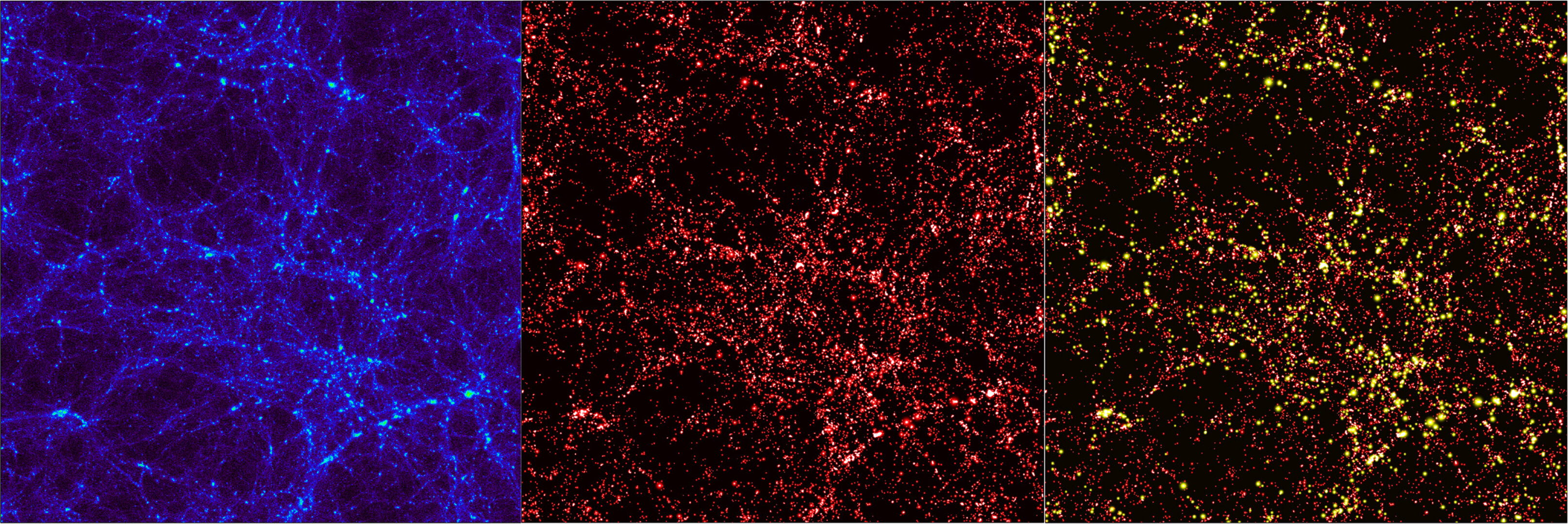
Matter that cannot be detected by current instruments, although its existence can be inferred by its gravitational interactions. For instance, by studying the speed at which the 'arms' in the spiral galaxies rotate, astronomers know that they must be more massive than what can be estimated based on the light that a telescope measures. It has been proposed that part of this matter might be in the form of non-baryonic matter.
Data
Facts (in the form of values, quantities given by an instrument) from which other information may be inferred. Plural term commonly treated as singular.
Decaying orbit
An unstable orbit from which the orbiting object will gradually spiral into the body it is orbiting.
Deep Space Network (DSN)
NASA network of radio telescopes used to communicate with spacecraft operating far from the Earth. It includes three 70 m antennas located at Goldstone (California), near Madrid (Spain) and near Canberra (Australia).
Density
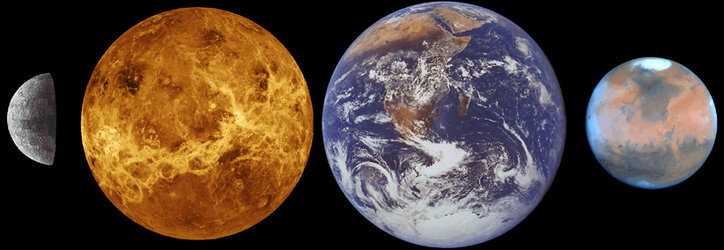
Mass per unit of volume.
Descent phase
The phase during which a spacecraft is dropped onto a celestial body, such as a planet or a moon.
Differential rotation
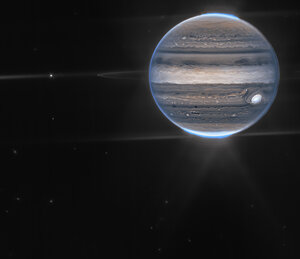
(1) The variable rotation rate of a gaseous body, such as a star or Jupiter-type planet according to latitude (distance from its equator). This results in gas near the equator rotating more quickly than gas near the poles.
(2) The variable rotation in a disc-shaped structure, such as a galaxy, according to distance from its centre. Stars near the centre take less time to complete one rotation than those further away.
Diffraction grating
Grating device that splits light into a spectrum of the component wavelengths.
Diffuse X-ray background
An X-ray emission not associated with known individual sources. Part of this emission, particularly at soft X-ray energies, arises from hot gas within the Galaxy.
Diode
Semiconductor electronic component. Ideally, a diode conducts electricity in one direction and does not allow the current to flow in the opposite direction. Thanks to this property diodes are used to rectify alternating currents, i.e., to convert alternating current (AC) to direct current (DC).
Dispersion
Scattering of an electromagnetic wave as light is split into its constituent colours by a prism or diffraction grating.
Doppler shift
The change in observed frequency due to relative motion between source and observer.
Drag
Effect of an atmosphere that slows a spacecraft and forces its orbit to decay.
Dust (cosmic, interstellar)
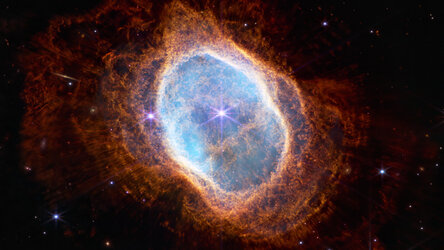
Tiny particles in space (in the Solar System, around and among the stars). Typically a few angstroms in size. Dust is produced in many diverse processes, such as supernovae explosions or asteroid collisions. The dust hampers the view of optical telescopes – to which it is opaque – but can be detected with infrared telescopes. The dust around a star absorbs the star's light and re-emits it as infrared light; therefore, dusty regions (e.g., star-forming regions) are best studied with infrared telescopes.