• → European Space Agency

      • Space for Europe
      • Space News
      • Space in Images
      • Space in Videos
    • About Us

      • Welcome to ESA
      • DG's News and Views
      • For Member State Delegations
      • Business with ESA
      • ESA Exhibitions
      • ESA Publications
      • Careers at ESA
    • Our Activities

      • Space News
      • Observing the Earth
      • Human Spaceflight
      • Launchers
      • Navigation
      • Space Science
      • Space Engineering
      • Operations
      • Technology
      • Telecommunications & Integrated Applications
    • For Public

    • For Media

      • Media
      • ESA TV
      • Videos for professionals
      • Photos
    • For Educators

    • For Kids

    • ESA

    • Space Science

    • Our Universe
    • About Space Science
    • ESA's 'Cosmic Vision'
    • Science missions
    • Mission navigator
    • Target groups
    • For Media
    • For Scientists
    • For Kids
    • Multimedia
    • Science images
    • Science videos
    • Animations
    • Downloads
    • Sounds from space
    • Resources
    • Reference section
    • Services
    • FAQs
    • Glossary
    • Help
    • Portal terms of use
    • Comments
    • Follow us
    • RSS feeds
    • ESA Sci on Twitter
    • ESA Space Science Images on Flickr
    • ESA 3D on Flickr

    ESA > Our Activities > Space Science

    Eddington factsheet

    Searching for habitable planets and mapping stellar interiors

    Name Many of the ideas behind Eddington originated before the coming of the Space Age with the physicist Arthur Stanley Eddington.

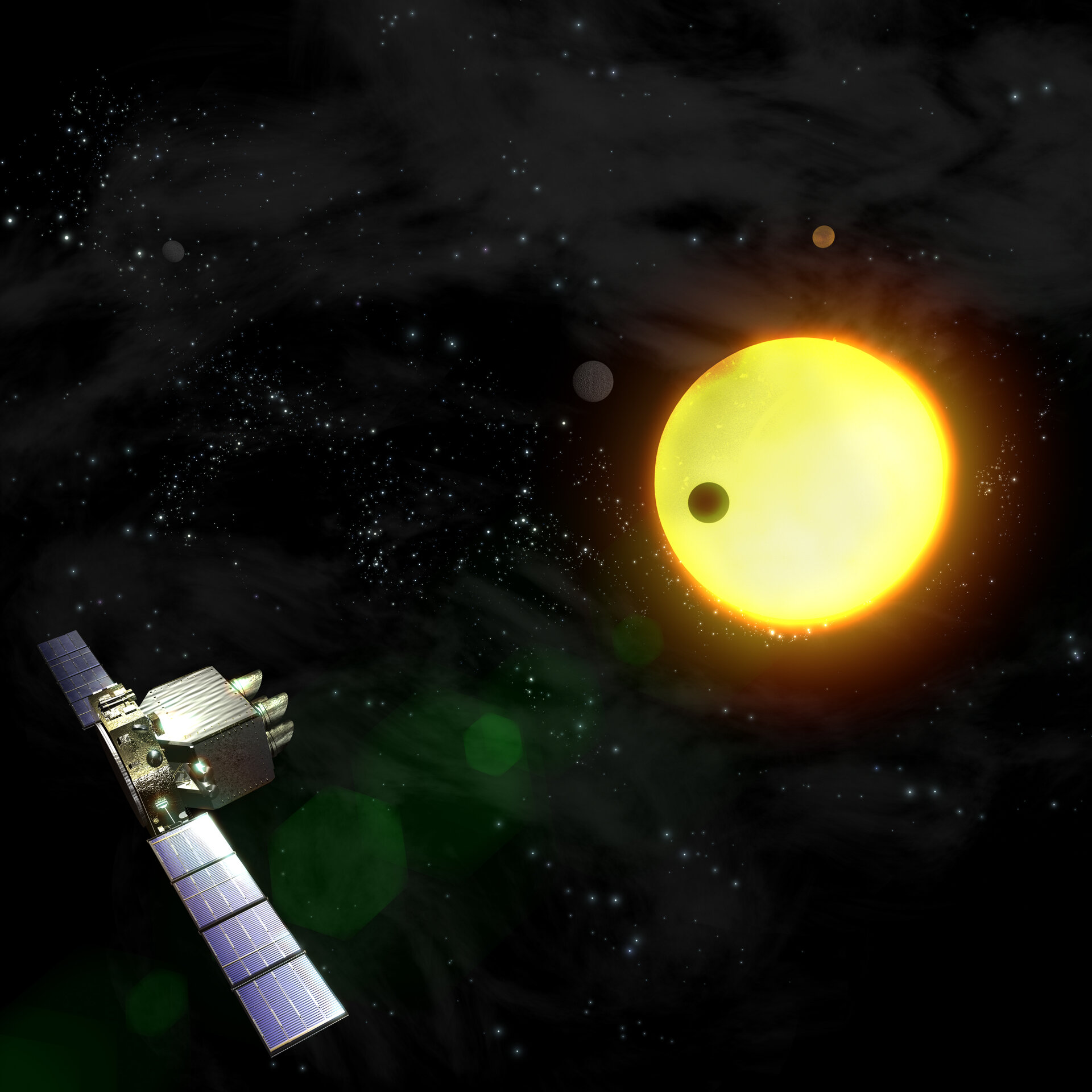
    Description Eddington will be a space telescope designed to detect subtle changes in the light from stars. It will spot oscillations that show the star’s interior condition. It will also find planets half the size of Earth and upwards, within the star’s habitable zone, as they cross the face of the star.


    Launch 2008 (Soyuz-Fregat rocket).

    Status Cancelled.

    Journey After leaving Earth, Eddington will travel beyond the Moon to a special orbit called the second Lagrangian point (known as L2). Here it will begin its five-year mission.

    Notes Eddington carries a precision photometer, that is, a device that will measure small changes in the brightness of a celestial object. These changes in brightness may well be due to the passing of planets in front of a star.

    Eddington will be so sensitive that if, for example, it were to observe a swarm of 10 000 fireflies, it would notice if just one of them `turned off'.

    Asteroseismology is the study of stellar oscillations in stars like our Sun (that is, the study of starquakes). Eddington will be the culmination of an international attempt to perform asteroseismology from space. Two small precursor space missions, MOST and Corot, are planned to lead the way.

    By looking at stars of similar mass to the Sun but of different ages, Eddington will allow astronomers to check their theories about how the Sun has changed since its birth and how it will evolve in the future.

    Eddington will help solve a problem called the Faint Sun Paradox. Astronomers expect that the Sun was about 30% fainter when it was born. However, geological records show that Earth's climate has remained more or less stable throughout its history. Either the solar models are wrong or our climate is remarkably resistant to change.

    Last update: 14 October 2004

    Rate this

    Views

    Share

    • Currently 0 out of 5 Stars.
    • 1
    • 2
    • 3
    • 4
    • 5
    Rating: 0/5 (0 votes cast)

    Thank you for rating!

    You have already rated this page, you can only rate it once!

    Your rating has been changed, thanks for rating!

    17
    Tweet
    • More about...
      • Eddington overview
      • Other missions looking for planets
        • COROT factsheet
          • Darwin factsheet
            • Gaia factsheet
            • Other missions in orbit at L2
              • Darwin factsheet
                • Gaia factsheet
                  • Herschel fact sheet
                    • JWST factsheet
                      • Planck in a nutshell
                      • Other missions launched for ESA by Russian Soyuz
                        • Cluster factsheet
                          • COROT factsheet
                            • Gaia factsheet
                              • Mars Express factsheet
                                • Solar Orbiter in a nutshell
                                  • Venus Express factsheet

    Connect with us

    • RSS
    • Youtube
    • Twitter
    • Flickr
    • G+
    • Facebook
    • Livestream
    • Subscribe
    • App Store
    • ESA Science Twitter

    Follow ESA science

    • LATEST ARTICLES
    • · Earth Explorers take centre stage …
    • · The fast winds of Venus are gettin…
    • · ExoMars 2016 set to complete const…
    • · Herschel ends operations as orbiti…
    • · Europe’s largest spaceship reache…
    • FAQ

    • Jobs at ESA

    • Site Map

    • Contacts

    • Terms and conditions