Eddington overview
Objective
Mapping stellar evolution, Eddington will determine the size and precise chemical composition of the stars, and will search for other Earth-sized worlds that harbour extraterrestrial life.

For more in-depth scientific and technical details of our Space Science Programme and missions, follow this link.
Mission
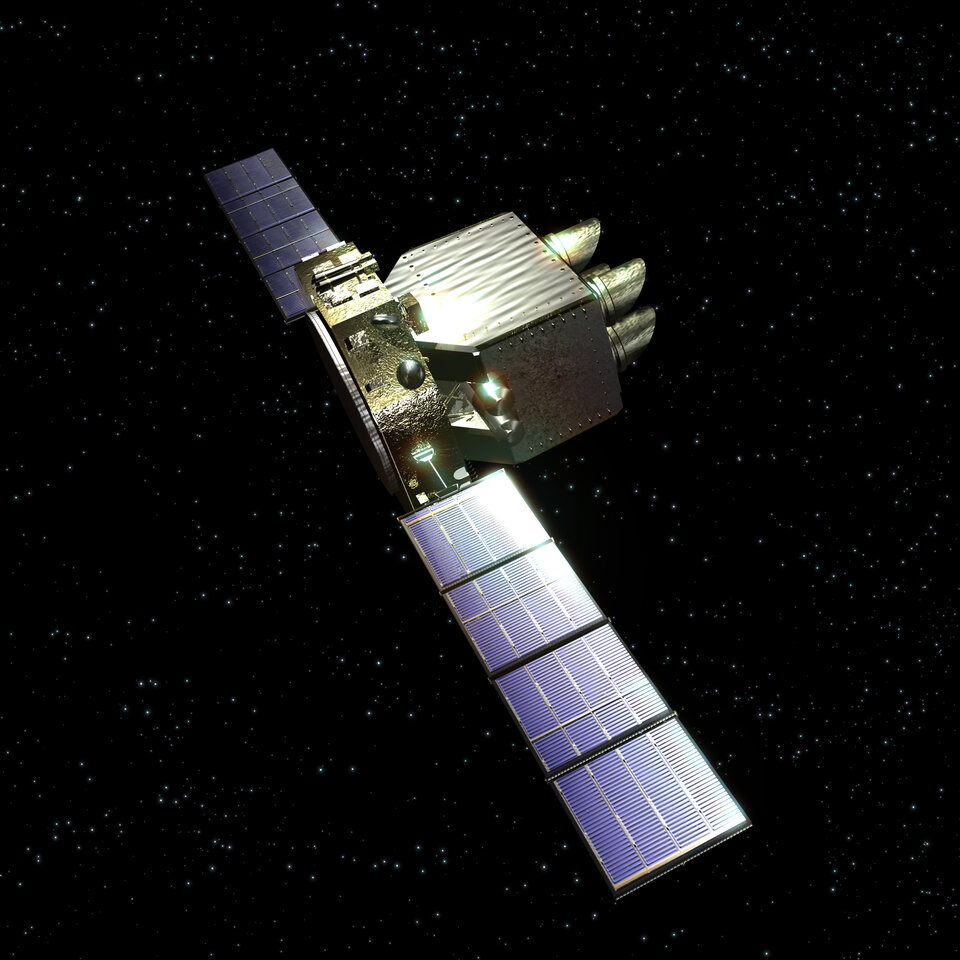
Eddington will be a space telescope designed to detect subtle changes in the light from stars. It will spot oscillations that show the star’s interior condition. It will also find planets half the size of Earth and upwards, within the star’s habitable zone, as they cross the face of the star.
Eddington is a precision photometer - a device that will measure small changes in the brightness of a celestial object. For example, if Eddington were to observe a swarm of 10 000 fireflies, it would notice if just one of them ‘turned off’.
All stars vary a little in brightness because they vibrate like ringing bells. The frequency of this oscillation is determined by factors such as the size, mass, composition, and age of the star. Eddington will study the brightness variations, allowing astronomers to relate them to the internal condition of the star. This technique is known as ‘asteroseismology’.
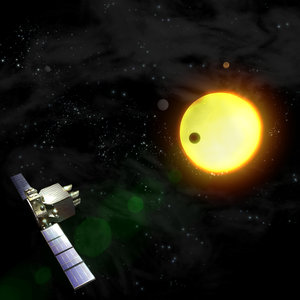
Eddington will also detect planets passing across the face of their parent star. When a planet crosses a star, it is called a transit and blocks out a tiny fraction of light. Eddington will detect the drop in light, revealing the existence of the planet.
What's special?
Asteroseismology is the study of stellar oscillations in stars of all types (that is, the study of starquakes). Eddington will be the culmination of an international attempt to perform asteroseismology from space. Two small precursor space missions, MOST and Corot are planned to lead the way.
MOST is a Canadian mission using a 15-centimetre telescope due for launch in 2003. It will monitor a handful of the very brightest stars such as Procyon and Eta Boötes for about a month each.
Corot is a French mission, with some funding from ESA, that uses a 27-centimetre telescope. It will be launched in late 2005. Corot will make long-term observations of between 20-30 stars, leading to high-precision data. It will also attempt to discover transiting planets, larger than a few times the size of the Earth.
These smaller missions will pave the way for Eddington which will perform an extensive and far-reaching survey, beginning in 2008. From a better vantage point, further from the Earth, this mission will study the interior composition of about 50 000 stars. It will also survey about 500 000 stars, looking for planets down to the size of Mars (that is, about one third the size of the Earth).
Spacecraft
The Eddington payload can be described as a wide-field, high-accuracy optical photometer, and it is characterised by its simplicity and robustness.
Thanks to its large field of view, Eddington will acquire data simultaneously on a very large number of targets: high-time-resolution asteroseismic data will be collected on about 50 000 stars, while planetary transits will be searched for on about 500 000 stars.
Its large collecting area will enable it to observe clusters and stars in crucial stages of stellar evolution which are not available among the bright stars in the sky. These facts will allow Eddington to achieve qualitatively different science goals than the small exploratory national projects which are currently under development.
Journey
After leaving Earth, Eddington will travel beyond the Moon to a special orbit called the second Lagrangian point (or L2 for short). Here it will begin its five-year mission.
History
Eddington builds on a solid heritage of smaller asteroseismology and transit-based planet-searching missions and of previous studies.
An asteroseismology mission was proposed to ESA in response to a Call for Proposals, under the name of STARS. STARS featured a 1-metre diameter telescope, and was selected for a study. Although in the final selection phase, the Planck mission (then COBRAS-SAMBA) was preferred to STARS, the mission and its scientific goals were rated very highly.
ESA recommended Planck, to first execute a smaller stellar seismology mission project in some Member States, before embarking on a full-scale STARS mission.
Partnerships
Eddington is a totally European mission. Spacecraft, telescope, launch, and spacecraft operations will all be provided by ESA.