• → European Space Agency

      • Space for Europe
      • Space News
      • Space in Images
      • Space in Videos
    • About Us

      • Welcome to ESA
      • DG's News and Views
      • For Member State Delegations
      • Business with ESA
      • ESA Exhibitions
      • ESA Publications
      • Careers at ESA
    • Our Activities

      • Space News
      • Observing the Earth
      • Human Spaceflight
      • Launchers
      • Navigation
      • Space Science
      • Space Engineering
      • Operations
      • Technology
      • Telecommunications & Integrated Applications
    • For Public

    • For Media

      • Media
      • ESA TV
      • Videos for professionals
      • Photos
    • For Educators

    • For Kids

    • ESA

    • Space Science

    • Our Universe
    • About Space Science
    • ESA's 'Cosmic Vision'
    • Science missions
    • Mission navigator
    • Target groups
    • For Media
    • For Scientists
    • For Kids
    • Multimedia
    • Science images
    • Science videos
    • Animations
    • Downloads
    • Sounds from space
    • Resources
    • Reference section
    • Services
    • FAQs
    • Glossary
    • Help
    • Portal terms of use
    • Comments
    • Follow us
    • RSS feeds
    • ESA Sci on Twitter
    • ESA Space Science Images on Flickr
    • ESA 3D on Flickr

    ESA > Our Activities > Space Science > Exploring space

    X-ray view of the Red Planet

    X-ray image of Mars
    13 December 2003

    Another ESA mission is turning its gaze towards Mars. This recent image was taken by the X-ray observatory XMM-Newton.

    All bodies in our Solar System, including planets such as Earth and Mars, emit X-ray radiation. As far as we know, there are several possible sources of this radiation.

    One of the main sources is thought to be ‘fluorescence emission’. X-rays from the Sun hit atoms of elements such as oxygen in the atmosphere of the planet, and this radiation is re-emitted as so-called ‘characteristic’ radiation which identifies those specific elements.

    This image from XMM-Newton, recorded as part of a study by Dr K. Dennerl (Max Planck Institute for Extraterrestrial Physics, Garching, Germany) shows X-ray fluorescence emission from the atmosphere of Mars, mainly from oxygen. All of these emissions tell us something about the interaction of radiation with the planet's atmosphere and its environment.

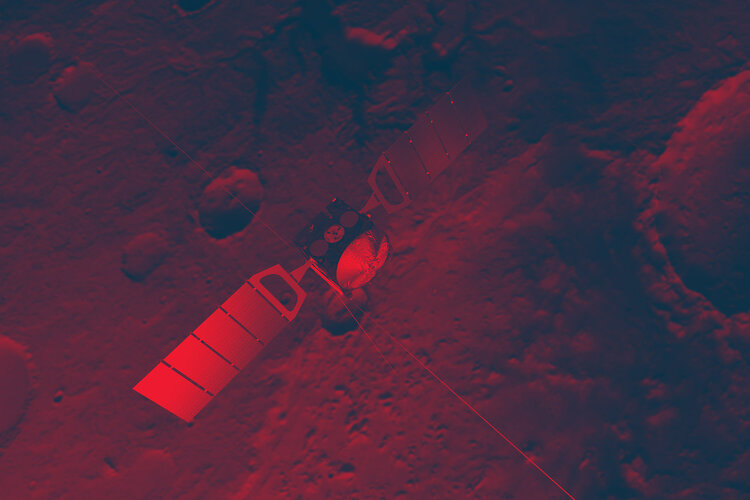
    The study of Mars in X-ray wavelengths brings together the work of two very important ESA missions XMM-Newton and Mars Express. Both are crucial to our understanding of our nearest planetary neighbour, demonstrating the coherence of the ESA Science programme.
    Rate this

    Views

    Share

    • Currently 0 out of 5 Stars.
    • 1
    • 2
    • 3
    • 4
    • 5
    Rating: 0/5 (0 votes cast)

    Thank you for rating!

    You have already rated this page, you can only rate it once!

    Your rating has been changed, thanks for rating!

    81
    Tweet
    • Looking at Mars
    • More about...
      • Mars Express overview
        • XMM-Newton overview
        • Related articles
          • Observations: Seeing in X-ray wavelengths
            • Mars Express instruments

    Connect with us

    • RSS
    • Youtube
    • Twitter
    • Flickr
    • G+
    • Facebook
    • Livestream
    • Subscribe
    • App Store
    • LATEST ARTICLES
    • · Rare merger reveals secrets of gal…
    • · Watching for hazards: ESA opens as…
    • · ESA astronaut Timothy Peake set fo…
    • · Space drives e-mobility
    • · Proba-V opens its eyes
    • FAQ

    • Jobs at ESA

    • Site Map

    • Contacts

    • Terms and conditions