

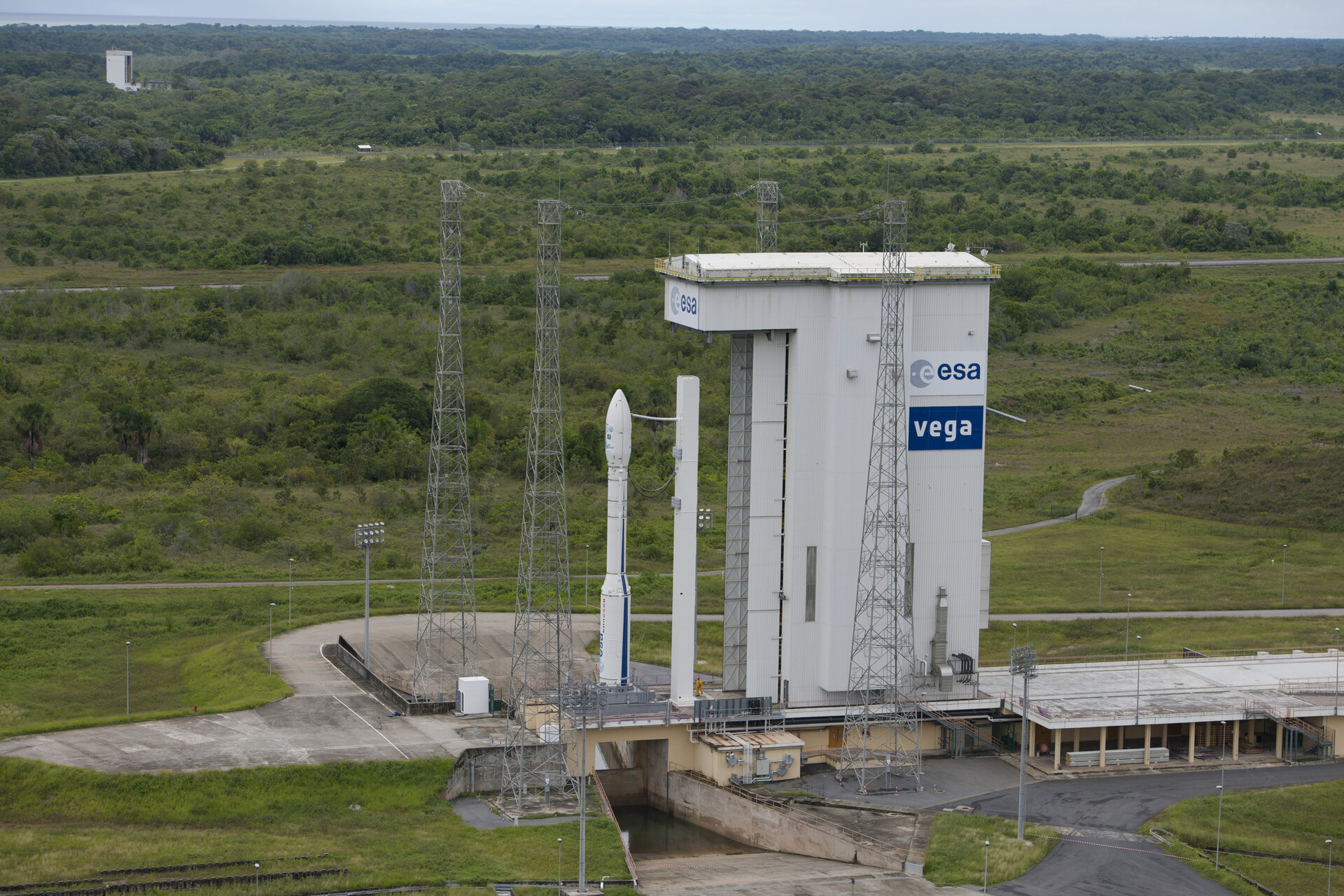
Getting ready for launch
After the spacecraft has passed its Flight Acceptance Review it is transported to its launch site. This marks the beginning of the launch campaign, during which the final system functional tests will take place, the spacecraft will be fuelled and mated with the launch vehicle, transported to the launch pad and eventually launched.
Launch sites and launchers
ESA launches its missions from Europe's spaceport at Kourou in French Guiana, or a Russian launch site, such as the Baikonur Cosmodrome or Plesetsk.
Kourou lies just over 500 km north of the equator. Its proximity to the equator makes it ideally placed for launches into geostationary transfer orbit as few changes have to be made to a satellite’s trajectory.
Russian launch sites, being located at high latitude, are more suited for launching polar orbiting missions, such as Cluster.

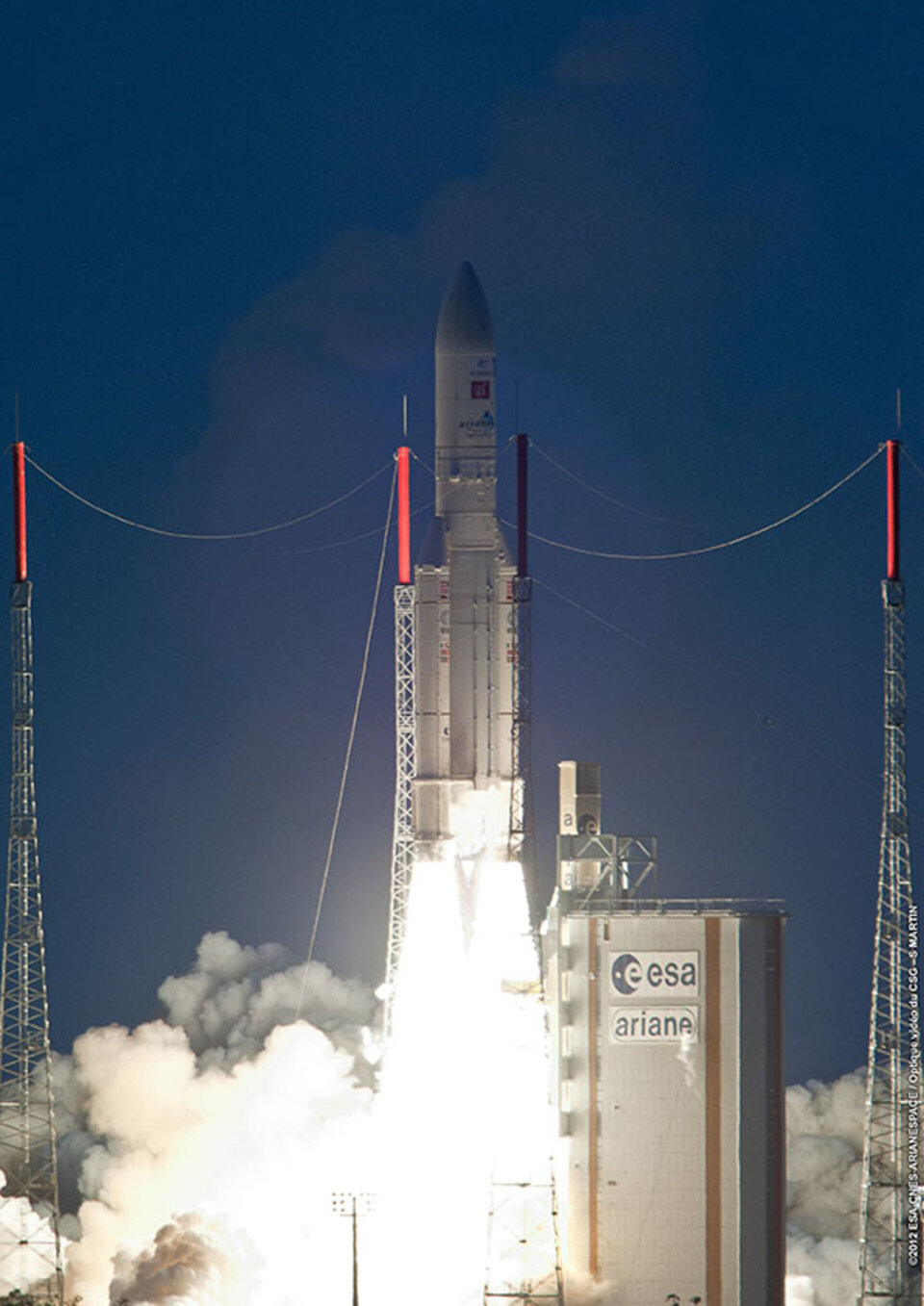
A variety of launchers cater for different needs: ESA’s Ariane family of rockets launch large satellites into their transfer trajectories, such as Herschel, Planck and Rosetta. Russian Soyuz rockets launch medium class satellites, such as Mars Express and Venus Express, onto their interplanetary trajectories. The most recent addition to ESA’s fleet of launchers is Vega, dedicated to launching low mass missions into low-Earth and polar orbits around Earth.
ESA will also start shortly the development of an advanced Ariane model with a restartable upper stage, which will enable two satellites to be launched at the same time and to be delivered, in sequence, into different orbits. This type of launch capability reduces the overall cost that would result from launching the satellites on two separate rockets.
Launch windows
If the spacecraft intends to rendezvous with another spacecraft, a planet, or other point in space, the launch must be carefully timed so that the orbits overlap. The period of time when the spacecraft can launch and reach its target is known as the ‘launch window’. If the weather is bad or a malfunction occurs during a launch window, the launch must be postponed until the next available window. This requires a wait on the launch pad of a few hours up to a couple of days or a return to the integration hall for defueling and refurbishing, in case the wait time is extended.
Flight ready
Transporting the spacecraft is always handled with extreme caution and once the spacecraft arrives at the launch site, it undergoes a final inspection and functional test. The final milestone to make sure the spacecraft is ready to fly is known as the 'flight readiness review'. When this has been successful, the spacecraft is fuelled.
Fuelling is a hazardous operation because rocket propellants are extremely toxic. Technicians wearing protective plastic 'spacesuits' supervise the fuelling, which can take up to a week to complete. It is a painstaking process because it is also irreversible. Once loaded, the fuel cannot be drained without inviting the risk of serious damage to the fuel tanks.
Once it has been fully fuelled the spacecraft is attached to the launch vehicle or to an upper stage – the rocket motor that will propel the spacecraft on its way once it has been placed in Earth’s orbit by the launch vehicle. The spacecraft and upper stage are then encased in a protective shroud and fixed to the launch vehicle itself, and another round of tests must be passed to ensure the mating has been successful.
In the case of a launch on a European Ariane rocket, all assembly is performed with the rocket upright. On the Russian Soyuz rockets – but only for launches that take place from the Russian launch sites – the assembly is performed horizontally and the rocket is only hoisted upright when it arrives at the launch pad.
The rollout to the pad takes place a few days ahead of launch. The rocket itself, however, is not fuelled until shortly before. In the last minutes before ignition, lots of data pass between the rocket and mission control. Computers verify that all systems are 'nominal' – the word that engineers use to refer to correct readings – and after the launch director has given the go ahead for launch, the final part of the countdown is executed leading then the rocket's main engines ignition, after which the spacecraft begins its journey into space.