Giant Herschel telescope assembled
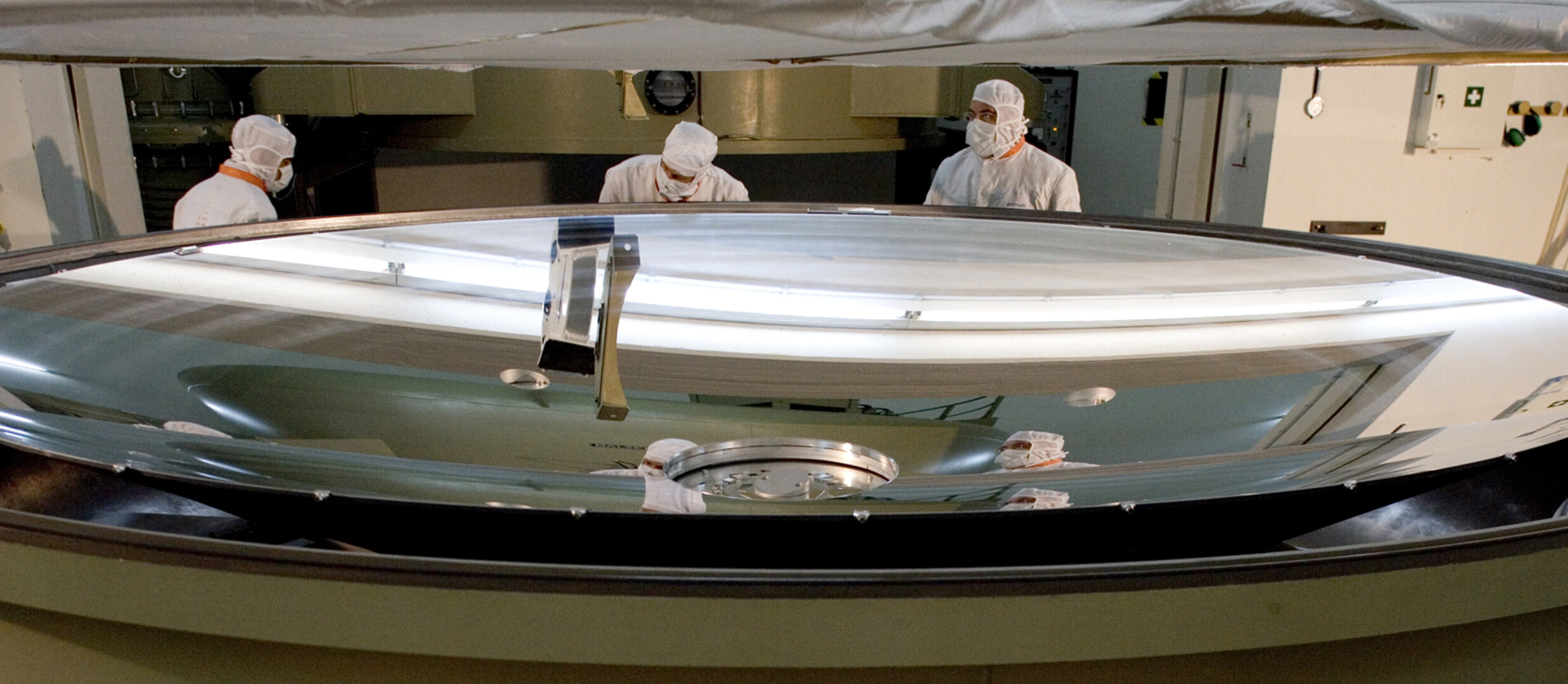
The largest telescope mirror ever built for space, due to be launched on board ESA’s Herschel spacecraft in 2007, has completed its assembly and first testing phase.
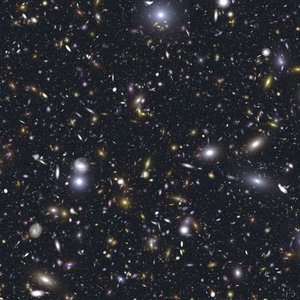
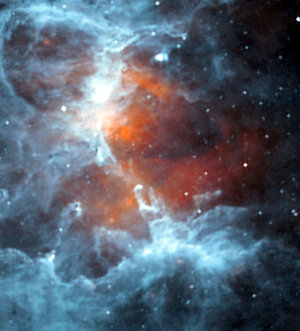
The Herschel telescope was designed to observe infrared radiation from the distant Universe and dig into the secrets of star and galaxy formation. With a 3.5-metre diameter, the telescope’s primary mirror makes Herschel the largest space telescope ever built, larger than Hubble, whose primary mirror is only 2.4 metres.
It is also the largest piece of ceramic ever manufactured. It is almost entirely made of silicon carbide, a technologically novel material particularly suited for space optics. Such technology is used because of its outstanding mechanical features: it is lightweight with high rigidity, and has ideal thermal characteristics, such as high conductivity and low expansion.

By using silicon carbide the thickness of the primary mirror can be kept to only three millimetres and the whole telescope weighs only 320 kilograms. By comparison, a similar sized mirror made of normal glass would weigh one and a half tons!
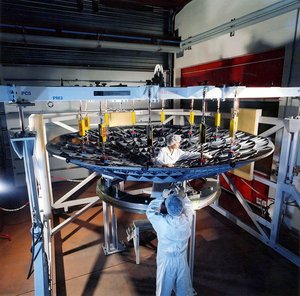
The telescope primary mirror is made of 12 petals individually manufactured and assembled by ‘brazing’ at 1400ºC (a technique of joining together two materials, like soldering) in a new type of oven, specially built for Herschel.
A polishing phase brought the mirror to the required parabolic shape to a precision of within three micrometres. The secondary mirror, 30 centimetres in diameter is also made of silicon carbide and has been polished to a precision better than one micrometre.
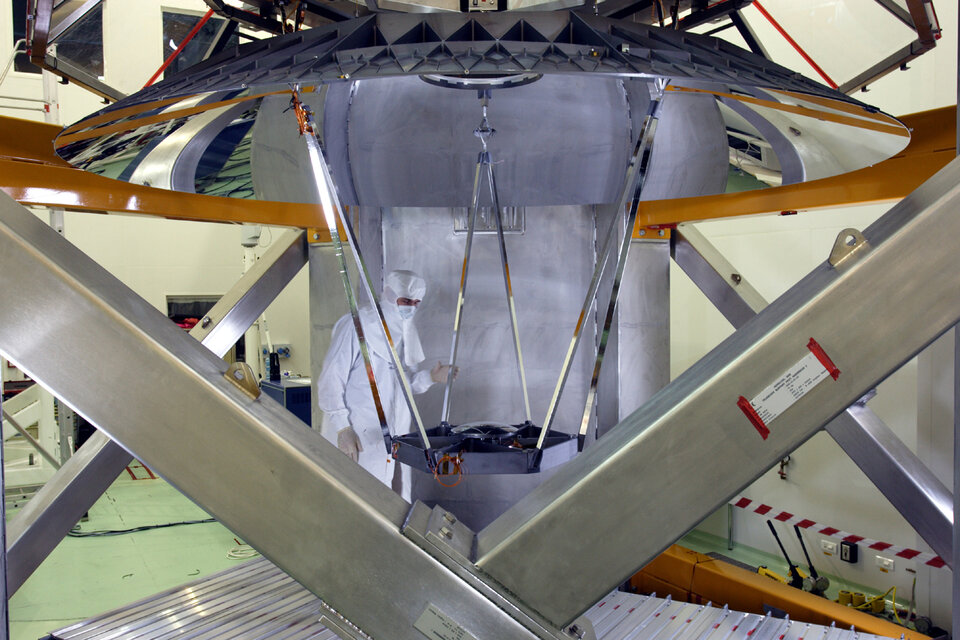
EADS Astrium in Toulouse, France, assembled the telescope in June 2005, after a four-year manufacturing phase. This integration phase consisted in accurately aligning the primary and the secondary mirrors with a precision greater than five micrometres in order to get the required optical performance.
Of course, this optical performance obtained under ambient ‘clean room’ and non-stressful conditions has to be preserved during the mission. Therefore, a series of tests have been begun to confirm the telescope performance in simulated launch and orbit conditions, because there will be no chance for repairs when it is in space.

In the first half of September this year, the telescope has undergone its qualification mechanical tests at Intespace, Toulouse, to verify its ability to withstand the acceleration and acoustic conditions during launch. Despite enduring ten times the force of gravity, the telescope maintained its initial alignments, as well its optical quality.
The mechanical qualification is now being followed by thermal qualification and optical characterization at operational temperature, to take place at the Centre Spatial de Liège, Belgium, until December this year.
Here the telescope will undergo several tests where it will have to survive cycles of temperatures down to minus 200ºC, representing the extreme thermal conditions found in space.
Once all the tests are completed, the telescope will be delivered to ESA and integrated onto the Herschel spacecraft by mid-2006. Herschel is due for launch by the end of 2007, sharing a ride with ESA’s Planck spacecraft which will study cosmic microwave background radiation.
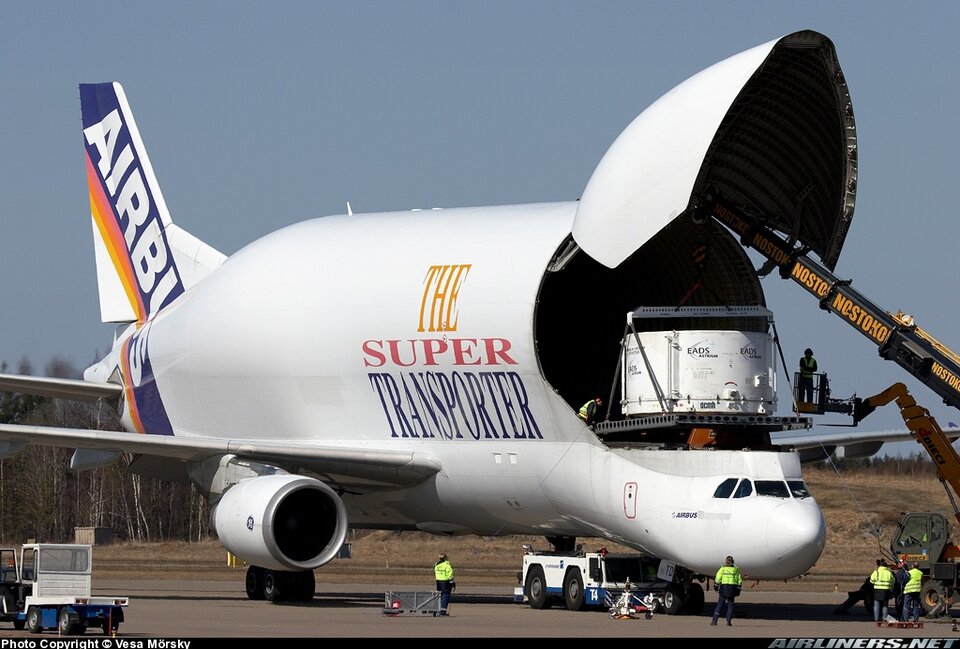
Notes to editors
The silicon carbide technology, as applied to space optics, was selected by ESA for the Herschel telescope and has been developed by EADS Astrium in partnership with Boostec, France.
Smaller silicon carbide optics, designed and integrated by EADS Astrium and produced by Boostec, are currently flown on ESA’s Rosetta (OSIRIS camera) and Aeolus (Aladin instrument) missions. Silicon carbide demonstrators for ESA’s Gaia mirror and NIRSpec optical bench (to be mounted on the NASA/ESA James Webb Space Telescope) are also being developed.
Also part of the industrial team are: Opteon (Finland), responsible for primary mirror polishing; Zeiss (Germany), responsible for secondary mirror polishing; Intespace (France) and Centre Spatial de Liège (Belgium), respectively responsible for mechanical and thermal testing; Calar-Alto Observatory (Spain), for their vacuum chamber used for the coating of the Herschel mirrors.
For more information:
Thomas Passvogel, ESA Herschel/Planck Project Manager
E-mail: thomas.passvogel @ esa.int
Göran Pilbratt, ESA Herschel Project Scientist
E-mail: gpilbratt @ rssd.esa.int
Yves Toulemont, EADS Astrium Herschel Telescope Project Manager
E-mail: yves.toulemont @ astrium.eads.net