• → European Space Agency

      • Space for Europe
      • Space News
      • Space in Images
      • Space in Videos
    • About Us

      • Welcome to ESA
      • DG's News and Views
      • For Member State Delegations
      • Business with ESA
      • ESA Exhibitions
      • ESA Publications
      • Careers at ESA
    • Our Activities

      • Space News
      • Observing the Earth
      • Human Spaceflight
      • Launchers
      • Navigation
      • Space Science
      • Space Engineering
      • Operations
      • Technology
      • Telecommunications & Integrated Applications
    • For Public

    • For Media

    • For Educators

    • For Kids

    • ESA

    • Space Science

    • [1/7] Vortex on Titan close up
    • [2/7] Saturn’s rings, Titan and Enceladus
    • [3/7] Saturn and Titan, side by side
    • [4/7] Saturn's rings and Enceladus
    • [5/7] Ring clumps and strands
    • [6/7] In the shadows of Saturn’s rings
    • [7/7] Titan's Nile River

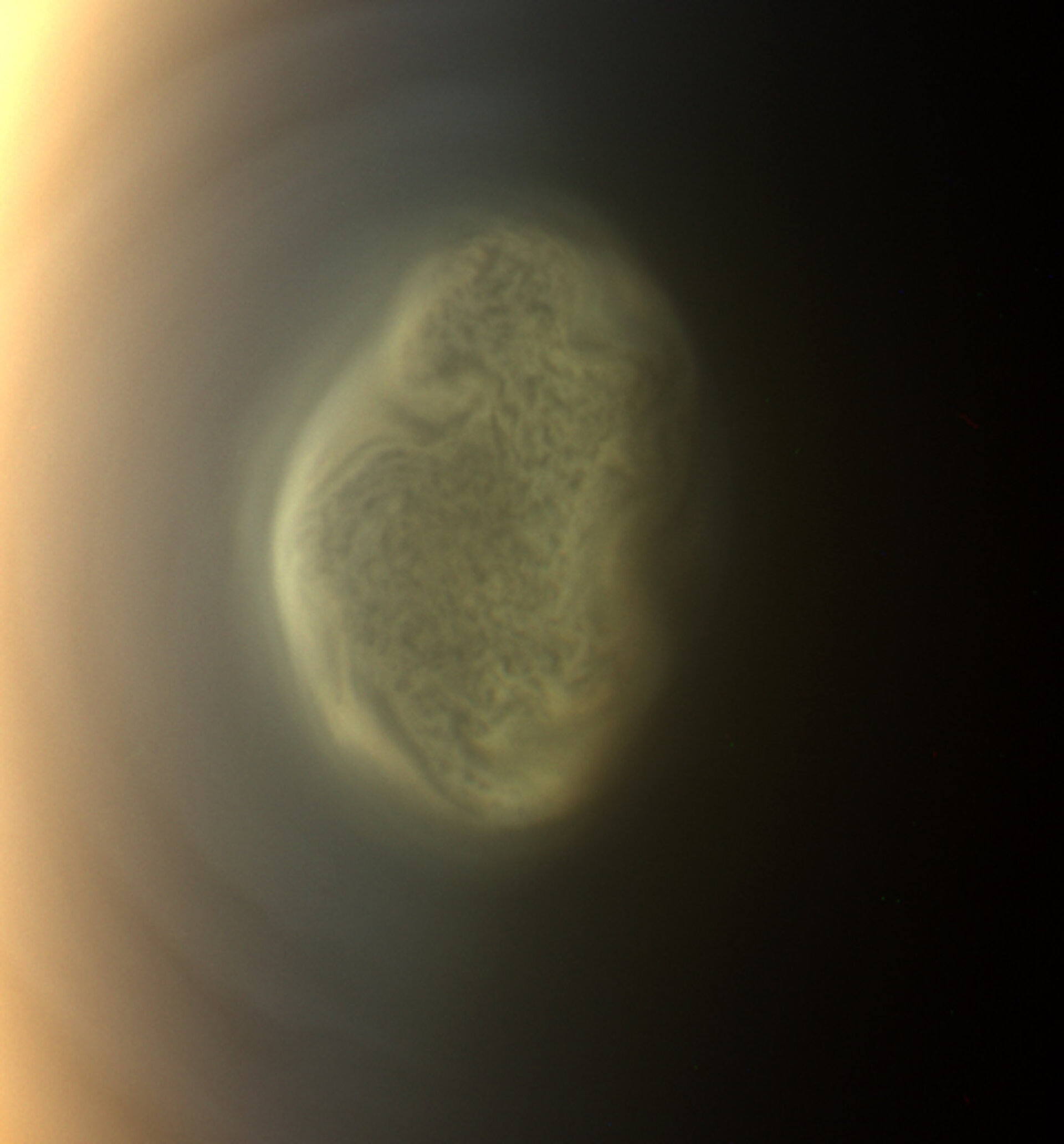
    Vortex on Titan close up
    Vortex on Titan close up

    A true-colour image of the south pole vortex observed in Titan’s atmosphere at about 200–300 km altitude, as seen during a Cassini flyby of Saturn’s largest moon on 27 June 2012. Since equinox in August 2009, the seasons have been changing, becoming spring in the northern hemisphere and autumn in the southern hemisphere. The formation of the vortex over the south pole indicates the effect of the changing seasons on the circulation pattern in Titan’s atmosphere, specifically with cooler air sinking down from warmer, high altitudes. 
    The images were obtained with the Cassini spacecraft narrow-angle camera at a distance of approximately 484,000 kilometres from Titan.

    Credits: NASA/JPL–Caltech/Space Science Institute
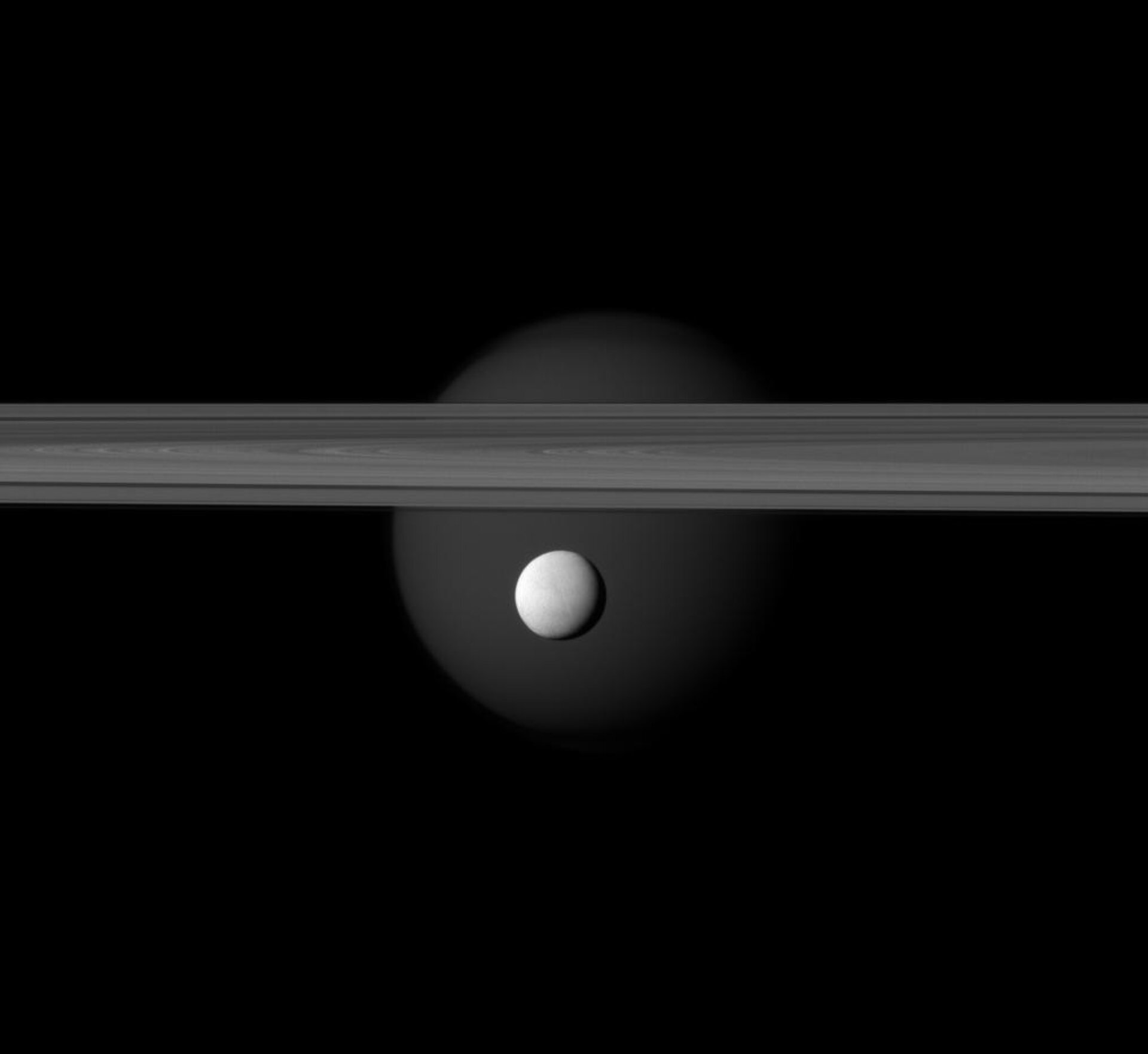
    Saturn’s rings, Titan and Enceladus
    Saturn’s rings, Titan and Enceladus

    Saturn’s icy moon Enceladus hangs below the gas giant’s rings while Titan lurks in the background, in this new image taken by the Cassini spacecraft.

    Faint detail of the tiger stripe markings can be seen on Enceladus’ surface, which is framed against Titan, Saturn’s largest moon. With jets of water ice and vapour streaming from Enceladus’ south pole, and liquid hydrocarbon lakes pooling beneath Titan’s thick atmosphere, these are two of Saturn’s most enigmatic moons.

    The northern, sun-lit side of Saturn’s rings are seen from just above the ring plane in this image, which was taken in visible green light by Cassini’s narrow-angle camera on 12 March while it was approximately one million kilometres from Enceladus. The image scale is six kilometres per pixel on Enceladus.

    Credits: NASA/JPL-Caltech/Space Science Institute
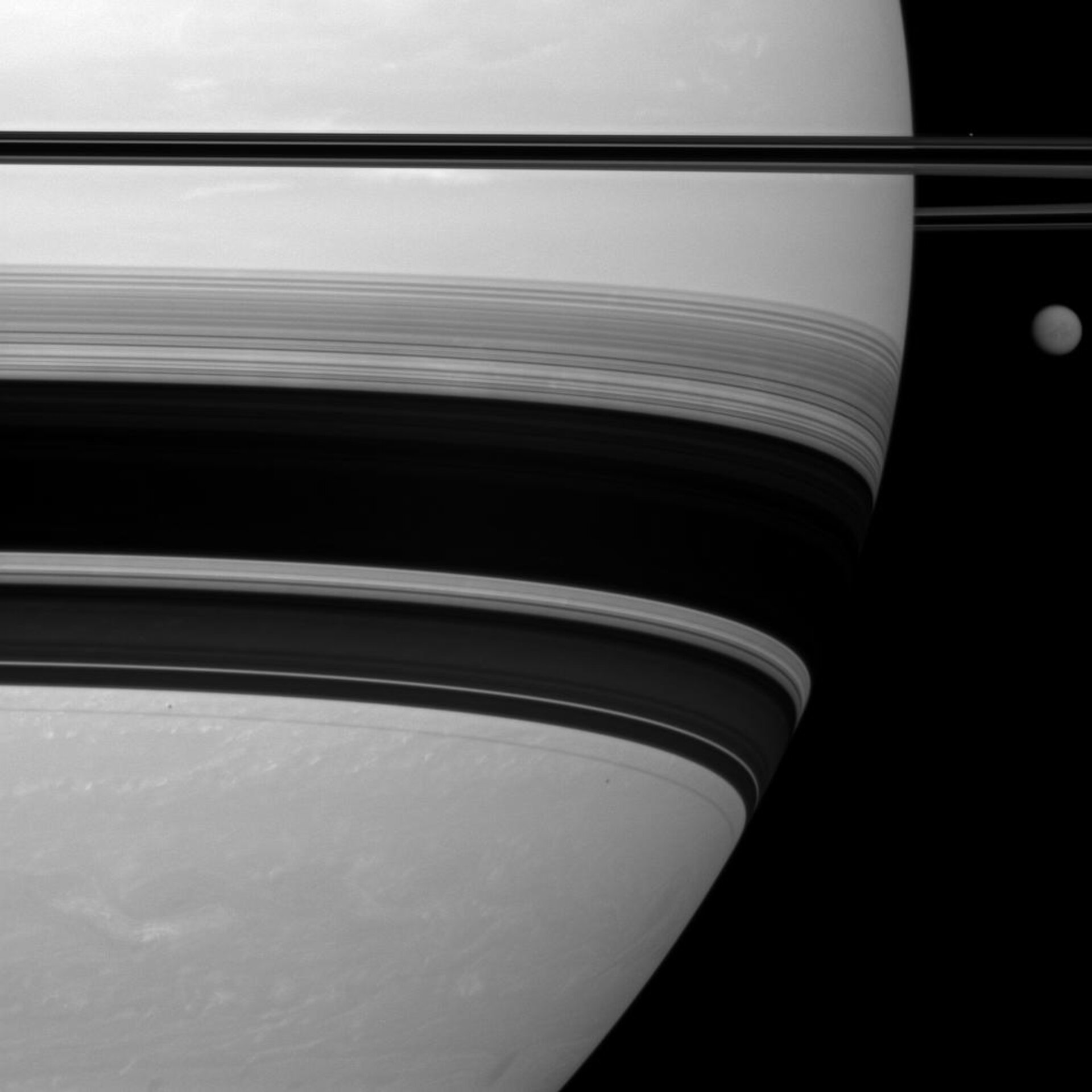
    Saturn and Titan, side by side
    Saturn and Titan, side by side

    Titan, Saturn’s largest moon at 5150 km across, looks small here, pictured to the right of the gas giant in this infrared image taken by the Cassini spacecraft.

     
    Saturn’s rings appear across the top of the image, casting shadows onto the planet across the middle of the image.

     
    A much smaller moon, Prometheus, 86 km across, appears as a tiny white speck above the rings in the far upper right of the image. The shadow cast by Prometheus can be seen as a small black speck on Saturn on the far left of the image, between the shadows cast by the main rings and the thin, faint F ring.

     
    The shadow of another moon, Pandora, 100 km at its widest, can be seen below the ring shadows towards the right side of the planet. However, Pandora itself is not visible in this image.

     
    Cassini’s wide-angle camera captured the view on 5 January, while it was about 685 000 km from Saturn. The image scale is 37 km per pixel on Saturn.

    Credits: NASA/JPL–Caltech/Space Science Institute
    Saturn's rings and Enceladus
    Saturn's rings and Enceladus

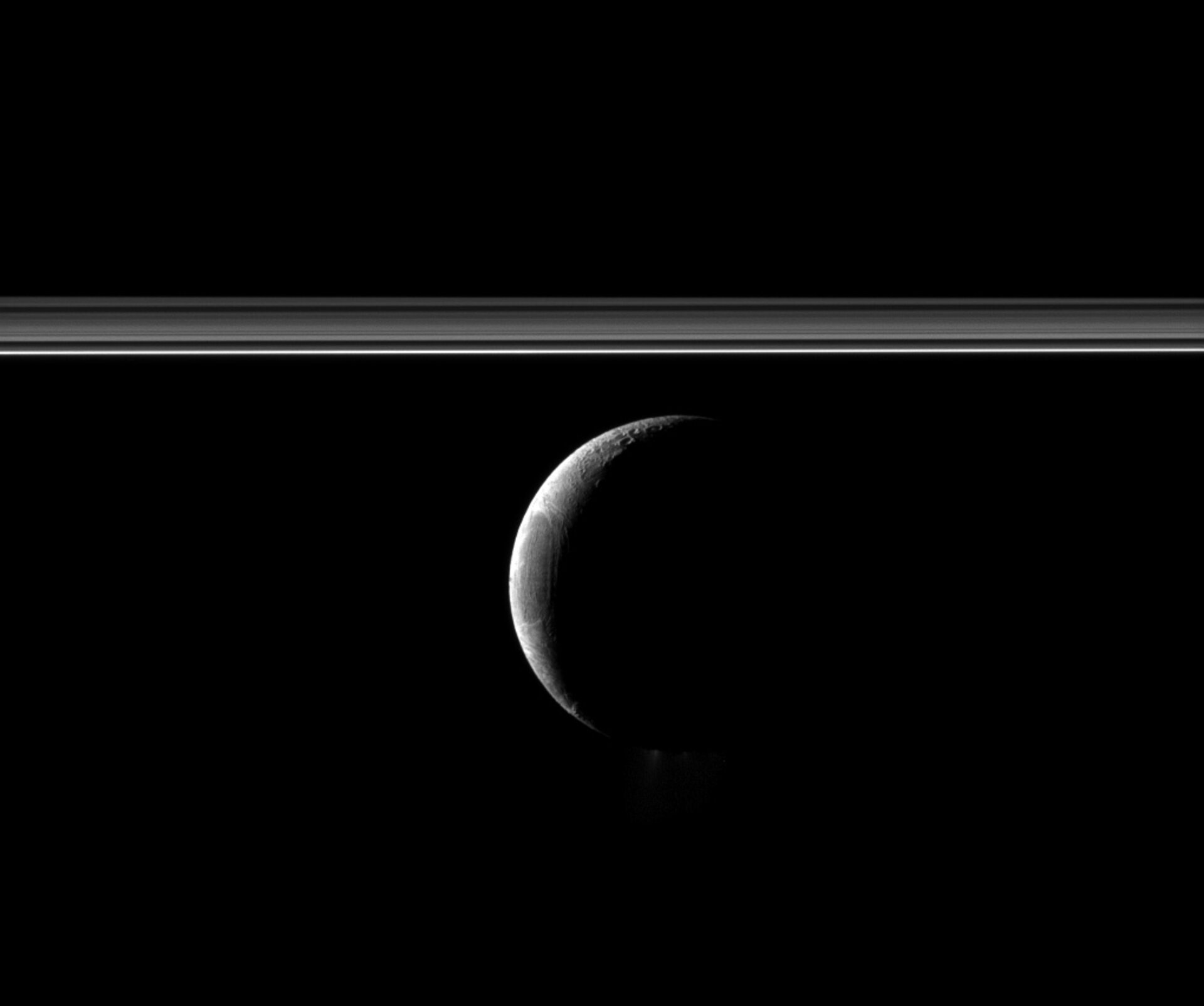
    A crescent Enceladus appears with Saturn’s rings in this Cassini spacecraft view of the moon.

    The famed jets of water ice emanating from the south polar region of the 504 km-diameter moon are faintly visible.

    They appear as a small white blur below the dark pole, down and to the right of the illuminated part of the moon’s surface. The image’s contrast was enhanced to increase their visibility.

    The sunlit terrain seen here is on the trailing hemisphere of Enceladus; north is up. This view looks toward the northern, sunlit side of the rings from just above the ringplane.

    The image was taken with Cassini’s narrow-angle camera on 4 January at a distance of 291 000 km from Enceladus. Image scale is about 2 km per pixel.

    Credits: NASA/JPL–Caltech/Space Science Institute
    Ring clumps and strands
    Ring clumps and strands

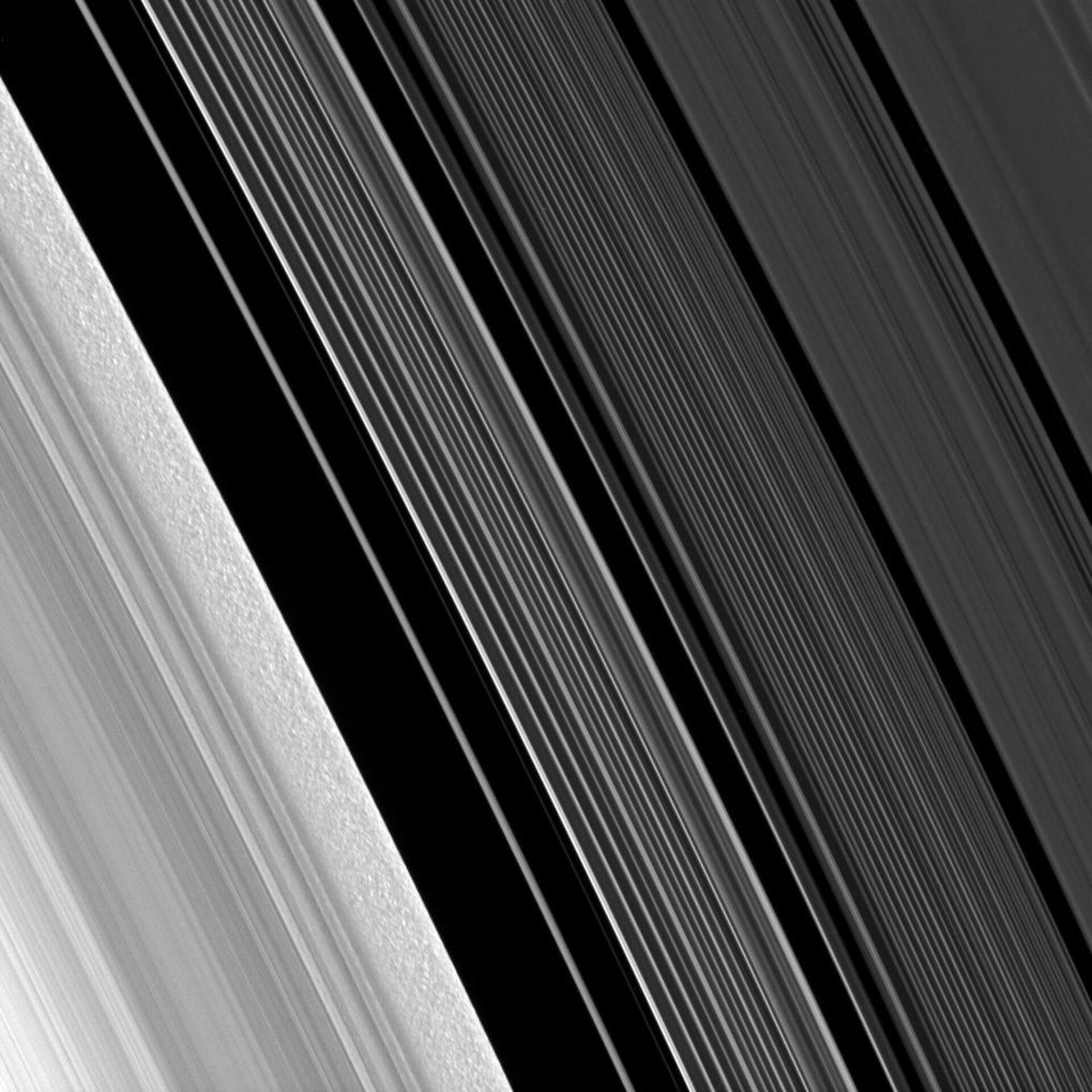
    Zooming in on clumps in Saturn’s B-ring (lower left), the image also spans the ringlets of the Cassini Division towards the A-ring in the top right. The view looks toward the sunlit side of the rings from about 31 degrees below the ring plane. The image scale is approximately 2 km per pixel.

    Credits: NASA/JPL/Space Science Institute
    In the shadows of Saturn’s rings
    In the shadows of Saturn’s rings

    Titan and Saturn, seen when the Cassini spacecraft passed by Titan at a distance of 700, 000 km on 6 May 2012.

    Credits: NASA/JPL-Caltech/Space Science Institute/J. Major
    Titan's Nile River
    Titan's Nile River

    A miniature version of the Nile River, seen on Saturn’s moon Titan by the international Cassini mission. The river valley stretches more than 400 km from its ‘headwaters’ to a large sea, and likely contains hydrocarbons.

    The image was acquired on 26 September 2012, on Cassini’s 87th close flyby of Titan. The river valley crosses Titan’s north polar region and runs into Kraken Mare, one of the three great seas in the high northern latitudes of the moon. 

    Credits: NASA/JPL–Caltech/ASI

    Exploring Saturn

    Recent Cassini images of the ringed planet and its enigmatic moons

    Access the image

    Access the image

    Access the image

    Access the image

    Access the image

    Access the image

    Access the image

    Rate this

    Views

    Share

    • Currently 5 out of 5 Stars.
    • 1
    • 2
    • 3
    • 4
    • 5
    Rating: 5/5 (3 votes cast)

    Thank you for rating!

    You have already rated this page, you can only rate it once!

    Your rating has been changed, thanks for rating!

    655
    facebook
    twitter
    reddit
    google plus
    digg
    tumbler
    digg
    blogger
    myspace

    Connect with us

    • RSS
    • Youtube
    • Twitter
    • Flickr
    • Google Buzz
    • Subscribe
    • App Store
    • ESA Science Twitter

    Follow ESA science

    • LATEST ARTICLES
    • · CryoSat hits land
    • · Ariane 5 completes seven launches …
    • · Measuring skull pressure without t…
    • · Malargüe station inauguration
    • · The solar wind is swirly
    • FAQ

    • Jobs at ESA

    • Site Map

    • Contacts

    • Terms and conditions