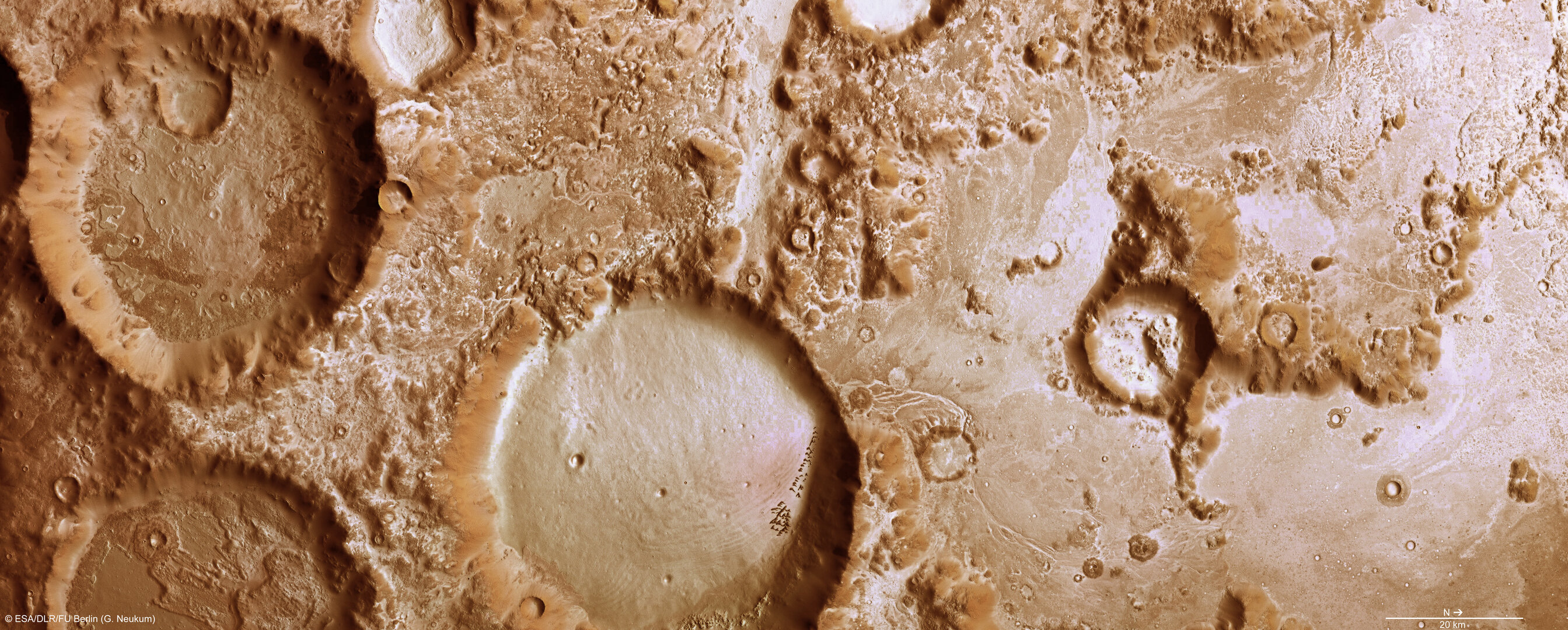
High-Resolution Stereo Camera (HRSC) nadir and colour channel data taken during revolution 10778 on 18 June 2012 by ESA’s Mars Express have been combined to form a natural-colour view of Charitum Montes. Centred at around 53°S and 334°E, the image has a ground resolution of about 20 m per pixel. The heavily cratered region in this image is at the edge of the almost 1000 km long mountain range, which itself wraps around the boundary of the Argyre impact basin, the second largest on Mars.
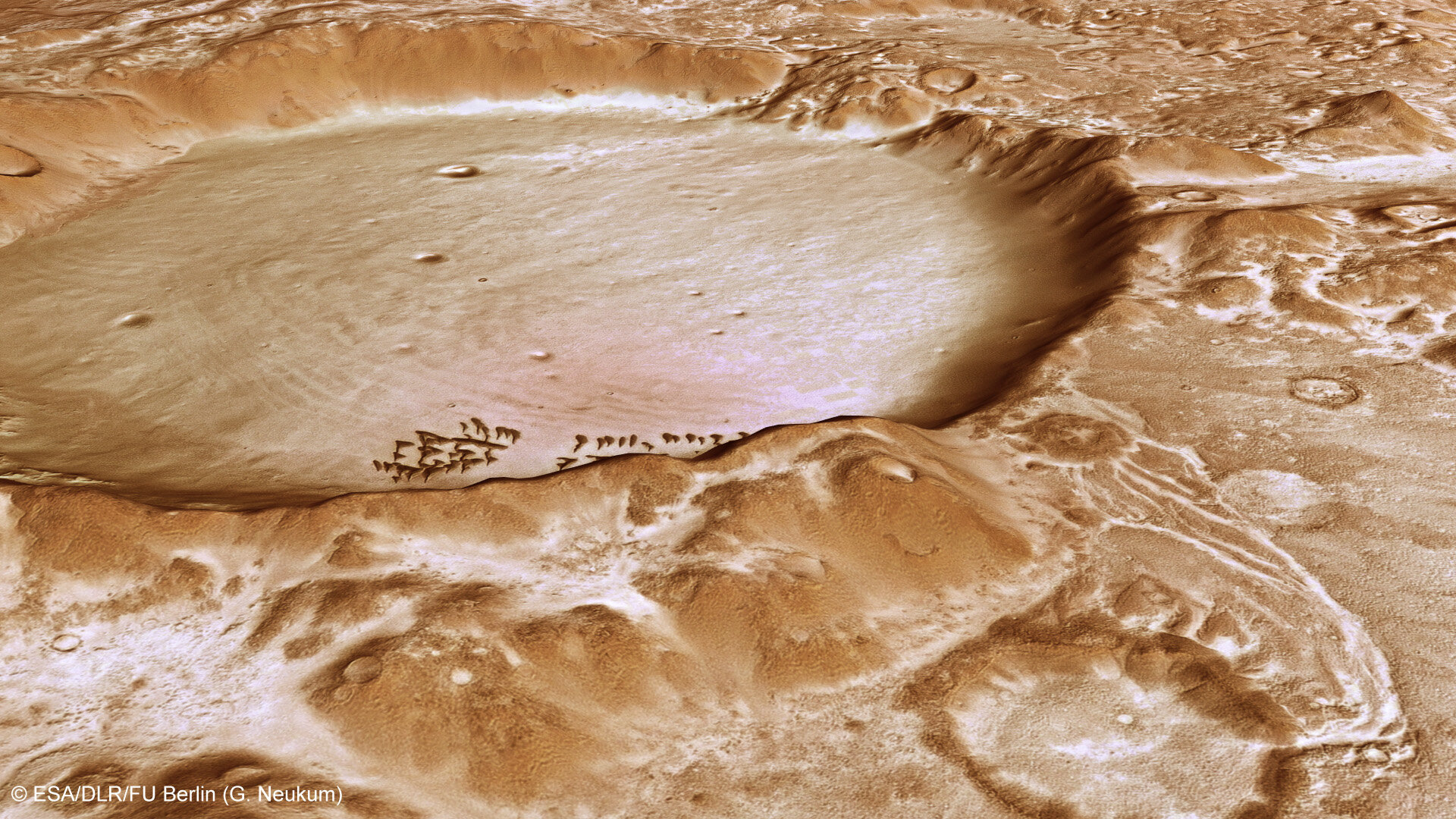
This computer-generated perspective view was created using data obtained from the High-Resolution Stereo Camera (HRSC) on ESA’s Mars Express. Centred at around 53°S and 334°E, the image has a ground resolution of about 20 m per pixel. This perspective view shows the breach on the northern side of the 50 km-wide crater that dominates the image. Dendritic patterns link to completely filled-in craters that flank the larger one, within which a small sand dune follows the contours of concentric sedimentary pattern. This image was taken during revolution 10778 on 18 June 2012.
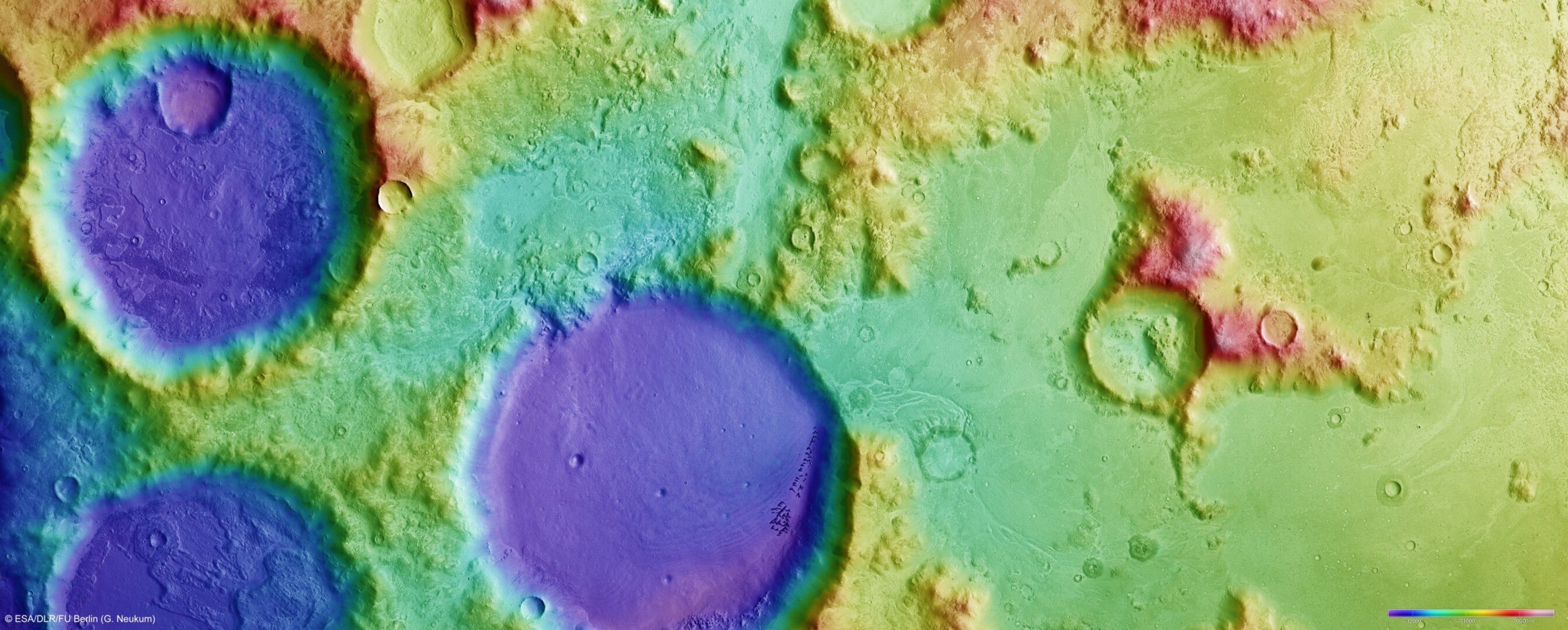
This colour-coded overhead view is based on an ESA Mars Express HRSC digital terrain model of the region, from which the topography of the landscape can be derived. The colour coding shows the very edge of the Charitum Montes mountain region at the top of the image, with the highest elevation, while the subtle pedestal craters that dot the image almost fade away with just a small amount of relief difference between the elevated ejecta and the surrounding area. Centred at around 53°S and 334°E, the image has a ground resolution of about 20 m per pixel. The image was taken during revolution 10778 on 18 June 2012.
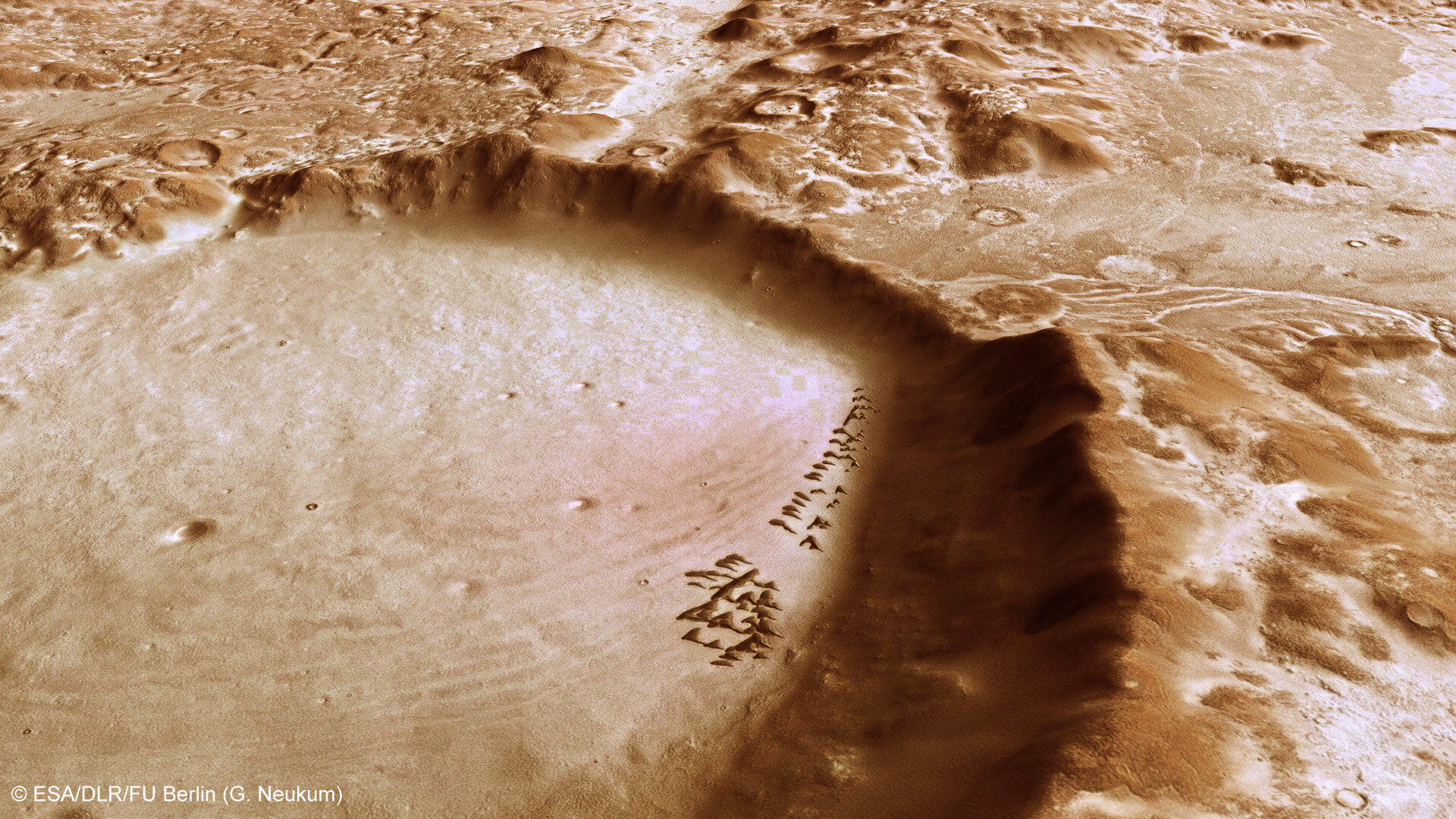
This computer-generated perspective view of Charitum Montes was created using data obtained from the High-Resolution Stereo Camera (HRSC) on ESA’s Mars Express. Centred at around 53°S and 334°E, the image has a ground resolution of about 20 m per pixel. The image shows the large breach in the northern wall of the crater, located near to the uppermost sand dune. The dusting of carbon dioxide ice is a seasonal feature in this region, which covers the crater floor and the surrounding plains.
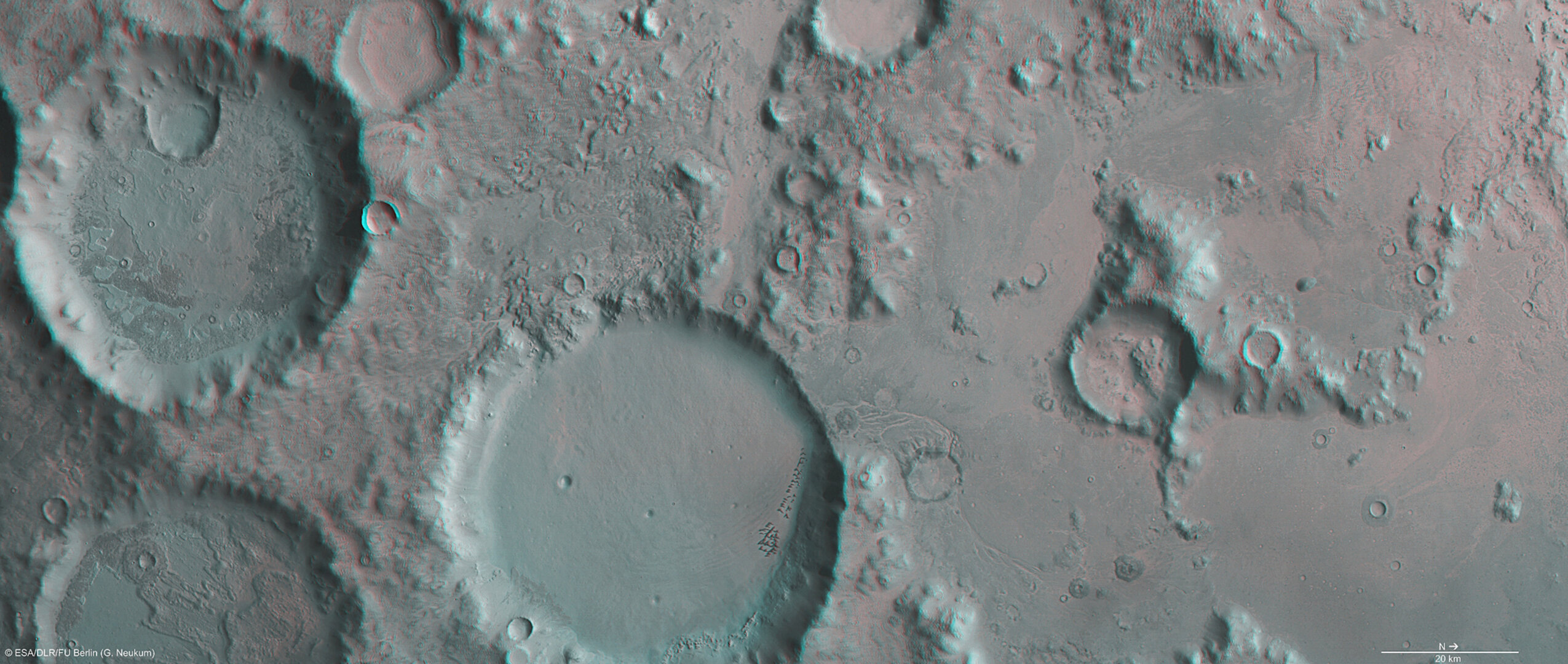
Charitum Montes imaged during revolution 10778 on 18 June 2012 by ESA’s Mars Express using the High-Resolution Stereo Camera (HRSC). Data from HRSC’s nadir channel and one stereo channel have been combined to produce this anaglyph 3D image that can be viewed using stereoscopic glasses with red–green or red–blue filters. Centred at around 53°S and 334°E, the image has a ground resolution of about 20 m per pixel
![[1/5] Charitum Montes](/var/esa/storage/images/esa_multimedia/images/2012/11/charitum_montes/12165704-1-eng-GB/Charitum_Montes_latestnews.jpg)
![[2/5] Perspective view of Charitum Montes](/var/esa/storage/images/esa_multimedia/images/2012/11/perspective_view_of_charitum_montes2/12165537-1-eng-GB/Perspective_view_of_Charitum_Montes_latestnews.jpg)
![[3/5] Topographic view of Charitum Montes](/var/esa/storage/images/esa_multimedia/images/2012/12/topographic_view_of_charitum_montes/12176047-1-eng-GB/Topographic_view_of_Charitum_Montes_latestnews.jpg)
![[4/5] Perspective view of Charitum Montes](/var/esa/storage/images/esa_multimedia/images/2012/11/perspective_view_of_charitum_montes/12165481-1-eng-GB/Perspective_view_of_Charitum_Montes_latestnews.jpg)
![[5/5] 3D view of Charitum Montes](/var/esa/storage/images/esa_multimedia/images/2012/11/3d_view_of_charitum_montes/12165397-1-eng-GB/3D_view_of_Charitum_Montes_latestnews.jpg)
Rate this
Views
Share
- Currently 4 out of 5 Stars.
- 1
- 2
- 3
- 4
- 5
Rating: 4/5 (5 votes cast)Thank you for rating!
You have already rated this page, you can only rate it once!
Your rating has been changed, thanks for rating!