• → European Space Agency

      • Space for Europe
      • Space News
      • Space in Images
      • Space in Videos
    • About Us

      • Welcome to ESA
      • DG's News and Views
      • For Member State Delegations
      • Business with ESA
      • ESA Exhibitions
      • ESA Publications
      • Careers at ESA
    • Our Activities

      • Space News
      • Observing the Earth
      • Human Spaceflight
      • Launchers
      • Navigation
      • Space Science
      • Space Engineering
      • Operations
      • Technology
      • Telecommunications & Integrated Applications
    • For Public

    • For Media

      • Media
      • ESA TV
      • Videos for professionals
      • Photos
    • For Educators

    • For Kids

    • ESA

    • Space Science

    • [1/5] Southeast of Amenthes Planum
    • [2/5] Valley feeding Palos Crater
    • [3/5] Trough feeding Amenthes Planum
    • [4/5] Amenthes Planum topography
    • [5/5] Amenthes Planum in 3D

    Southeast of Amenthes Planum
    Southeast of Amenthes Planum

    High-Resolution Stereo Camera nadir and colour channel data taken during revolution 11497 on 13 January 2013 by ESA’s Mars Express have been combined to form a natural-colour view of the region southeast of Amenthes Planum and north of Hesperia Planum. The region imaged, which lies to the west of Tinto Vallis and Palos crater, is centred at around 3°S and 109°E, and has a ground resolution of about 22 m per pixel.

    The image features craters, lava channels and a valley from which water may have once flowed. Dark wind-blown sediments fill the valleys and the floors of the craters.

    Credits: ESA/DLR/FU Berlin (G. Neukum)
    Valley feeding Palos Crater
    Valley feeding Palos Crater

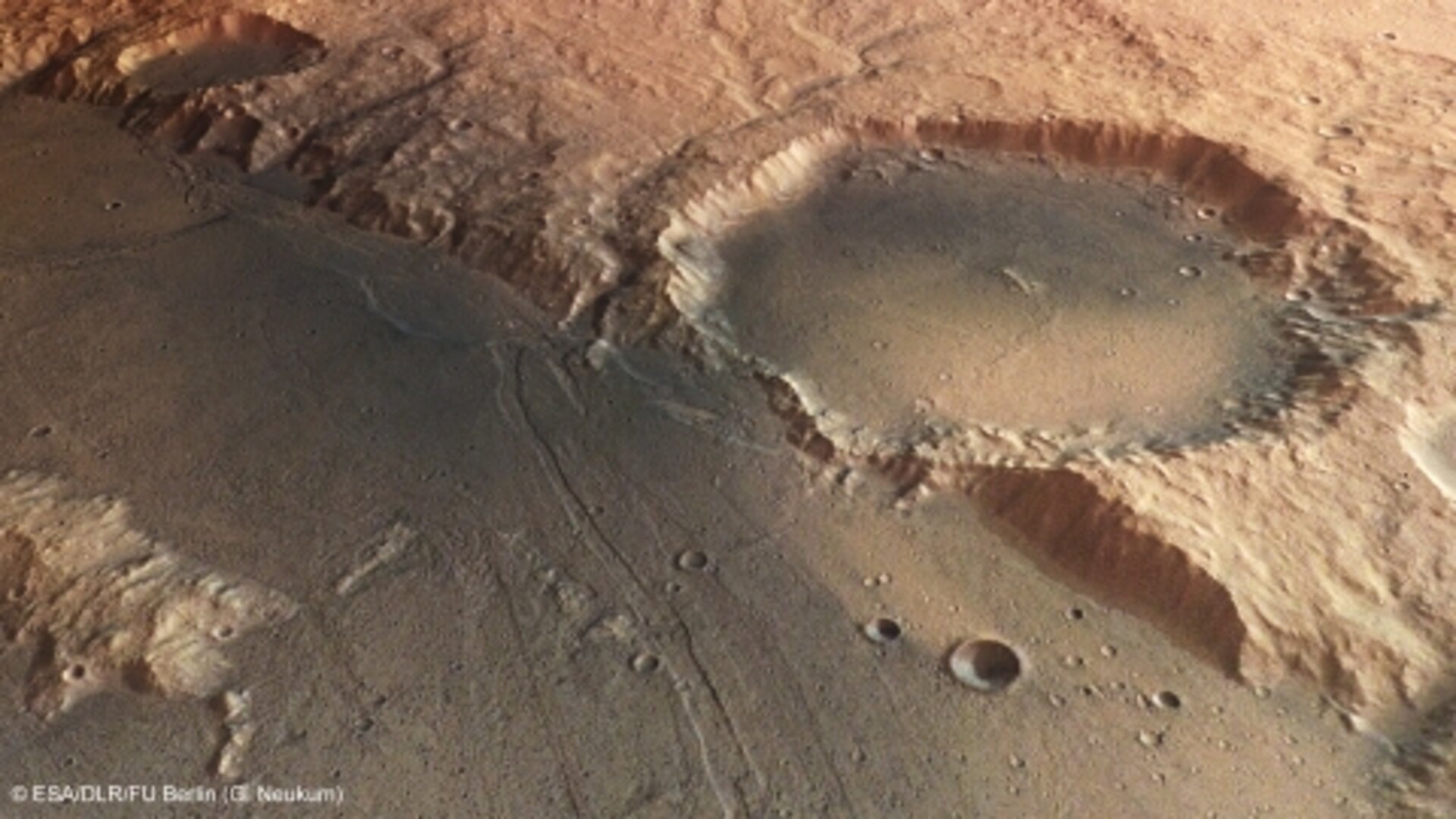
    This computer-generated perspective view of a network of short valleys feeding Palos crater was created using data from the High-Resolution Stereo Camera on ESA’s Mars Express. Taken during revolution 11497 and centred at around 3°S and 109°E, the image has a ground resolution of about 22 m per pixel. The valley’s U-shaped cross section is indicative of a process called groundwater sapping, whereby volcanic heat has melted subsurface ice, liberating water to the surface and causing the ground around it to collapse. The top left of the image is the periphery of a 100 km-wide crater.

    Credits: ESA/DLR/FU Berlin (G. Neukum)
    Trough feeding Amenthes Planum
    Trough feeding Amenthes Planum

    Computer-generated perspective view of the southeastern corner of the volcanic plains of Amenthes Planum, This view was created using data obtained from the High-Resolution Stereo Camera on ESA’s Mars Express. Imaged during revolution 11497 on 13 January 2013 and centred at around 3°S and 109°E, the image has a ground resolution of about 22 m per pixel. The image shows a 30 km-wide crater, the north eastern rim of which rests against a smooth volcanic trough that may have once transported fluvial and volcanic materials from Palos crater and Tinto Vallis into Amenthes Planum.

    Credits: ESA/DLR/FU Berlin (G. Neukum)
    Amenthes Planum topography
    Amenthes Planum topography

    This colour-coded overhead view is based on an ESA Mars Express High-Resolution Stereo Camera digital terrain model of the region southeast of Amenthes Planum and north of Hesperia Planum, from which the topography of the landscape can be derived. Centred at around 3°S and 109°E, the image has a ground resolution of about 22 m per pixel. The image was taken during revolution 11497 on 13 January 2013. The colour coding emphasises the superposed craters on the large 100 km-wide crater to the left (south) of the image. Also more clearly seen are the various mesa and buttes within the larger 100 km crater. At the bottom of the image is a small river valley that feeds into Palos crater, which may once have hosted a lake. 

    Credits: ESA/DLR/FU Berlin (G. Neukum)
    Amenthes Planum in 3D
    Amenthes Planum in 3D

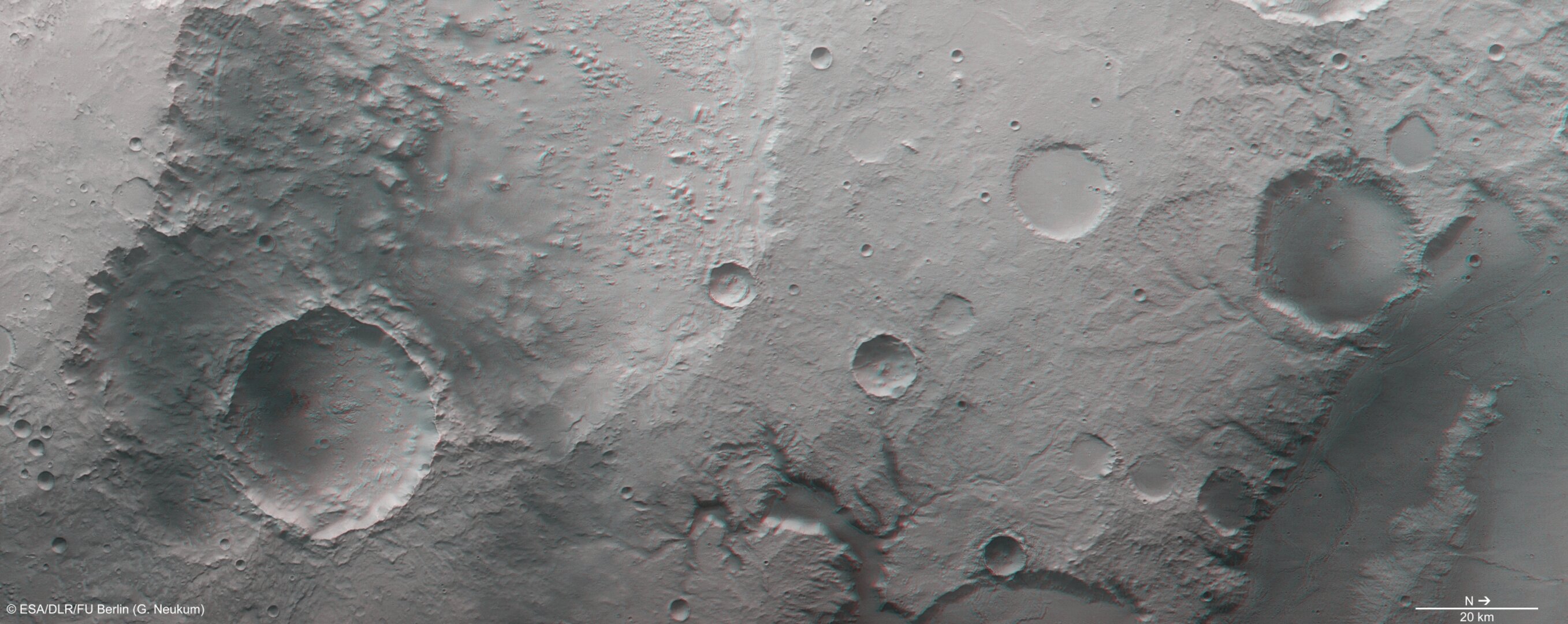
    The region southeast of Amenthes Planum and north of Hesperia Planum imaged during revolution 11497 on 13 January 2013 by ESA’s Mars Express using the High-Resolution Stereo Camera (HRSC). Data from HRSC’s nadir channel and one stereo channel have been combined to produce this anaglyph 3D image that can be viewed using stereoscopic glasses with red–green or red–blue filters. Centred at around 3°S and 109°E, the image has a ground resolution of about 22 m per pixel. 

    Credits: ESA/DLR/FU Berlin (G. Neukum)

    Mars images

    New images of the Red Planet's Amenthes region by ESA's Mars Express

    Access the image

    Access the image

    Access the image

    Access the image

    Access the image

    Rate this

    Views

    Share

    • Currently 5 out of 5 Stars.
    • 1
    • 2
    • 3
    • 4
    • 5
    Rating: 4.88/5 (9 votes cast)

    Thank you for rating!

    You have already rated this page, you can only rate it once!

    Your rating has been changed, thanks for rating!

    2824
    Tweet

    Connect with us

    • RSS
    • Youtube
    • Twitter
    • Flickr
    • G+
    • Facebook
    • Livestream
    • Subscribe
    • App Store
    • ESA Science Twitter

    Follow ESA science

    • LATEST ARTICLES
    • · Rare merger reveals secrets of gal…
    • · Watching for hazards: ESA opens as…
    • · ESA astronaut Timothy Peake set fo…
    • · Space drives e-mobility
    • · Proba-V opens its eyes
    • FAQ

    • Jobs at ESA

    • Site Map

    • Contacts

    • Terms and conditions