• → European Space Agency

      • Space for Europe
      • Space News
      • Space in Images
      • Space in Videos
    • About Us

      • Welcome to ESA
      • DG's News and Views
      • For Member State Delegations
      • Business with ESA
      • ESA Exhibitions
      • ESA Publications
      • Careers at ESA
    • Our Activities

      • Space News
      • Observing the Earth
      • Human Spaceflight
      • Launchers
      • Navigation
      • Space Science
      • Space Engineering
      • Operations
      • Technology
      • Telecommunications & Integrated Applications
    • For Public

    • For Media

    • For Educators

    • For Kids

    • ESA

    • Integral

    • ESA Science

    • Integral in brief
    • Integral overview
    • Integral factsheet
    • A truly international mission
    • About Integral
    • The spacecraft
    • The launcher
    • The launch site - Baikonur
    • The journey
    • Integral's mission

      • What's special?
      • Why do we observe gamma rays?
      • Observations: Seeing in the gamma-ray wavelengths
      • The atoms that make us
      • The densest objects in the Universe
      • Giant black holes
      • Gamma-ray bursts (GRBs)
    • Multimedia
    • Image gallery
    • Pre-launch images, Sept 2002
    • Pre-launch images, October 2002
    • Video gallery
    • 3D Flash 'model'
    • Make a model

    ESA > Our Activities > Space Science > Integral

    The densest objects in the Universe

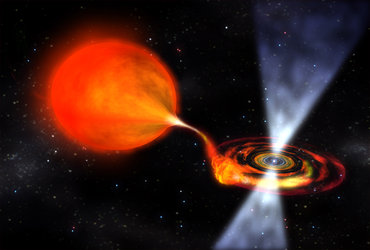
    A stellar black hole can be seen when it rips a companion star to pieces

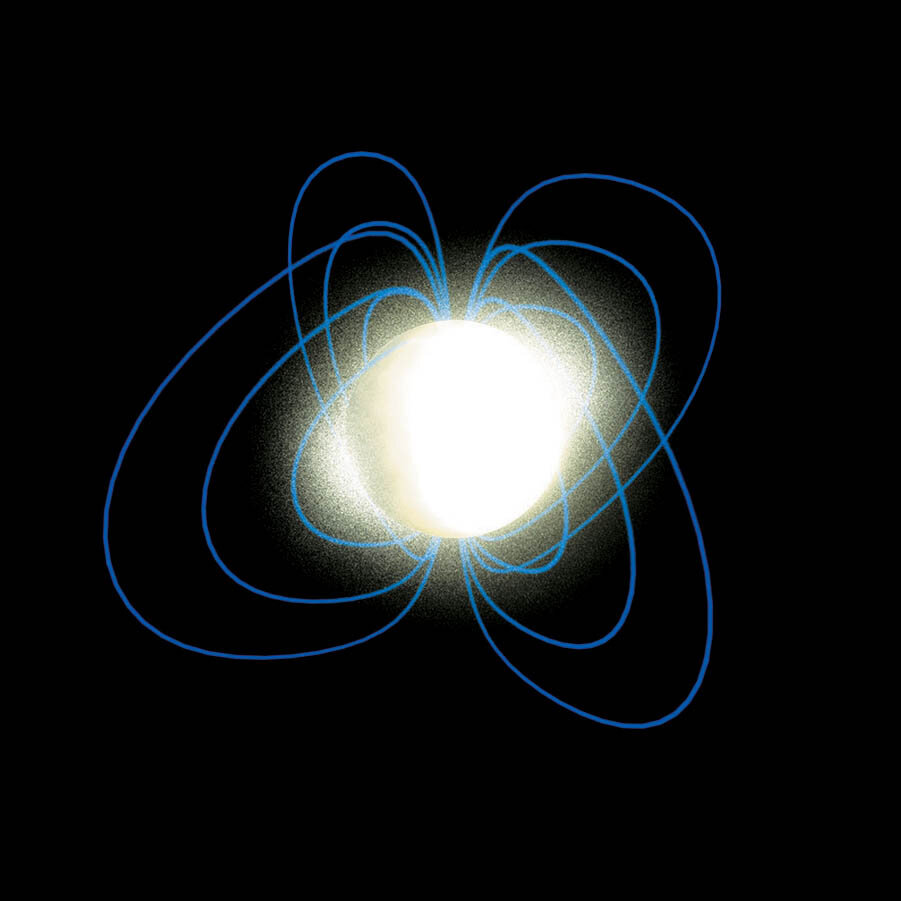
    When a massive star explodes, not all the material is ejected into space. Some of it collapses into an extremely compact object known as a neutron star, inside which gravitational forces crush protons and electrons together, turning them into particles known as neutrons.

    A neutron star contains a few solar masses of material squeezed into a radius of only 20 km. This means the matter is so compressed that a thimble full of it would weigh millions of tonnes on Earth. Fast-spinning neutron stars, whose radio emissions seem to pulse on and off, are called pulsars.
    Beyond the mass limit of a neutron star - about three solar masses - gravity becomes overwhelming and collapses the star even further, creating a black hole. These are perhaps the strangest objects in the Universe because nothing, not even light, can escape from inside a black hole. So, the presence of a black hole can only be inferred by its effect on surrounding celestial objects and other interstellar material.

    A neutron star
    A neutron star

    Virtually all types of compact objects are significant sources of high-energy emission because of the enormous gravitational fields they tend to generate. Gravitational fields can accelerate particles in the vicinity to extreme velocities, which then emit gamma rays and X-rays.

    Integral will capture images of the high-energy emission from such compact objects with unprecedented detail, allowing astronomers a clearer look than ever before at these enigmatic objects.
    Last update: 15 October 2002

    Rate this

    Views

    Share

    • Currently 0 out of 5 Stars.
    • 1
    • 2
    • 3
    • 4
    • 5
    Rating: 0/5 (0 votes cast)

    Thank you for rating!

    You have already rated this page, you can only rate it once!

    Your rating has been changed, thanks for rating!

    1035
    Tweet
    • Artist's view of Integral
      Artist's view of Integral
      ESA's gamma-ray astronomy mission
      • Observations: Seeing in the gamma-ray wavelengths
        • Observations: Seeing in X-ray wavelengths
        • Related links
        • Sci & Tech Integral page
        • Integral Science Operations Centre
        • Integral Science Data Centre
        • Integral video
        • The densest objects in the Universe

    Connect with us

    • RSS
    • Youtube
    • Twitter
    • Flickr
    • G+
    • Facebook
    • Livestream
    • Subscribe
    • App Store
    • LATEST ARTICLES
    • · Proba-V opens its eyes
    • · First new Galileo satellite arrive…
    • · Next destination: space
    • · Leak repaired on International Spa…
    • · After Chelyabinsk: European expert…
    • FAQ

    • Jobs at ESA

    • Site Map

    • Contacts

    • Terms and conditions