• → European Space Agency

      • Space for Europe
      • Space News
      • Space in Images
      • Space in Videos
    • About Us

      • Welcome to ESA
      • DG's News and Views
      • For Member State Delegations
      • Business with ESA
      • ESA Exhibitions
      • ESA Publications
      • Careers at ESA
    • Our Activities

      • Space News
      • Observing the Earth
      • Human Spaceflight
      • Launchers
      • Navigation
      • Space Science
      • Space Engineering
      • Operations
      • Technology
      • Telecommunications & Integrated Applications
    • For Public

    • For Media

      • Media
      • ESA TV
      • Videos for professionals
      • Photos
    • For Educators

    • For Kids

    • ESA

    • Integral

    • ESA Science

    • Integral in brief
    • Integral overview
    • Integral factsheet
    • A truly international mission
    • About Integral
    • The spacecraft
    • The launcher
    • The launch site - Baikonur
    • The journey
    • Integral's mission

      • What's special?
      • Why do we observe gamma rays?
      • Observations: Seeing in the gamma-ray wavelengths
      • The atoms that make us
      • The densest objects in the Universe
      • Giant black holes
      • Gamma-ray bursts (GRBs)
    • Multimedia
    • Image gallery
    • Pre-launch images, Sept 2002
    • Pre-launch images, October 2002
    • Video gallery
    • 3D Flash 'model'
    • Make a model

    ESA > Our Activities > Space Science > Integral

    The spacecraft

    SPI will gauge gamma-ray energies with exceptional precision

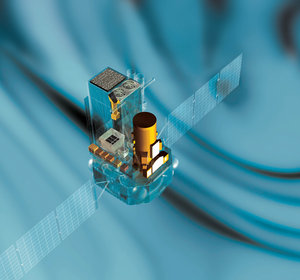
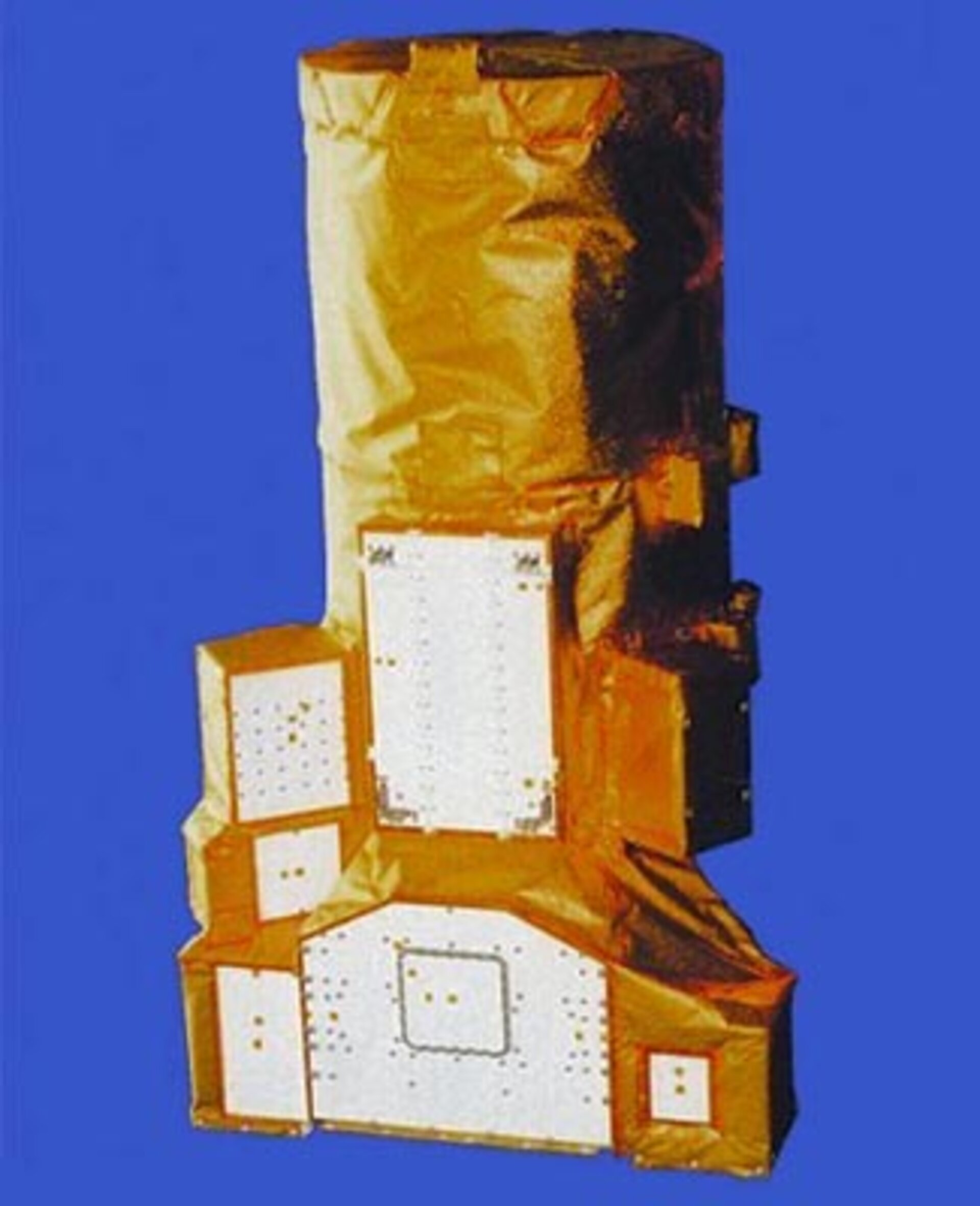
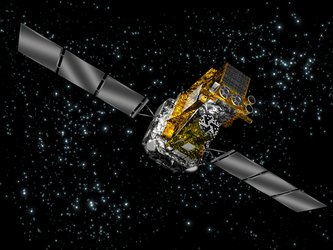
    Standing 5 metres high and more than 4 tonnes in weight, the Integral spacecraft is impressive. The satellite has two main parts. The service module is the lower part of the satellite and contains all spacecraft subsystems. The payload module is mounted on the service module and carries the scientific instruments.

    To limit the costs of the mission the service module is a rebuild of the one developed for XMM-Newton, ESA's X-ray Multi-Mirror satellite. It is a closed structure made of composite material, a combination of aluminium and carbon fibre. It houses the satellite systems, including solar power generation, power conditioning and control, data handling, telecommunications and thermal, attitude and orbit control.
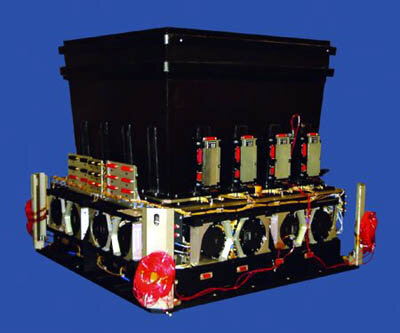
    The sharpest gamma-ray images to this day will come from IBIS

    The four scientific instruments of Integral's payload module weigh 2 tonnes, making this payload the heaviest ever placed in orbit by ESA. This is due to the need to shield the detectors from background radiation in order to make them sensitive. There are two main instruments detecting gamma rays. An imager will give the sharpest gamma-ray images so far. A spectrometer will gauge gamma-ray energies extremely precisely. Two other instruments, an X-ray monitor and an optical camera, will help to identify the gamma-ray sources.

    There is a special support structure 4 metres above the platform with the instrument detectors. This carries so-called 'coded masks'. These metal masks produce the images of the gamma-ray sources. Since gamma rays cannot be focussed by conventional lenses or mirrors, Integral has to use an entirely different technique to make its images, known as the coded mask technique. A coded-mask telescope is a pinhole camera with not just one but many pinholes.
    Last update: 14 September 2004

    Rate this

    Views

    Share

    • Currently 0 out of 5 Stars.
    • 1
    • 2
    • 3
    • 4
    • 5
    Rating: 0/5 (0 votes cast)

    Thank you for rating!

    You have already rated this page, you can only rate it once!

    Your rating has been changed, thanks for rating!

    103
    Tweet
    • Artist's view of Integral
      Artist's view of Integral
      ESA's gamma-ray astronomy mission
      • Observations: Seeing in the gamma-ray wavelengths
        • Observations: Seeing in X-ray wavelengths
        • Related links
        • Sci & Tech Integral page
        • Integral Science Operations Centre
        • Integral Science Data Centre
        • Integral video
        • Integral spacecraft

    Connect with us

    • RSS
    • Youtube
    • Twitter
    • Flickr
    • G+
    • Facebook
    • Livestream
    • Subscribe
    • App Store
    • LATEST ARTICLES
    • · Rare merger reveals secrets of gal…
    • · Watching for hazards: ESA opens as…
    • · ESA astronaut Timothy Peake set fo…
    • · Space drives e-mobility
    • · Proba-V opens its eyes
    • FAQ

    • Jobs at ESA

    • Site Map

    • Contacts

    • Terms and conditions