• → European Space Agency

      • Space for Europe
      • Space News
      • Space in Images
      • Space in Videos
    • About Us

      • Welcome to ESA
      • DG's News and Views
      • For Member State Delegations
      • Business with ESA
      • ESA Exhibitions
      • ESA Publications
      • Careers at ESA
    • Our Activities

      • Space News
      • Observing the Earth
      • Human Spaceflight
      • Launchers
      • Navigation
      • Space Science
      • Space Engineering
      • Operations
      • Technology
      • Telecommunications & Integrated Applications
    • For Public

    • For Media

    • For Educators

    • For Kids

    • ESA

    • Space Science

    JWST overview

    JWST logo Status

    Under development

    Objective

    Successor to Hubble, the James Webb Space Telescope (JWST) will help us to find out more about the origins of the Universe by observing infrared light from the first stars and galaxies and will show us in detail how stars and planets form.

    Don't click here, use the red link ->> Bookmark this page as:


    For more in-depth scientific and technical details of our Space Science Programme and missions, follow this link.
    JWST in depth
    • Our Universe
    • About Space Science
    • ESA's 'Cosmic Vision'
    • Science missions
    • Mission navigator
    • Target groups
    • For Media
    • For Scientists
    • For Kids
    • Multimedia
    • Science images
    • Science videos
    • Animations
    • Downloads
    • Sounds from space
    • Resources
    • Reference section
    • Services
    • FAQs
    • Glossary
    • Help
    • Portal terms of use
    • Comments
    • ESA Press Releases
    • Follow us
    • RSS feeds
    • ESA Sci on Twitter
    • ESA Space Science Images on Flickr
    • ESA 3D on Flickr

    ESA > Our Activities > Space Science

    JWST

    Mission

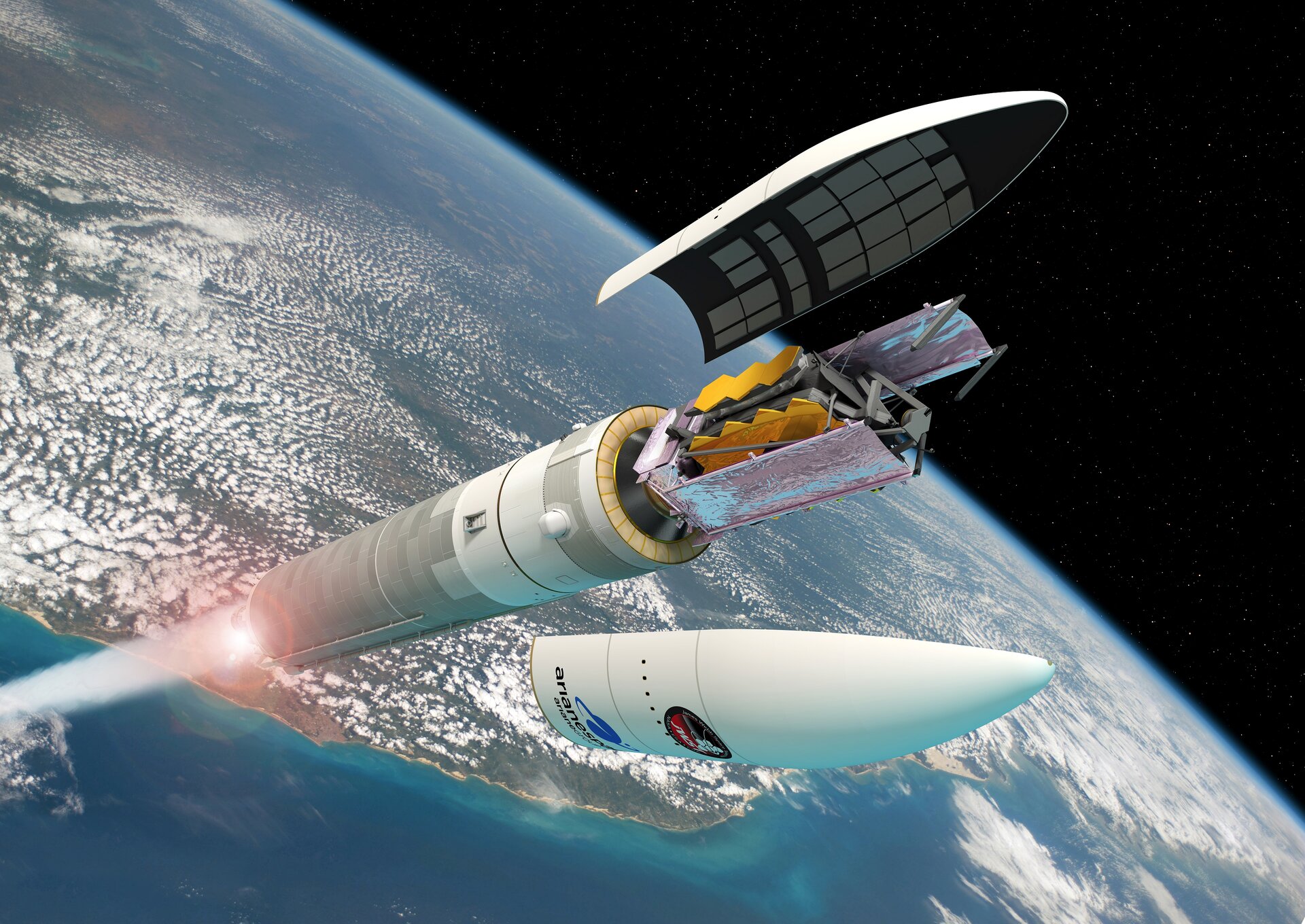
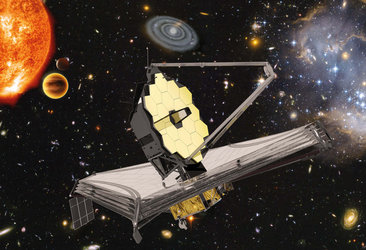
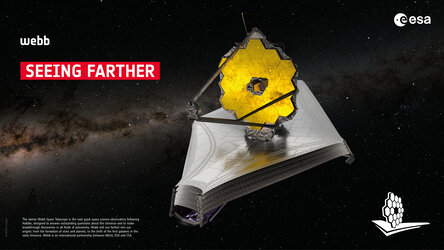
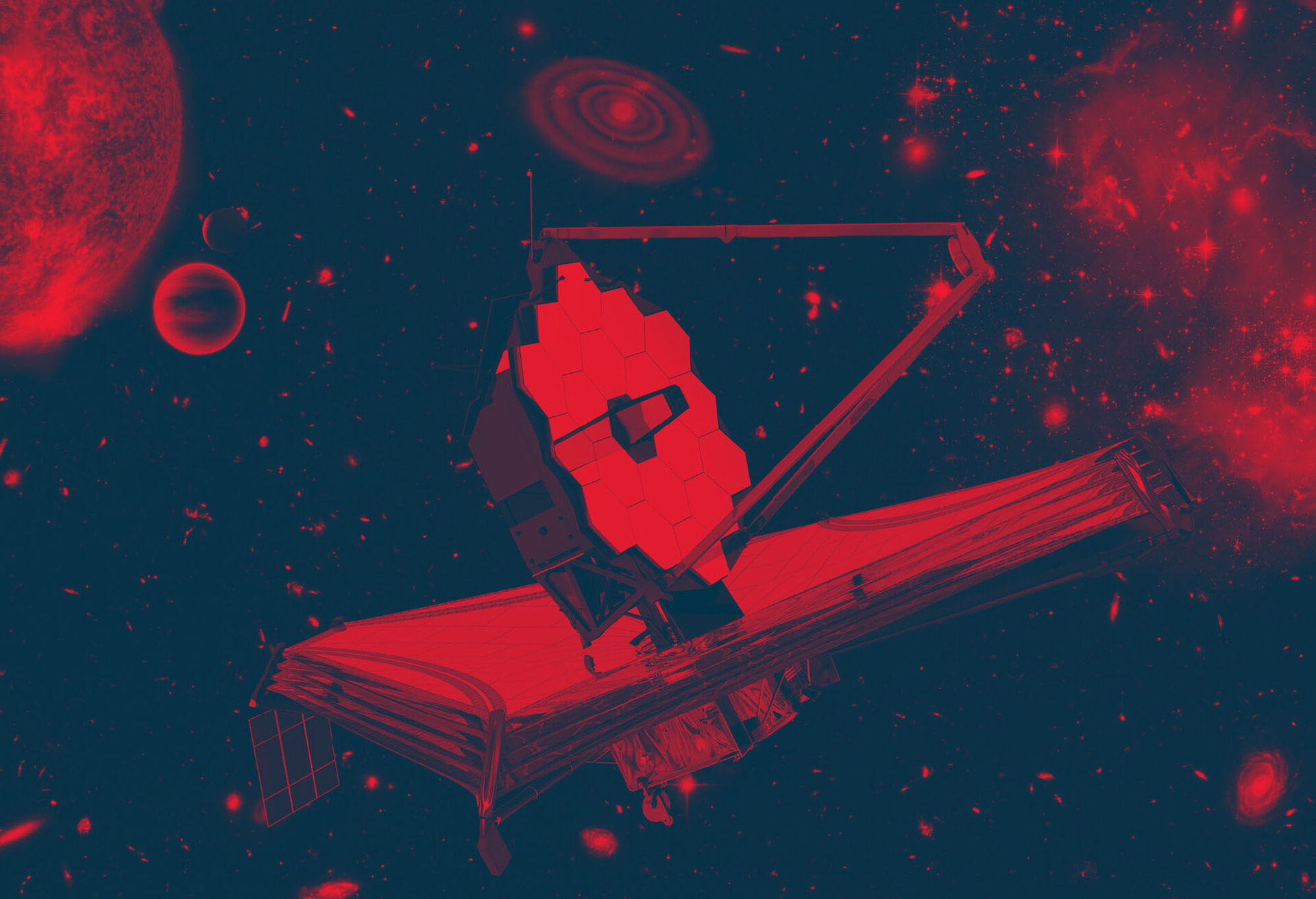
    September 2009 artist conception of JWST.

    The James Webb Space Telescope (JWST) is designed to expand the scientific success of the Hubble Space Telescope. Being a 'cool' telescope, JWST is designed to operate at very low temperatures (around -230° C). This will give it an unprecedented view of the Universe at infrared wavelengths and will allow it to observe a wide variety of celestial objects, ranging from planets in the Solar System to nearby stars, from neighbouring galaxies to galaxy clusters, and out to the farthest reaches of the very distant Universe. It is planned to operate for five years, possibly ten.

    What’s special?

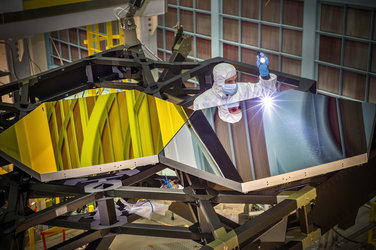
    JWST is also very big, as its primary mirror has an area seven times larger than that of Hubble, which will make it much more sensitive. JWST will combine superb image quality, a large field of view, and a low level of background light with a highly stable environment away from the turbulence of the Earth's atmosphere that blurs images collected on the ground. All of these characteristics set JWST apart from other existing or planned observatories and will be instrumental in the search for the faintest stars and galaxies.

    Spacecraft

    September 2009 artist conception of JWST.

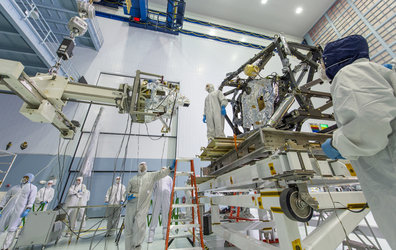
    JWST will be launched on board an Ariane V ECA rocket from the European Spaceport of Kourou, in French Guiana. One technical challenge is trying to pack a 6.5-m spacecraft into a 5 m diameter rocket, described as ‘a bit like designing a ship in a bottle’. Besides the telescope mirrors, the spacecraft, and the large sun shield, the JWST observatory has four scientific instruments mounted behind the telescope itself:

    The Near Infrared Camera (NIRCam) is mainly designed for imaging studies and the detection of faint objects. The topics for which NIRCam will be invaluable include the search for the first stars, star clusters and galaxy cores that formed after the Big Bang; the study of far distant galaxies seen in the process of formation or merging; the detection of light distortion due to dark matter; the discovery of supernovae in remote galaxies; studies of the stellar population in nearby galaxies, of young stars in the Milky Way and of Kuiper Belt objects in our Solar System.

    The Near-Infrared Spectrograph (NIRSpec) will obtain spectra of more than 100 galaxies or stars simultaneously and is sensitive over a wavelength range that matches the peak emission from the most distant galaxies. The key scientific objectives of NIRSpec are the study of star formation and chemical abundances of young distant galaxies; tracing the creation of the chemical elements back in time; exploring the history of the intergalactic medium, i.e. the gaseous material that fills the vast volumes of space between the galaxies; characterising the atmospheres of extra-solar planets.

    The Mid-Infrared Camera and Spectrograph (MIRI) is an essential tool for studying extremely old and distant stellar populations; regions of intense star formation that are hidden behind thick layers of obscuring dust; hydrogen emission from previously unthinkable distances; the physics of protostars; Kuiper Belt objects and faint comets.

    The Fine Guidance Sensor (FGS) will provide high-precision signals to the observatory to enable stable pointing at the milli-arcsecond level. It will also support star field identification via correlation with a star catalogue as well as spatial and radiometric calibrations.

    Journey

    JWST must be cooled so that the instruments’ own infrared emission cannot overwhelm the faint signals from observed objects. The JWST orbit will be 1.5 million km away from Earth, at Lagrange Point 2 (L2), so it must be extremely reliable, even though it is using new and innovative technology, because it will be too far away for astronauts to service it.

    History

    The James Webb Space Telescope was formerly known as the Next Generation Space Telescope (NGST). Due for launch on an Ariane 5, it will follow in HST’s footsteps. ESA has participated actively in both missions from the very beginning, bringing huge scientific benefits to European astronomers, while promoting competitiveness and cross-border collaboration within European science as a whole. NASA and ESA, joined by the Canadian Space Agency, have collaborated on JWST since 1997.

    Partnerships

    JWST is a partnership between ESA, NASA and the Canadian Space Agency.

    Last update: 14 November 2011

    • More about...
      • JWST factsheet
        • Hubble factsheet
        • Related articles
          • ESA on the trail of the earliest stars
            • Observations: Seeing in infrared wavelengths

    Connect with us

    • RSS
    • Youtube
    • Twitter
    • Flickr
    • Google Buzz
    • Subscribe
    • App Store
    • ESA Science Twitter

    Follow ESA science

    • LATEST ARTICLES
    • · CryoSat hits land
    • · Ariane 5 completes seven launches …
    • · Measuring skull pressure without t…
    • · Malargüe station inauguration
    • · The solar wind is swirly
    • FAQ

    • Jobs at ESA

    • Site Map

    • Contacts

    • Terms and conditions