Webb factsheet
Overview of the James Webb Space Telescope (Webb) mission
Mission Exploring the Universe from the solar neighbourhood to the most distant galaxies.
Name The James Webb Space Telescope (JWST, or Webb) honours NASA's second administrator, James E. Webb, who headed the agency during part of the Apollo era, from February 1961 to October 1968. The mission was previously known as the Next Generation Space Telescope (NGST).
Partnership Webb is a joint project between NASA, ESA and the Canadian Space Agency (CSA).
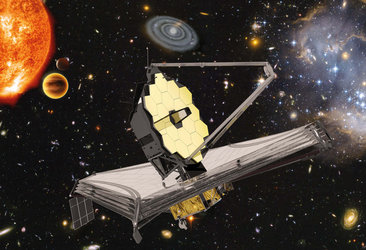
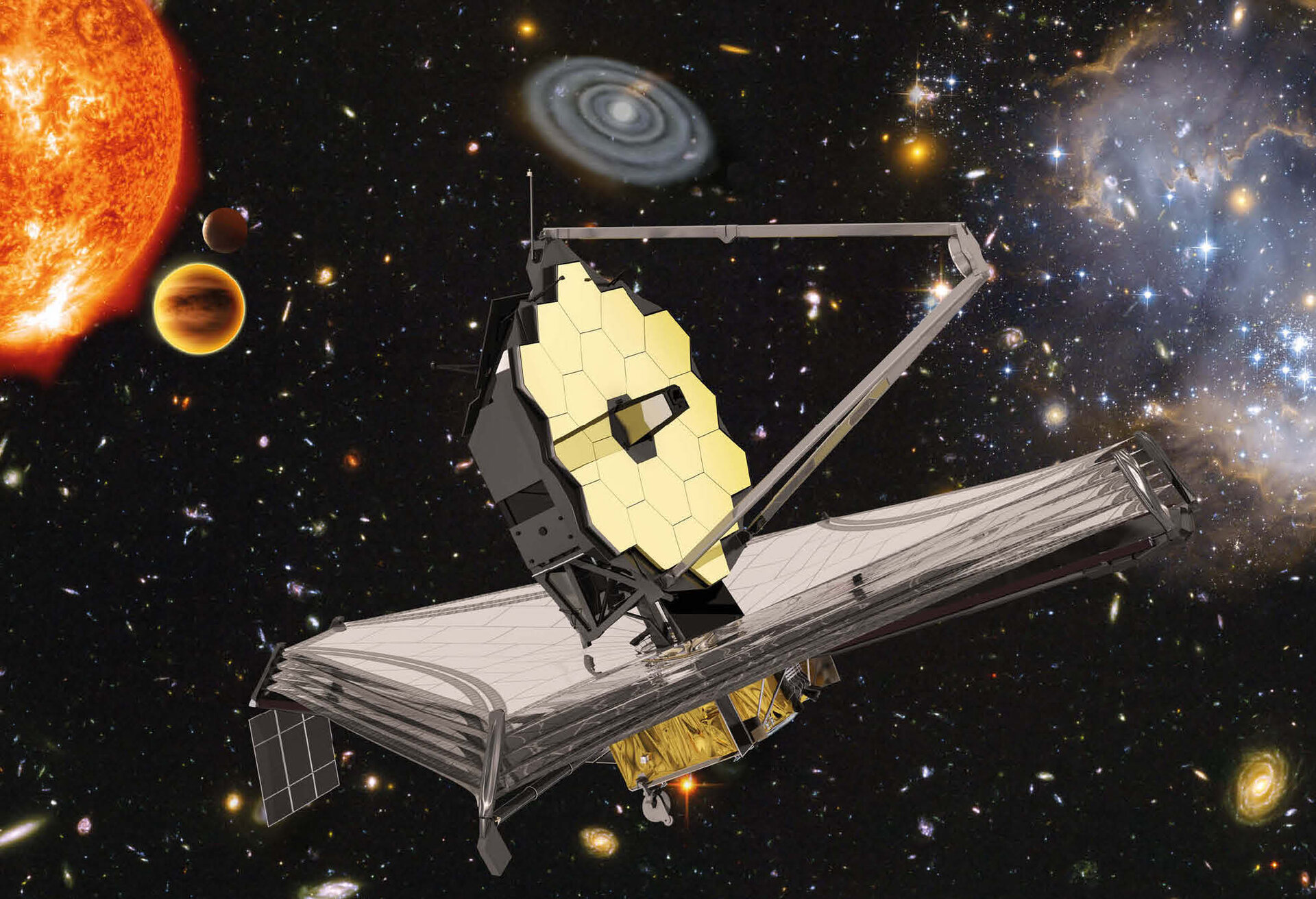
Description Webb is a major space observatory often presented as the successor to the very successful NASA/ESA Hubble Space Telescope (HST, or Hubble). It has a large 6.5-metre segmented mirror that collects almost six times more light than Hubble. It has also been designed to work with infrared light. It addresses a broad variety of scientific topics ranging from detecting the first galaxies in the Universe to studying planets around other stars.
Instruments Webb carries four state-of-the-art science instruments: the MIRI mid-infrared camera and spectrograph, the NIRSpec near-infrared spectrograph, the NIRCam near-infrared camera, and the FGS-NIRISS combined fine guidance sensor and near-infrared imager and slitless spectrograph.
Launch The telescope launched on 25 December 2021 on an Ariane 5 ECA rocket from Europe's Spaceport in French Guiana.
Journey and orbit Since launch and one month on a transfer trajectory, the observatory has operated at approximately 1.5 million kilometres from Earth, in an orbit around the second Lagrange point of the Sun-Earth system, L2.
European contribution The four major contributions of Europe to the mission are: the provision of the NIRSpec instrument; the provision of the MIRI instrument optical bench assembly; the provision of the launcher; and the provision of manpower to support Webb's operation. In return for these contributions, European scientists get a minimum share of 15% of the total observing time, like for Hubble.
Webb mission facts
Launch mass: 6200 kg, including observatory, on-orbit consumables and launch vehicle adaptor
The wavelength range covered by Webb's scientific instruments is about 0.6 μm to 28 μm (visible to mid-infrared light). By comparison, the Hubble Space Telescope observes at 0.1–2.5 microns (ultraviolet to the near infrared).
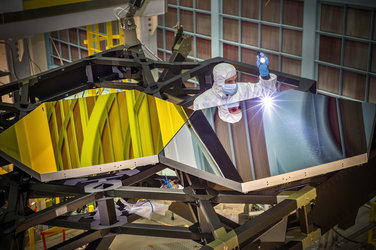
Webb has a segmented primary mirror with a diameter of 6.5 metres that collects almost six times more light than the Hubble Space Telescope.
A giant, five layered shield protects the telescope and the instruments from the light and heat of the Sun. At 22×12 metres, this is about the size of a tennis court. The shield keeps the telescope and its instruments permanently in the shade where they will cool down to –233 °C.
The mid-infrared instrument MIRI is cooled down even further, to –266 °C by using an innovative cooling system
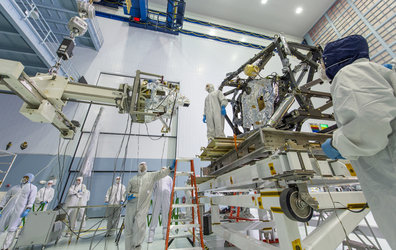
Webb scientists have described packing a 6.5-metre telescope equipped with a sun-shield the size of a tennis court into a small rocket fairing with a diameter of five metres as 'a bit like designing a ship in a bottle'.