J - K - L
J
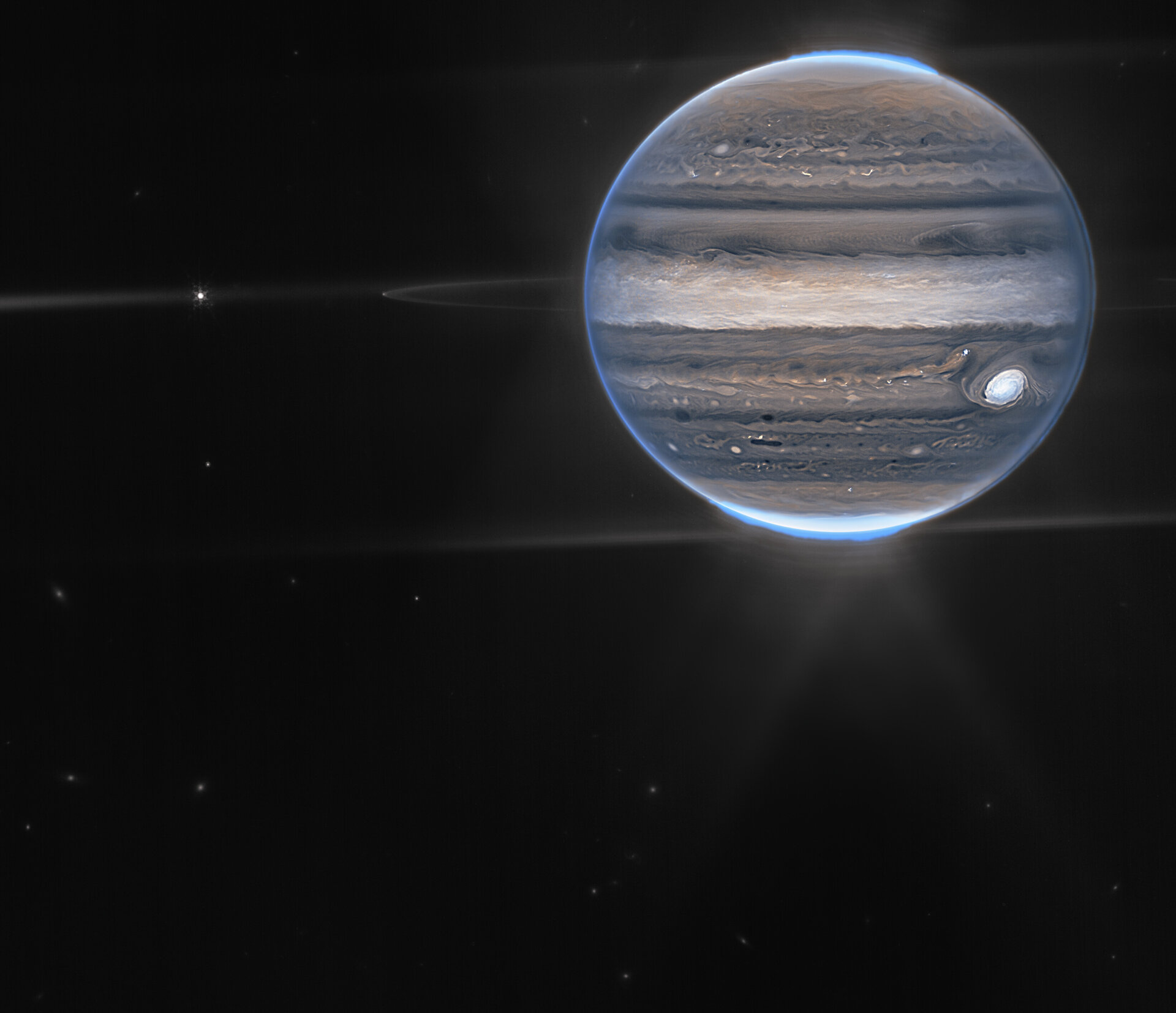
Jupiter
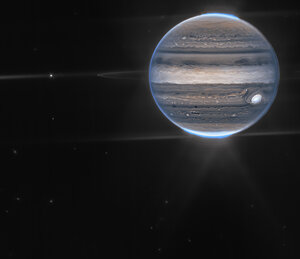
The fifth planet out from the Sun and the first and largest of the gas giants. Jupiter is 5.2 AU away from the Sun, has a mass 318 times that of the Earth and could hold 1400 'Earths' in its volume. It is mainly composed of hydrogen and helium but has a small core of rock and ice.
K
K-band
A band of radio frequencies extending from 10 900 to 36 000 MHz.
Kelvin
The Kelvin (K) is the unit of the absolute temperature scale, in which the temperature of the triple point of water (the temperature at which water can exist simultaneously in solid, liquid and gaseous form) assumes the value of 273.16 K. Kelvin can be converted to degrees Celsius by subtracting 273.15.
Kourou
Coastal town of French Guiana, just north of the Equator, where France created a launch site in 1964. Since 1977, the site has been exclusively devoted to the Ariane launchers, developed by the European Space Agency and commercially operated by Arianespace.
Kuiper Belt
Spherical region of the outer Solar System populated by numerous `ice dwarfs', otherwise known as Kuiper Belt Objects or trans-Neptunian objects. Several hundred of these have so far been discovered. The planet Pluto appears to be the largest of these objects. The belt seems to occur at 30 - 150 AU from the Sun and is believed to be the source of short-period comets. Named after Dutch-American astronomer Gerard Kuiper who predicted its existence. Also known as the Edgeworth-Kuiper Belt, in recognition of the work of another (Irish) scientist, Kenneth Edgeworth.
L
Lagrangian points
Points where the gravitational forces of three different massive bodies exactly cancel. For the Sun-Earth-Moon system we have five different Lagrange points, known as L1, L2, L3, L4 and L5.
Lander
A small spacecraft designed to land on another Solar System body.
Latch
Mechanical device that attaches one component, such as a science instrument, to the structure of the telescope and holds it in precisely the right place.
Launch window
The launch window is a term used to describe a time period in which a particular mission must be launched.
Launcher
Powered vehicle used to carry one or more satellites into space.
Lens
Transparent optical element or assembly with either a concave or convex surface, which refracts light to form an image.
Leonids
Meteor shower which occurs around 17 November each year. The meteors appear to radiate from the constellation of Leo. They are caused by dust grains along the orbit of periodic comet Tempel-Tuttle which burn up when they enter the Earth's upper atmosphere. Spectacular displays may occur at approximately 33-year intervals, with the last `storm' taking place in 1966.
Light
All electromagnetic radiation can be called light. However, the term 'light' is commonly used for the electromagnetic radiation that the human eye can detect, that is, the 'visible' or 'optical' light.
Light elements
The chemical elements produced during the first minutes of existence of the Universe. They are helium, deuterium (an isotope of hydrogen), lithium, beryllium and boron. They are called 'light elements' because their nuclei are made of just a few nuclear particles, and thus their mass is very low. The other elements - those produced in the core of stars - are 'heavier'; iron, for instance, has 26 protons in its nucleus. See also Nucleosynthesis and Primordial nucleosynthesis.
Lightning
Sudden high-current discharge caused by a planet atmosphere's electrical breakdown.
Light-year (ly)
The distance travelled by light through space in one year. 1 light-year (ly) equals about 9.5 million million kilometres (=0.3066 parsecs = 63240 AU = a parallax of 3.259 arcsecs).
Line (absorption)
Absorption spectra are formed when continuous spectra from a star shine through a gas that absorbs only certain colours of light. The absorption spectra, therefore, look like continuous spectra with dark bands (absorption lines) at discrete wavelengths. These lines characterise the chemical composition of the gas which surrounds the star.
Luminosity
The amount of radiation emitted by a star or celestial object in a given time.