• → European Space Agency

      • Space for Europe
      • Space News
      • Space in Images
      • Space in Videos
    • About Us

      • Welcome to ESA
      • DG's News and Views
      • For Member State Delegations
      • Business with ESA
      • ESA Exhibitions
      • ESA Publications
      • Careers at ESA
    • Our Activities

      • Space News
      • Observing the Earth
      • Human Spaceflight
      • Launchers
      • Navigation
      • Space Science
      • Space Engineering
      • Operations
      • Technology
      • Telecommunications & Integrated Applications
    • For Public

    • For Media

    • For Educators

    • For Kids

    • ESA

    • ESA Science

    • Mars Express

    • Europe goes to Mars

      • Europe reclaims a stake in Mars exploration
      • Space age transforms our knowledge about Mars
    • About Mars Express

      • Mars Express mission facts
      • Mars Express instruments
      • The mission
      • The spacecraft
      • The launcher
    • About Mars

      • Geography of Mars
      • Water on early Mars?
      • Signatures of life
      • Facts about Mars
    • Meet the team

      • International collaboration
      • Project Manager
      • Project Scientist
      • Mars Lead Scientist
      • Principal Investigators
      • Operations
      • Industry
    • Multimedia
    • VideoTalk
    • Mars Express images
    • Mars Express videos
    • HRSC videos
    • Animation in 11 languages
    • Download wallpapers
    • Download screensavers
    • 3D Flash 'model'
    • Make a model
    • Services
    • Comments

    ESA > Our Activities > Space Science > Mars Express

    The High Resolution Stereo Camera (HRSC)

    Behind the lens...

    13 February 2004

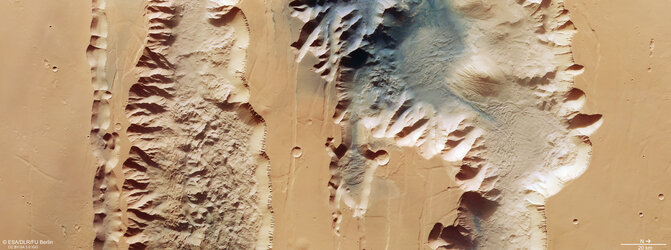
    This is the camera behind the stunning European imagery from Mars. The High Resolution Stereo Camera on ESA’s Mars Express is now mapping most of the Martian surface with unprecedented detail.

    The HRSC was originally designed for the Russian Mars ’96 space mission. After an unsuccessful launch in November 1996, the back-up model of the camera was modified for use on the European Mars Express mission. Another version, the HRSC-AX, has been built for airborne high-resolution 3D Earth reconnaissance and has already been used in a large number of projects.

    The main part of the HRSC, the Camera Head, has a resolution of 10 metres per pixel at an altitude of 250 kilometres, the point of closest approach to Mars. The Super Resolution Channel (SRC) part is the high resolving channel with a resolution of down to 2.3 metres per pixel. The whole unit measures only 515 mm by 300 mm. SRC images will provide the most detailed information about areas of special interest, for example the examination of future landing sites.

    The imaging electronics of the HRSC are based on the principle of a ‘linescan’ camera. This means only a line is exposed to the light, and not an area (like on ordinary 35 mm film). One CCD line of the HRSC consists of 5184 light-sensitive cells (pixels). The HRSC has nine of these lines, one for each imaging channel. The CCD exposure time is adjusted to match the ground velocity of the spacecraft.


    Three channels are sensitive to the spectral ranges of red, green and blue. Another one obtains data in near-infrared. Then there are three stereo channels which are used to the digital terrain models – these take angled views to get a downward, backward and a forward-view of the surface.

    From these different views, you can derive three-dimensional images. The last two channels are two photometric channels, giving data for the physical analysis of the Martian surface.

    The SRC is the second part of the HRSC camera system and uses an area sensor. This means the light intensity is measured by a matrix of 1024 by 1032 elements. This produces a picture of 1024 x 1032 pixels and, from an altitude of 250 kilometres, this corresponds to a square on the Martian surface with sides of length 2.35 kilometres, each pixel representing 2.3 metres.

    Normally, the main camera and the SRC work simultaneously, because of the difficulty in locating the SRC images on the Martian surface. The high-resolution SRC images are nested in the HRSC strips, giving very detailed information about areas of special interest.
    Rate this

    Views

    Share

    • Currently 0 out of 5 Stars.
    • 1
    • 2
    • 3
    • 4
    • 5
    Rating: 0/5 (0 votes cast)

    Thank you for rating!

    You have already rated this page, you can only rate it once!

    Your rating has been changed, thanks for rating!

    21
    facebook
    twitter
    reddit
    google plus
    digg
    tumbler
    digg
    blogger
    myspace
    • Looking at Mars
    • More about...
      • Mars Express mission facts
        • Mars Express instruments
          • Principal Investigators
          • Related links
          • High Resolution Stereo Camera
          • ESA Science & Technology HRSC page
          • Download wallpapers
          • File size 1024x768
          • File size 800x600

    Connect with us

    • RSS
    • Youtube
    • Twitter
    • Flickr
    • Google Buzz
    • Subscribe
    • App Store
    • LATEST ARTICLES
    • · CryoSat hits land
    • · Ariane 5 completes seven launches …
    • · Measuring skull pressure without t…
    • · Malargüe station inauguration
    • · The solar wind is swirly
    • FAQ

    • Jobs at ESA

    • Site Map

    • Contacts

    • Terms and conditions