• → European Space Agency

      • Space for Europe
      • Space News
      • Space in Images
      • Space in Videos
    • About Us

      • Welcome to ESA
      • DG's News and Views
      • For Member State Delegations
      • Business with ESA
      • ESA Exhibitions
      • ESA Publications
      • Careers at ESA
    • Our Activities

      • Space News
      • Observing the Earth
      • Human Spaceflight
      • Launchers
      • Navigation
      • Space Science
      • Space Engineering
      • Operations
      • Technology
      • Telecommunications & Integrated Applications
    • For Public

    • For Media

    • For Educators

    • For Kids

    • ESA

    • ESA Science

    • Mars Express

    • Europe goes to Mars

      • Europe reclaims a stake in Mars exploration
      • Space age transforms our knowledge about Mars
    • About Mars Express

      • Mars Express mission facts
      • Mars Express instruments
      • The mission
      • The spacecraft
      • The launcher
    • About Mars

      • Geography of Mars
      • Water on early Mars?
      • Signatures of life
      • Facts about Mars
    • Meet the team

      • International collaboration
      • Project Manager
      • Project Scientist
      • Mars Lead Scientist
      • Principal Investigators
      • Operations
      • Industry
    • Multimedia
    • VideoTalk
    • Mars Express images
    • Mars Express videos
    • HRSC videos
    • Animation in 11 languages
    • Download wallpapers
    • Download screensavers
    • 3D Flash 'model'
    • Make a model
    • Services
    • Comments

    ESA > Our Activities > Space Science > Mars Express

    Hubble's close encounter with Mars

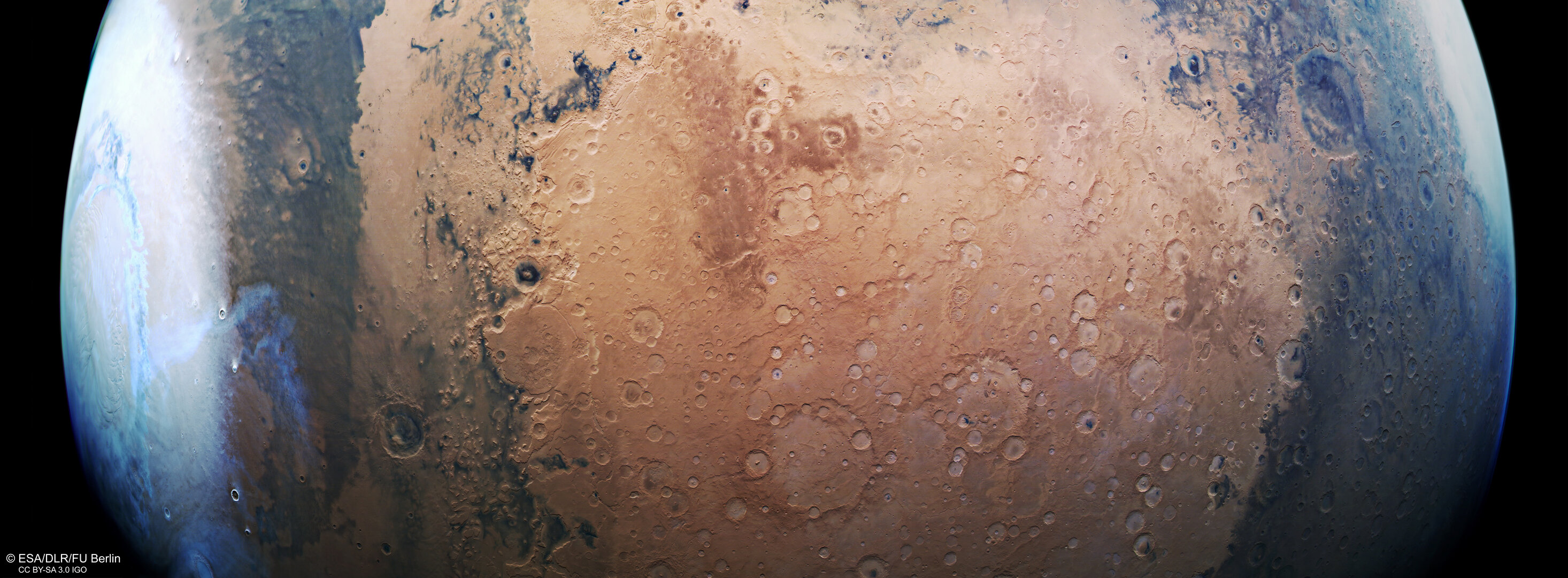
    Facts about Mars

       
    Orbit 227 940 000 km (1.52 AU) mean distance from Sun
    Diameter 6794 km
    Martian day (sol) 24 hours, 37 mins 22 seconds
    Martian year 669 Martian days (sols), 687 Earth days
    Average temperature 218 K (-55 degrees C)
    Minimum temperature 140K (-133 degrees C) (winter pole)
    Maximum temperature 300K (27 degrees C) (summer dayside)
    Surface area 144 x 106 km2, about the same as the land area of Earth
    Atmospheric pressure at surface 6.35 mbar, that is less than one hundredth Earth's atmospheric pressure.
    Atmospheric composition 95.32% carbon dioxide, 2.7% nitrogen, 1.6% argon, 0.13% oxygen
    Moons Phobos - diameter 22 km, orbit 5981 km from surface
    Deimos - diameter 12 km, orbit 20,062 km

    Last update: 19 November 2004

    Rate this

    Views

    Share

    • Currently 0 out of 5 Stars.
    • 1
    • 2
    • 3
    • 4
    • 5
    Rating: 0/5 (0 votes cast)

    Thank you for rating!

    You have already rated this page, you can only rate it once!

    Your rating has been changed, thanks for rating!

    71
    facebook
    twitter
    reddit
    google plus
    digg
    tumbler
    digg
    blogger
    myspace
    • Looking at Mars
    • More about...
      • Mars Express mission facts
      • Related articles
        • Mars Express instruments
          • The search for life
            • Chances of life are linked to water
              • Water on early Mars?
                • Signatures of life
                  • Geography of Mars

    Connect with us

    • RSS
    • Youtube
    • Twitter
    • Flickr
    • Google Buzz
    • Subscribe
    • App Store
    • LATEST ARTICLES
    • · CryoSat hits land
    • · Ariane 5 completes seven launches …
    • · Measuring skull pressure without t…
    • · Malargüe station inauguration
    • · The solar wind is swirly
    • FAQ

    • Jobs at ESA

    • Site Map

    • Contacts

    • Terms and conditions