The spacecraft
Spacecraft facts
| Spacecraft bus dimensions | 1.5 x 1.8 x 1.4 m |
| Thrust of main spacecraft engine | 400 N |
| Attitude thrusters | |
| Propellant tanks volume | |
| Pointing accuracy | Better than 0.5° |
| Solar array area | 11.42 m² |
| Lithium batteries | 3 at 22.5 Amp hours each (at launch) |

Propulsion
Most of the energy needed to propel Mars Express from Earth to Mars was provided by the three-stage Soyuz/Fregat launcher. The Fregat upper stage separated from the spacecraft after placing it on a Mars-bound trajectory.
The spacecraft used its on board means of propulsion solely for orbit corrections and to slow the spacecraft down for Mars orbit insertion.
The main engine on the underside of the spacecraft body (or 'bus') was capable of delivering a force of 400 Newtons, and was used to reduce the speed of the spacecraft by 2880 kilometres per hour in 30 minutes (400 Newtons is equivalent to the force needed on Earth to suspend a 40 kilogram weight above the ground). The main engine was deactivated after Mars Express reached its operational orbit.
Subsequent small orbit changes have been made using its eight 10 Newton thrusters, attached to the bottom corners of the spacecraft bus.
Attitude Control
The spacecraft uses four ‘reaction wheels’ to control its attitude (orientation in space) to point its instruments towards areas of scientific interest on Mars and its moons, or to point its high gain antenna towards Earth for communication. The reaction wheels are flywheels; each one can be used to turn the spacecraft in a particular direction by increasing the rotation of the wheel in the opposite direction.
The 10 Newton thrusters are used to regularly to reduce, or ‘dump’ angular momentum from the reaction wheels and can also be used to control the attitude of the spacecraft in emergencies.
Navigation
The spacecraft has six laser gyros and two star trackers, which it uses to precisely measure its attitude and which are then used by the onboard computers to command the reaction wheels to accurately point the spacecraft’s instruments or the high gain antenna at 35-metre dishes on Earth, up to 400 million kilometres away. The spacecraft also has two coarse Sun sensors, which can be used to point the solar arrays at the Sun in an emergency.
Electrical power
This is provided by the spacecraft's solar panels which were deployed shortly after launch. When Mars is at its maximum distance from the Sun (aphelion), the solar panels are still be capable of delivering more than 500 Watts (equivalent to a typical washing machine), which is enough to meet the spacecraft’s normal requirements.
When the spacecraft periodically passes into the shadow of Mars (eclipse), three lithium-ion batteries previously charged from the solar panels, provide power to the spacecraft. The batteries had a capacity of 67.5 Amp hours (capacity to provide 1A for 67.5 hours, or equivalent) at the time of the launch of the spacecraft, but now due to aging only retain about half of this capacity.
Communications
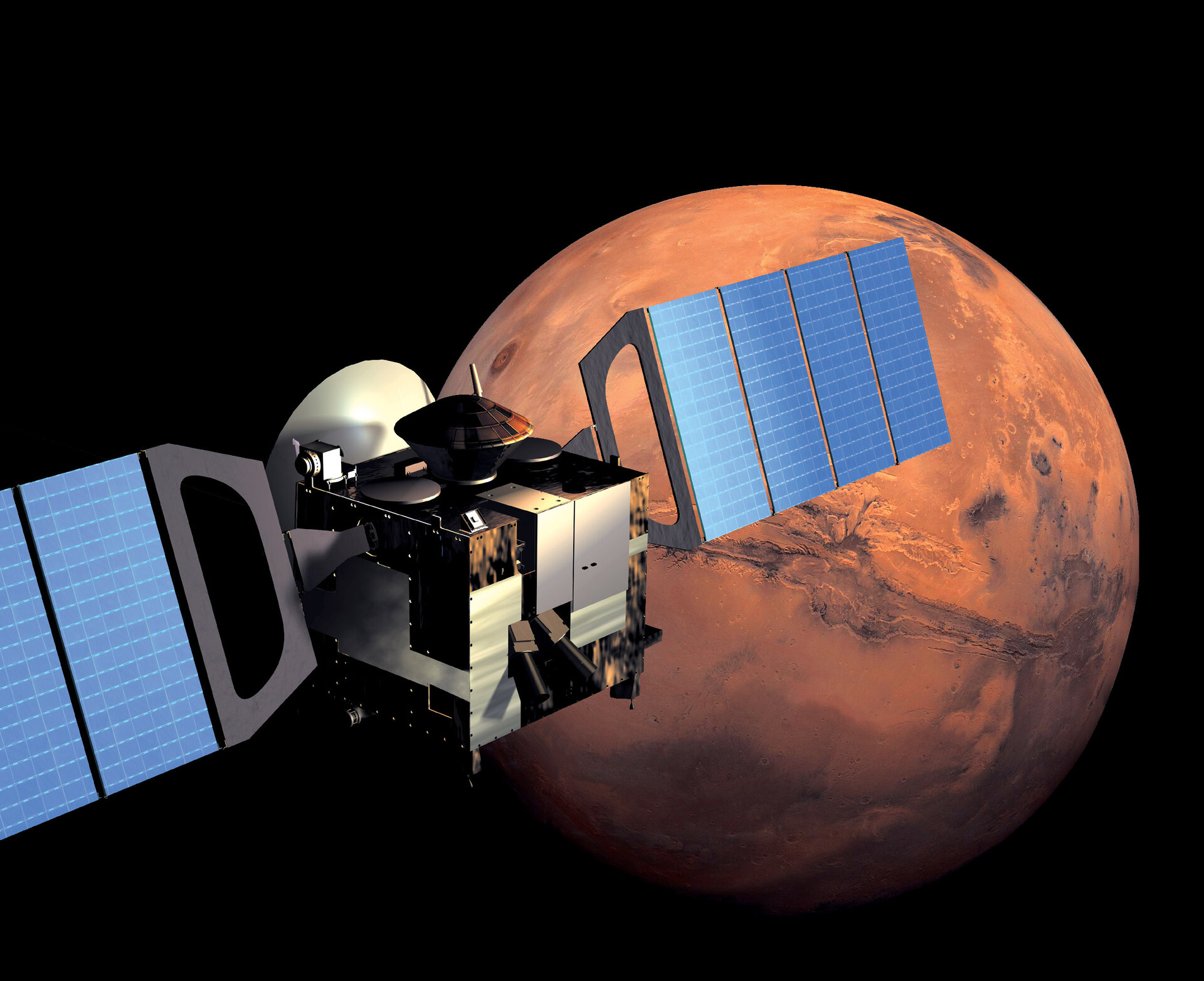
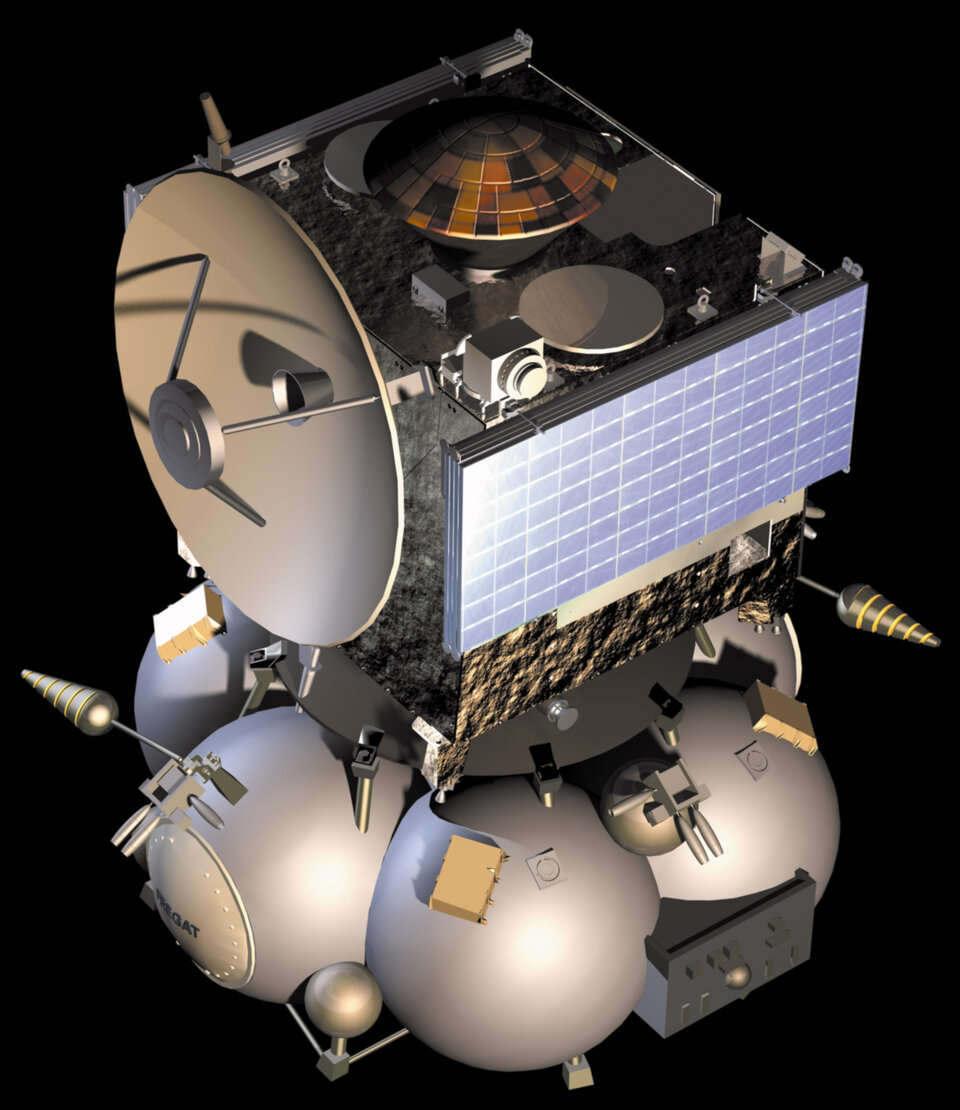
The circular dish attached to one face of the spacecraft bus is a 1.6-metre diameter high-gain antenna, for receiving and transmitting radio signals. The data transfer rate depends on the distance between Earth and Mars which changes quite dramatically during the martian year. The time to send a signal to Mars Express over this period changes from around 4 mins to 25 mins. This results in a data rate of 228kps at closest approach to 57kbps when the planets are furthest apart.
The spacecraft also has two low gain antennas, which were used when it was close to Earth and can still be used for communications in an emergency.
Data storage
As scientific data cannot be transmitted back to Earth as soon as they are collected, they are stored in the spacecraft mass memory until transmission is possible. The mass memory has 12 Gbits of solid-state storage capacity (approx. 1.5 Gbytes).
Control
The onboard computers interpret and distribute the commands received from the Earth, control all aspects of the spacecraft functioning including switching instruments on and off, assessing the spacecraft orientation in space and issuing commands to change it. The onboard software is also responsible for monitoring the health of key spacecraft systems and intervening if issues occur. Intervention can range from simply switching off a piece of equipment or activating a back-up unit, all the way through to putting the spacecraft into ‘safe mode’ where it will shut down all non-essential systems, turn towards the Sun to ensure it has power before finally pointing the antenna at the Earth and turning on the transmitter. This ensures the spacecraft is in a safe and stable configuration allowing the operations team to diagnose the problem and recover and resume the science mission.
Thermal control
The spacecraft must provide a benign environment for the instruments and onboard equipment. Two instruments, PFS and OMEGA, have infrared detectors that need to be kept at very low temperatures (about -180°C). The sensors on the camera (HRSC) also need to be kept cool. But the rest of the instruments and on-board equipment function best at room temperature (10–20°C).
The spacecraft is wrapped in multi-layer insulation (MLI) thermal blankets and has heaters to keep the interior at 10–20°C. The instruments that need to be kept cold are thermally insulated from the warm interior of the spacecraft and have active coolers and radiators that lose heat to space.