P
Parabolic (mirror)
A mirror whose surface is figured to the shape of a paraboloid, a particular form of open curve.
Parallax
Change in the apparent position of objects when viewed from two widely separated positions.
Parsec (pc)
A distance equal to 3.26 light-years, often used as a unit for measuring distances to stars and galaxies. One million parsecs are more conveniently expressed as 1 Megaparsec (Mpc).
Particle(s)
A fundamental constituent of matter. About 200 different elementary particles are thought to exist.
Payload
Cargo of a spacecraft. Scientific instruments are part of a satellite's payload. For ESA scientific missions, they are usually designed and built by scientists at their home institutes.
Payload module
Some satellites are built in a modular way. They consist of a payload module with the scientific instruments and a service module with the housekeeping equipment.
Periapsis
The point of an orbit nearest to the center of attraction of an orbiting body.
Pericentre
The point on a spacecraft's orbit at which it is nearest to the centre of mass of the system.
Perigee
The closest point to Earth on a satellite's orbit.
Perihelic opposition
When the Earth passes between a planet and the Sun when the planet is at its closest from the Sun.
Perihelion
The point in a planet's orbit when it is nearest to the Sun.
Period
Time interval between two consecutive and similar phases of a regularly occurring event. For example, the period of rotation of the Earth is the time taken to complete one revolution; the period of a variable star is the time between two successive maxima or minima on its light-curve.
Photochemistry
The study of the effects of light on chemical reactions.
Photometer
In astronomy, an instrument to measure the amount of light that reaches the telescope.
Photon
A particle of light, unit of electromagnetic energy.
Picture
Visual representation of something, such as the image of a star obtained by a telescope.
Pipe-line (processing)
Analysis and processing of scientific data in a sequential manner.
Pixel
Single picture element of a detection device.
Planck constant
The Planck constant, h, is a fundamental physical constant. Electromagnetic radiation has a dual nature. It can be considered to be composed of waves or of particles (photons). The wave-like and particle-like properties are related by Planck's Law in which the constant of proportionality is h. (h = 6.62 x 10⁻³⁴ Joule seconds).
Planck's Law
The relationship between the wave-like and particle-like (photon) properties of Electromagnetic radiation. E = hf, where E is the energy of the photon, h is the Planck constant and f is the frequency of the wave.
Plane (focal)
A surface upon which the image of all points in the field of view of an optical instrument is created.
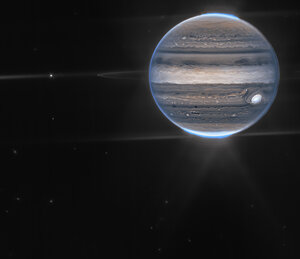
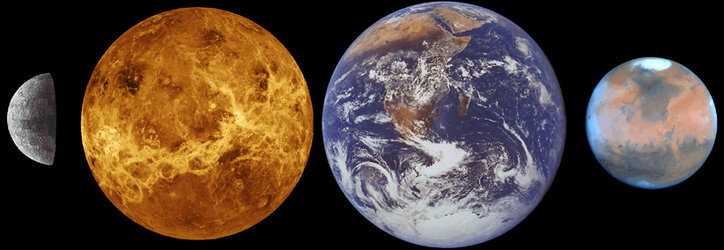
Planet
Large, spherical, rocky or icy body which orbits the Sun or another star.
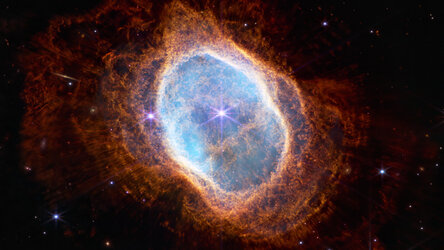
Planetary nebula
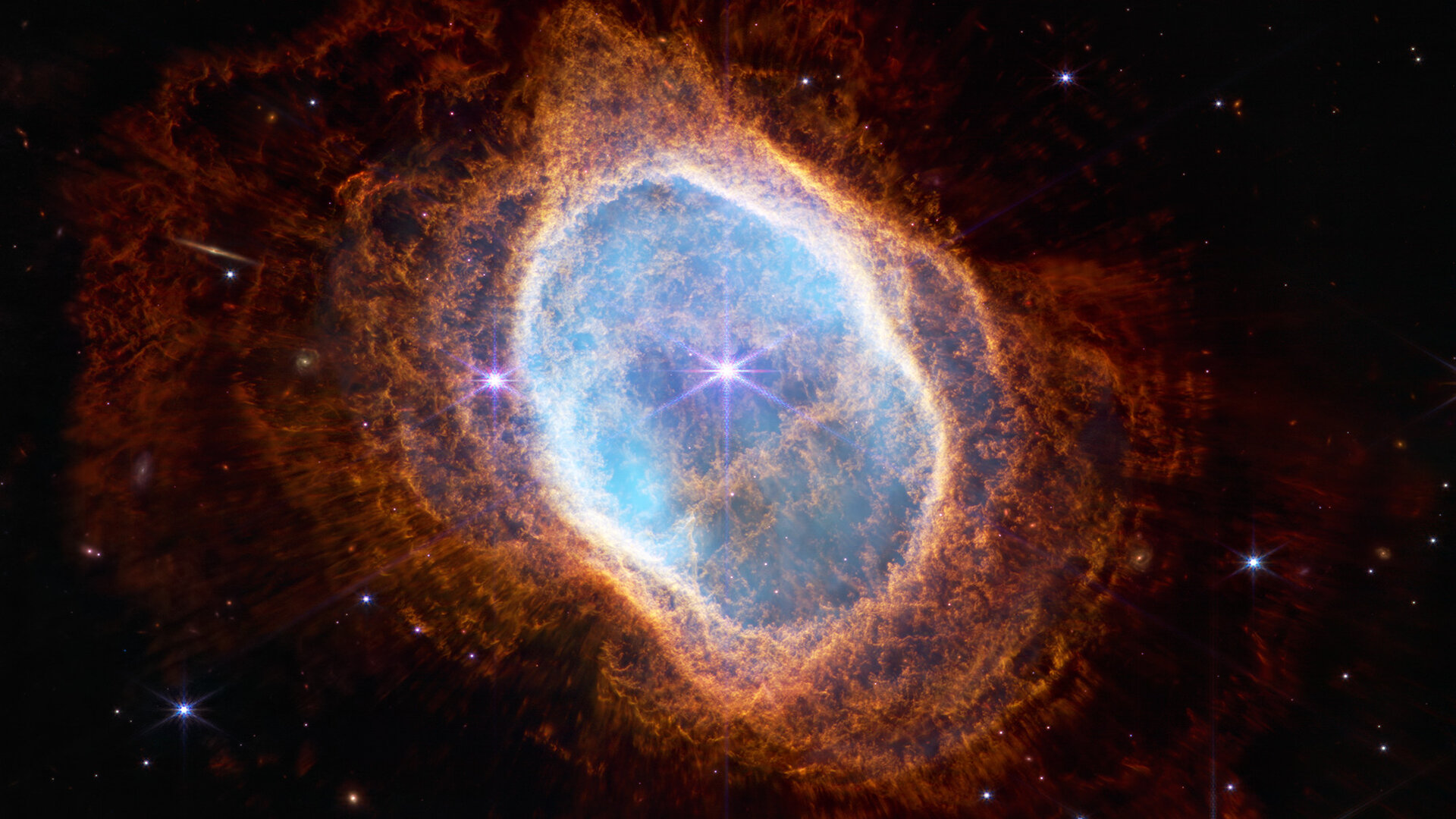
A bright cloud of dust and gas surrounding an old star, namely a red giant. Towards the end of its life the star ejects the dust and gas violently, losing most of its mass and becoming a white dwarf. The nebula disappears after approximately 100 000 years. They are called 'planetary' because originally astronomers thought they looked like planetary discs.
Plasma
Matter containing more or less equal amounts of positively charged ions and negatively charged electrons. It is usually extremely hot and found in or near stars.
Platform
Main supporting structure of a spacecraft accommodating its main subsystems such as propellant, flight electronics and communications.
Pleiades
The Pleiades star cluster, also known as the seven sisters or M45, is a young star cluster in the constellation Taurus. It is no more than 80 million years old and lies at a distance of about 400 light-years from the Sun. The cluster contains thousands of stars, of which 6 are visible with the naked-eye: Alcyone, Maia, Atlas, Electra, Merope and Taygeta.
Plumes
Feather-like formation of hot, rising gas in the atmosphere of a star or planet caused by convection.
Pluto
Originally classified as the ninth planet from the Sun, Pluto was recategorised as a dwarf planet and plutoid in 2006. Pluto orbits the Sun on a highly eccentric orbit with an average radius of 39.4 AU, which sometimes takes it within the orbit of Neptune. Pluto has a very thin atmosphere consisting mainly of methane and nitrogen. The average surface temperature is 50 K.
Polarisation
Restricting the vibrations of waves, particularly light, to move in one direction, along one plane.
Pole
Usually the coldest regions on a planet, being the areas around an axis through the planet perpendicular to the plane of rotation about the Sun.
Positron
The antiparticle of the electron. A positron has the same characteristics as an electron but it has a positive charge instead of a negative one.
Prebiotic
Related to the period before life appears on a planet.
Preliminary design review
A major review of the design for a spacecraft before construction can begin. The preliminary design review marks the boundary between the design phase and the construction phase.
Primaeval soup
Mixture of water and chemical ingredients that constituted the oceans on Earth about three or four billion years ago. Among the chemicals were simple organic molecules. The primeval soup is thought to have been the place where life originated.
Primary mirror
Large mirror in a reflecting telescope the size of which determines the light-gathering power of the prism.
Primordial nucleosynthesis
The first time that nuclear atomic particles, neutrons and protons, could combine to make atomic nuclei. This happened during the first thousand seconds of existence of the Universe. The first atomic nuclei made were those of the light elements.
Prism
Device that breaks light into its composite wavelength spectrum.
Probe
An unmanned vehicle travelling into space to celestial bodies in order to collect information about them.
Prominence (solar)
Large cloud of plasma extending above the Sun's chromosphere. They are divided into two main classes. Quiescent types show little motion, may last for several solar rotations and disappear slowly. Eruptive or active types form and disappear very quickly, and may grow to tremendous size.
Proportional counter
Instrument used for detecting gamma rays and X-rays in which radiation triggers an electrical discharge resulting in a pulse of electric current whose strength is proportional to the energy of the radiation.
Propulsion
Process by which something can be moved by producing a reaction with a force of thrust.
Proton
Positively charged constituent of all atomic nuclei. A proton is made up of three quarks. The number of protons in a nucleus is called the atomic number and determines the chemical element.
Proton rocket
Russia's largest operational launch vehicle. The four-stage booster has a length of more than 57 m, its total lift-off mass is almost 700 tonnes. Over the past 30 years it has been used in more than 230 launches.
Protoplanetary disc
The disc of dust surrounding a star out of which planets might form.
Protostellar object
The earliest stages of star formation, when the nuclear reactions in the star's core have not begun yet. Stars form in opaque clouds of very cold dust and gas, which can be seen only with infrared telescopes.
Pulsar
A stellar source, such as a rotating single star or pair of stars, emitting electromagnetic radiation which is characterised by rapid frequency and regularity.
Pyrolyser
An instrument that breaks complex molecules into constituents by using heat.