• → European Space Agency

      • Space for Europe
      • Space News
      • Space in Images
      • Space in Videos
    • About Us

      • Welcome to ESA
      • DG's News and Views
      • For Member State Delegations
      • Business with ESA
      • ESA Exhibitions
      • ESA Publications
      • Careers at ESA
    • Our Activities

      • Space News
      • Observing the Earth
      • Human Spaceflight
      • Launchers
      • Navigation
      • Space Science
      • Space Engineering
      • Operations
      • Technology
      • Telecommunications & Integrated Applications
    • For Public

    • For Media

      • Media
      • ESA TV
      • Videos for professionals
      • Photos
    • For Educators

    • For Kids

    • ESA

    • Space Science

    • Our Universe
    • About Space Science
    • ESA's 'Cosmic Vision'
    • Science missions
    • Mission navigator
    • Target groups
    • For Media
    • For Scientists
    • For Kids
    • Multimedia
    • Science images
    • Science videos
    • Animations
    • Downloads
    • Sounds from space
    • Resources
    • Reference section
    • Services
    • FAQs
    • Glossary
    • Help
    • Portal terms of use
    • Comments
    • Follow us
    • RSS feeds
    • ESA Sci on Twitter
    • ESA Space Science Images on Flickr
    • ESA 3D on Flickr

    ESA > Our Activities > Space Science

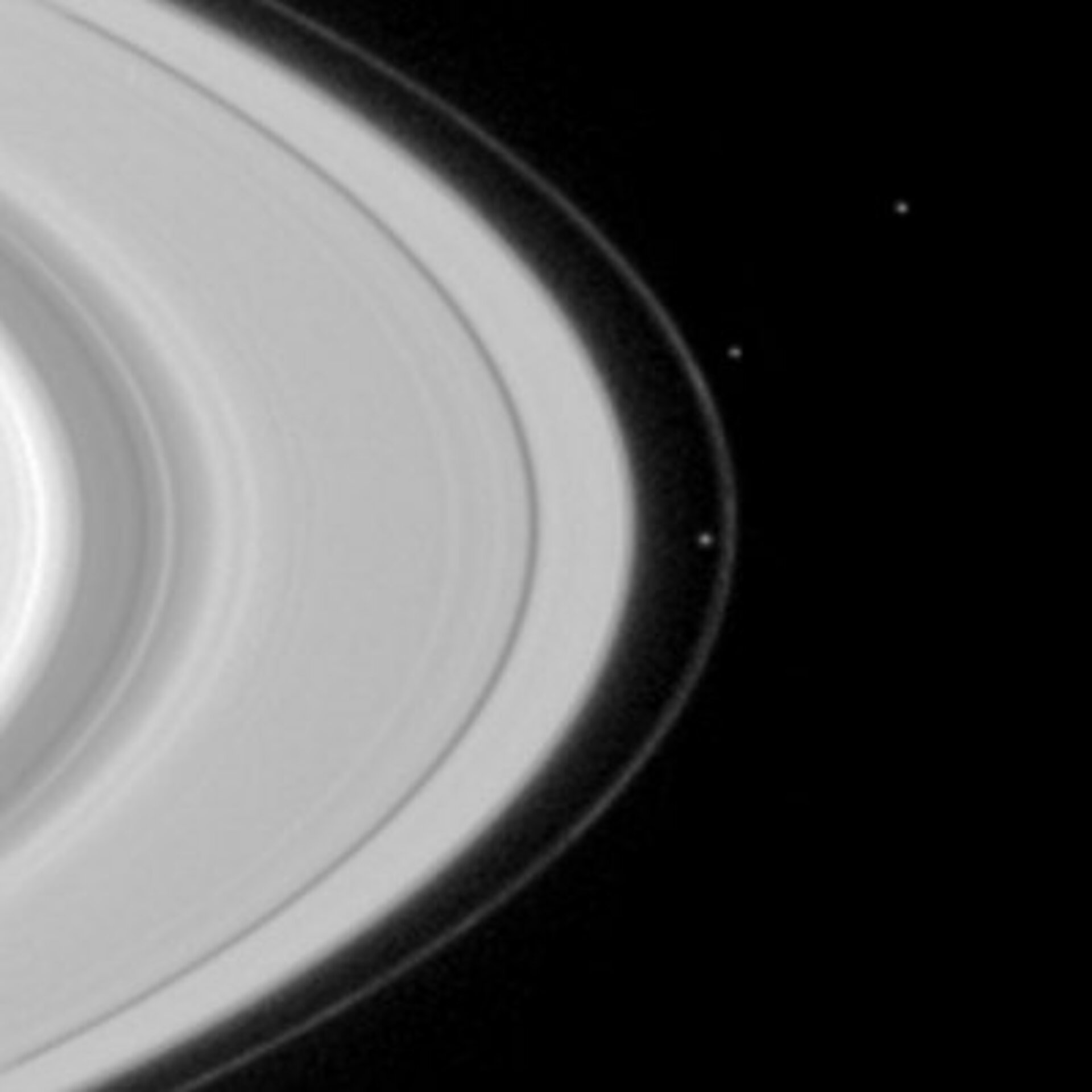
    Saturn's moons Pandora, Prometheus and Epimetheus

    Pandora, Prometheus and Epimetheus

    24 May 2004

    Two of Saturn’s moons, Prometheus and Pandora, are seen here shepherding the planet’s narrow F-ring. Epimetheus is seen to the right.

    Prometheus (102 kilometres across) and Pandora (84 kilometres across), are seen here shepherding the planet’s narrow F-ring. Prometheus overtakes Pandora in orbit around Saturn about every 25 days. Epimetheus is 116 kilometres across.

    This image was taken with the narrow-angle camera on the NASA/ESA/ASI Cassini-Huygens spacecraft on 1 May 2004, at a distance of 31.4 million kilometres from Saturn. Image resolution is 187 kilometres per pixel. The image has been magnified and greatly contrast-enhanced to aid visibility.

    The Cassini-Huygens mission is a co-operative project of NASA, ESA and the Italian Space Agency.

    Credits: NASA/JPL/Space Science Institute
    Rate this

    Views

    Share

    • Currently 1 out of 5 Stars.
    • 1
    • 2
    • 3
    • 4
    • 5
    Rating: 1/5 (1 votes cast)

    Thank you for rating!

    You have already rated this page, you can only rate it once!

    Your rating has been changed, thanks for rating!

    32
    Tweet
    • At Saturn and Titan
    • More about...
    • More on Cassini-Huygens spacecraft
    • More on Cassini instruments
    • Related articles
      • Life on Titan?
        • Christiaan Huygens: Discoverer of Titan
          • Jean-Dominique Cassini: Astrology to astronomy
          • Related links
          • NASA JPL Cassini-Huygens site
          • Italian Space Agency (ASI)

    Connect with us

    • RSS
    • Youtube
    • Twitter
    • Flickr
    • G+
    • Facebook
    • Livestream
    • Subscribe
    • App Store
    • ESA Science Twitter

    Follow ESA science

    • LATEST ARTICLES
    • · Rare merger reveals secrets of gal…
    • · Watching for hazards: ESA opens as…
    • · ESA astronaut Timothy Peake set fo…
    • · Space drives e-mobility
    • · Proba-V opens its eyes
    • FAQ

    • Jobs at ESA

    • Site Map

    • Contacts

    • Terms and conditions