• → European Space Agency

      • Space for Europe
      • Space News
      • Space in Images
      • Space in Videos
    • About Us

      • Welcome to ESA
      • DG's News and Views
      • For Member State Delegations
      • Business with ESA
      • ESA Exhibitions
      • ESA Publications
      • Careers at ESA
    • Our Activities

      • Space News
      • Observing the Earth
      • Human Spaceflight
      • Launchers
      • Navigation
      • Space Science
      • Space Engineering
      • Operations
      • Technology
      • Telecommunications & Integrated Applications
    • For Public

    • For Media

      • Media
      • ESA TV
      • Videos for professionals
      • Photos
    • For Educators

    • For Kids

    • ESA

    • Launch Special

    • Planck

    • Herschel

    • ESA Science

    • About Planck

      • Science objectives
      • Planck highlights
      • History of microwave astronomy
    • The Microwave Universe

      • Why the microwave
      • Key questions
    • The spacecraft

      • Vital stats
      • Telescope
      • Instruments
      • Sophisticated spacecraft
    • The mission

      • Journey
      • Launch and early operations
      • Operating Planck
    • Meet the team

      • Planck Project Scientist: An interview with Jan Tauber
      • Herschel and Planck Programme Manager: An interview with Thomas Passvogel
    • Multimedia
    • Planck images
    • Planck videos
    • Science@ESA vodcast

    ESA > Our Activities > Space Science > Planck

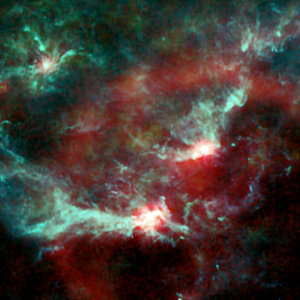
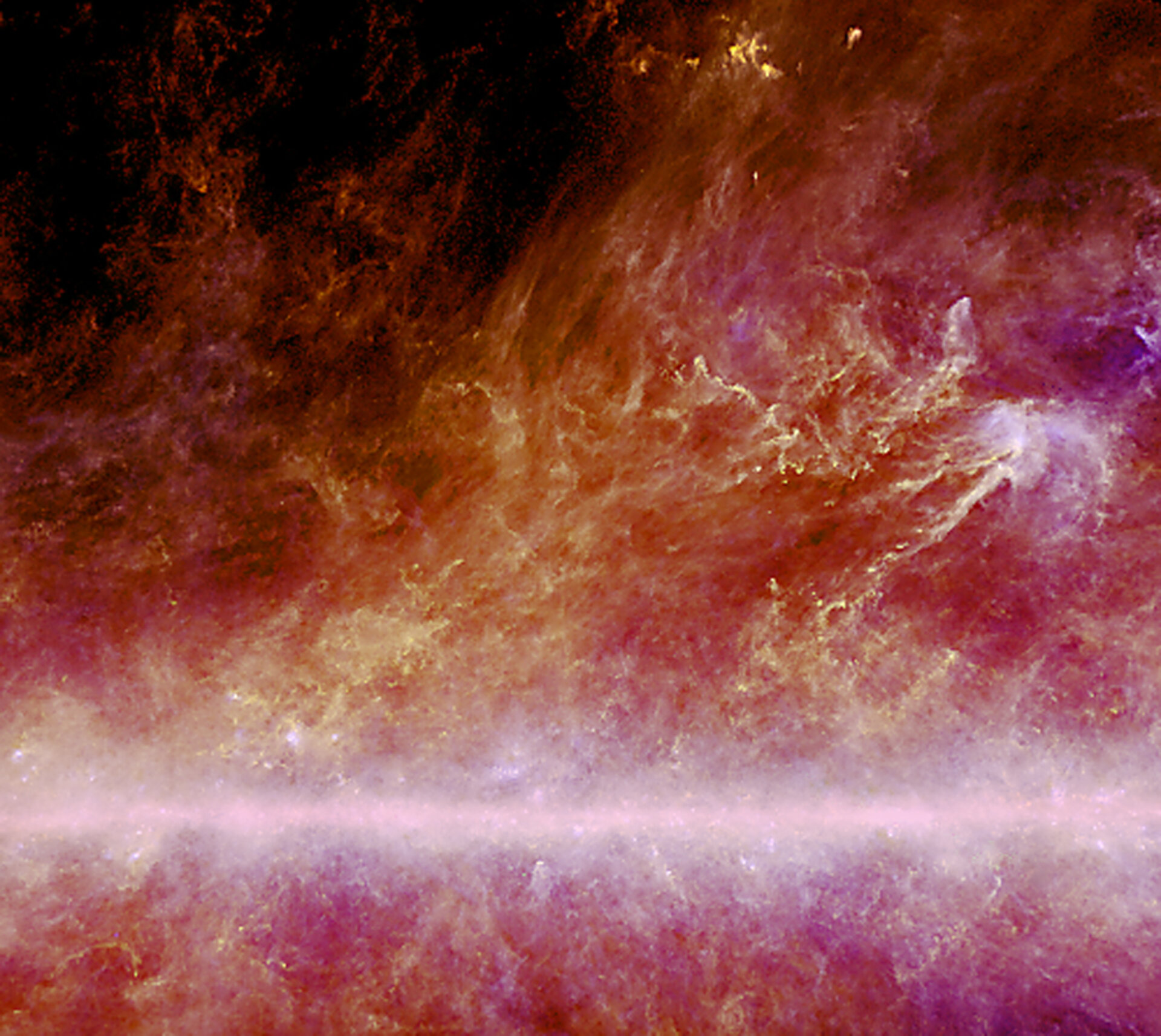
    Dust structures within 500 light-years of the Sun

    Planck sees tapestry of cold dust

    17 March 2010

    Giant filaments of cold dust stretching through our Galaxy are revealed in a new image from ESA’s Planck satellite. Analysing these structures could help to determine the forces that shape our Galaxy and trigger star formation.

    Planck is principally designed to study the biggest mysteries of cosmology. How did the Universe form? How did the galaxies form? This new image extends the range of its investigations into the cold dust structures of our own Galaxy.

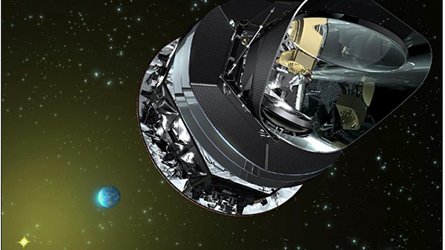
    Planck scanning the sky

    The image shows the filamentary structure of dust in the solar neighbourhood – within about 500 light-years of the Sun. The local filaments are connected to the Milky Way, which is the pink horizontal feature near the bottom of the image. Here, the emission is coming from much further away, across the disc of our Galaxy.

    The image has been colour coded to discern different temperatures of dust. White-pink tones show dust of a few tens of degrees above absolute zero, whereas the deeper colours are dust at around –261°C, only about 12 degrees above absolute zero. The warmer dust is concentrated into the plane of the Galaxy whereas the dust suspended above and below is cooler.


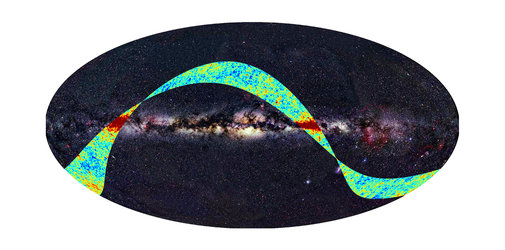
    Planck's newly imaged region shown in box

    “What makes these structures have these particular shapes is not well understood,” says Jan Tauber, ESA Project Scientist for Planck. The denser parts are called molecular clouds while the more diffuse parts are ‘cirrus’. They consist of both dust and gas, although the gas does not show up directly in this image.

    There are many forces at work in the Galaxy to help shape the molecular clouds and cirrus into these filamentary patterns. For example, on large scales the Galaxy rotates, creating spiral patterns of stars, dust, and gas. Gravity exerts an important influence, pulling on the dust and gas. Radiation and particle jets from stars push the dust and gas around, and magnetic fields also play a role, although to what extent is presently unclear.

    Bright spots in the image are dense clumps of matter where star formation may take place. As the clumps shrink, they become denser and better at shielding their interiors from light and other radiation. This allows them to cool more easily and collapse faster.
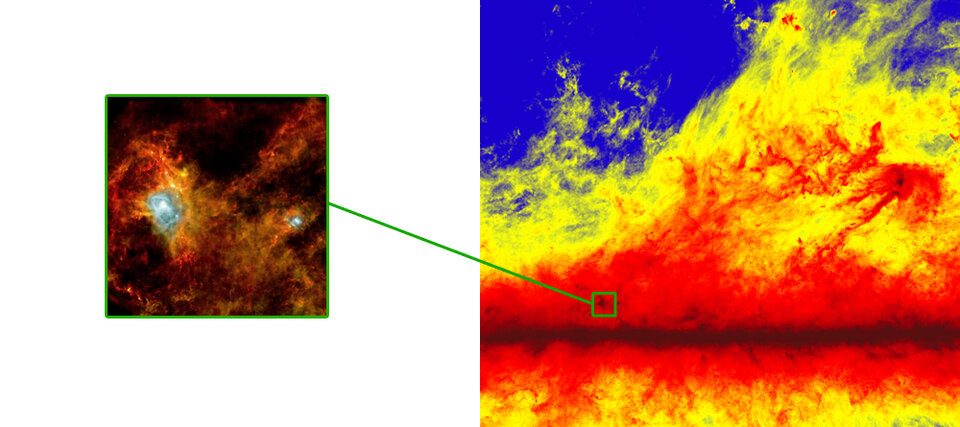
    Filamentary structures on large and small scales in the Milky Way

    ESA’s Herschel space telescope can be used to study such regions in detail, but only Planck can find them all over the sky. Launched together in May 2009, Planck and Herschel are both studying the coolest components of the Universe. Planck looks at large structures, while Herschel can make detailed observations of smaller structures, such as nearby star-forming regions.

    One puzzle to be solved is why there is similar filamentary structure on both the large and the small scale. “That’s a big question,” says Tauber.

    The new image is a combination of data taken with Planck’s High Frequency Instrument (HFI), at wavelengths of 540 micrometres and 350 micrometres, and a 100-micrometre image taken in 1983 with the IRAS satellite.

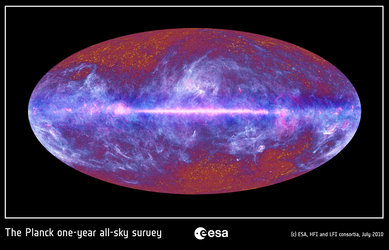
    The HFI data were recorded as part of Planck’s first all-sky survey at microwave wavelengths. As the spacecraft rotates, its instruments sweep across the sky. During every rotation, they cross the Milky Way twice. Thus, in the course of Planck’s mission to precisely map the afterglow of the big bang, it is also producing exquisite maps of the Galaxy.

    For more information

    Jan Tauber, Planck Project Scientist
    European Space Agency
    Email: Jan.Tauber @ esa.int

    Rate this

    Views

    Share

    • Currently 5 out of 5 Stars.
    • 1
    • 2
    • 3
    • 4
    • 5
    Rating: 4.75/5 (4 votes cast)

    Thank you for rating!

    You have already rated this page, you can only rate it once!

    Your rating has been changed, thanks for rating!

    466
    Tweet
    • Herschel: ESA's giant infrared observatory
    • Planck: looking back at the dawn of time
    • Planck on YouTube
    • Looking inside Planck
    • Related articles
      • Planck unveils the Universe – now and then
        • Planck highlights the complexity of star formation
          • Planck sees tapestry of cold dust
            • Planck first light yields promising results
              • Herschel and Planck pass in-orbit 'exam'
                • Coolest spacecraft ever in orbit around L2
                  • Planck satellite manoeuvre aims at L2 arrival
                    • Herschel and Planck commissioning has begun
                    • Read more
                      • L2, the second Lagrangian Point
                      • In depth
                      • This story in depth
                      • Planck in depth
                      • For specialists
                      • Planck Science Team
                      • For the media
                        • Notes for editors
                        • International participation in Herschel and Planck (pdf)
                        • Related links
                        • Planck on Chromoscope

    Connect with us

    • RSS
    • Youtube
    • Twitter
    • Flickr
    • G+
    • Facebook
    • Livestream
    • Subscribe
    • App Store
    • LATEST ARTICLES
    • · Earth Explorers take centre stage …
    • · The fast winds of Venus are gettin…
    • · ExoMars 2016 set to complete const…
    • · Herschel ends operations as orbiti…
    • · Europe’s largest spaceship reache…
    • FAQ

    • Jobs at ESA

    • Site Map

    • Contacts

    • Terms and conditions