• → European Space Agency

      • Space for Europe
      • Space News
      • Space in Images
      • Space in Videos
    • About Us

      • Welcome to ESA
      • DG's News and Views
      • For Member State Delegations
      • Business with ESA
      • ESA Exhibitions
      • ESA Publications
      • Careers at ESA
    • Our Activities

      • Space News
      • Observing the Earth
      • Human Spaceflight
      • Launchers
      • Navigation
      • Space Science
      • Space Engineering
      • Operations
      • Technology
      • Telecommunications & Integrated Applications
    • For Public

    • For Media

      • Media
      • ESA TV
      • Videos for professionals
      • Photos
    • For Educators

    • For Kids

    • ESA

    • Launch Special

    • Planck

    • Herschel

    • ESA Science

    • About Planck

      • Science objectives
      • Planck highlights
      • History of microwave astronomy
    • The Microwave Universe

      • Why the microwave
      • Key questions
    • The spacecraft

      • Vital stats
      • Telescope
      • Instruments
      • Sophisticated spacecraft
    • The mission

      • Journey
      • Launch and early operations
      • Operating Planck
    • Meet the team

      • Planck Project Scientist: An interview with Jan Tauber
      • Herschel and Planck Programme Manager: An interview with Thomas Passvogel
    • Multimedia
    • Planck images
    • Planck videos
    • Science@ESA vodcast

    ESA > Our Activities > Space Science > Planck

    Earth and a spacecraft orbiting the Sun
    Earth and a spacecraft orbiting the Sun

    What are Lagrange points?

    Joseph-Louis Lagrange
    Joseph-Louis Lagrange

    Lagrange points are locations in space where gravitational forces and the orbital motion of a body balance each other.

    They were discovered by French mathematician Louis Lagrange in 1772 in his gravitational studies of the ‘Three body problem’: how a third, small body would orbit around two orbiting large ones.

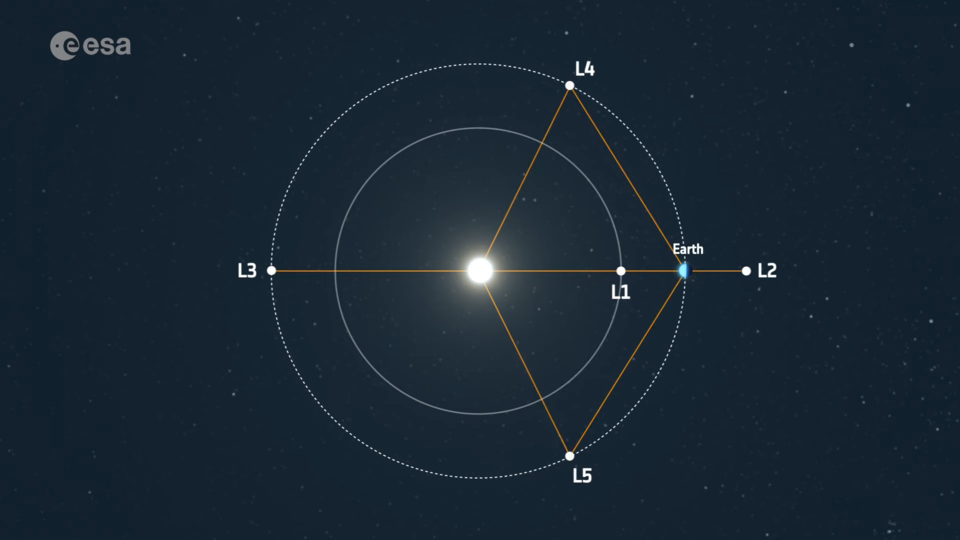
    There are five Lagrangian points in the Sun-Earth system and such points also exist in the Earth-Moon system.


    Descriptions of individual Lagrange points

    L1

    Spacecraft in 'sync' with Earth orbit
    Spacecraft in 'sync' with Earth orbit

    Kepler’s laws require that the closer a planet is to the Sun, the faster it will move. Any spacecraft going around the Sun in an orbit smaller than Earth's will also soon overtake and move away, and will not keep a fixed station relative to Earth.

    However, there is a loophole. If the spacecraft is placed between Sun and Earth, Earth's gravity pulls it in the opposite direction and cancels some of the pull of the Sun. With a weaker pull towards the Sun, the spacecraft then needs less speed to maintain its orbit.

    If the distance is just right - about a hundredth of the distance to the Sun - the spacecraft, too, will keep its position between the Sun and the Earth and will need just one year to go around the Sun. This is L1.

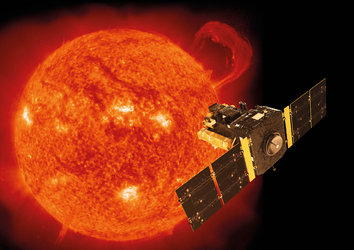
    L1 is a very good position for monitoring the Sun. The solar wind reaches it about one hour before reaching Earth. In 1978, the International Sun-Earth Explorer-3 (ISEE-3) was launched towards L1, where it conducted such observations for several years. Now the ESA/NASA SOHO solar watchdog is positioned there.

    Such spacecraft must have their own rocket engines because the position is unstable: if a spacecraft slips off L1, it will slowly drift away, and some correcting action is needed. In fact, the preferred position is actually some distance to the side of L1, because if the spacecraft is right on the Sun-Earth line, the antennas which track it from Earth are also aimed at the Sun, a source of interfering radio waves. Corrections are needed regularly.

    L2

    Spacecraft on L2
    Spacecraft on L2

    An effect similar to that which causes the L1 point occurs on the ‘night’ side of Earth (further away from the Sun but about the same distance from Earth).

    A spacecraft placed there is more distant from the Sun and therefore should orbit it more slowly than the Earth; but the extra pull of the Earth adds up to the Sun's pull, and this allows the spacecraft to move faster and keep up with Earth.

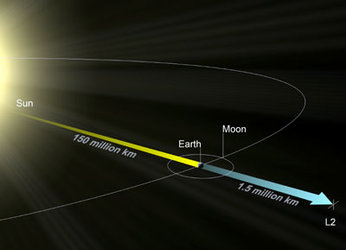
    At a certain point, the spacecraft’s orbital period equals that of Earth’s. This is L2. It is located 1.5 million kilometres directly 'behind' the Earth as viewed from the Sun. It is about four times further away from the Earth than the Moon.

    Gaia mapping the stars of the Milky Way
    Gaia mapping the stars of the Milky Way

    L2 is a great place from which to observe the larger Universe. A spacecraft would not have to make constant orbits of Earth, which result in it passing in and out of Earth's shadow and causing it to heat up and cool down, distorting its view. Free from this restriction and far away from the heat radiated by Earth, L2 provides a much more stable viewpoint.

    ESA has a number of missions that will make use of this spot in the coming years. L2 will become home to ESA missions such as Herschel, Planck, Gaia and the James Webb Space Telescope.

    L3

    Spacecraft on L3
    Spacecraft on L3

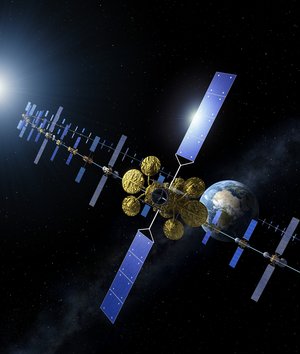
    L3 lies on a line defined by the Sun and Earth, but beyond the position of the Sun.

    On the opposite side of the Sun, just outside the orbit of Earth, the combination of the Sun’s and Earth’s gravity would cause a spaceraft’s orbital period to equal that of Earth.

    Since the position of this Lagrange point lies behind the Sun, any objects which may be orbiting there cannot be seen from Earth.

    L4 and L5

    The L4 and L5 points lie at 60 degrees ahead of and behind Earth in its orbit as seen from the Sun. Unlike the other Lagrange points, L4 and L5 are resistant to gravitational perturbations. Because of this stability, objects tend to accumulate in these points, such as dust and some asteroid-type objects.

    A spacecraft at L1, L2, or L3 is ‘meta-stable’, like a ball sitting on top of a hill. A little push or bump and it starts moving away. A spacecraft at one of these points has to use frequent rocket firings or other means to remain in the same place. Orbits around these points are called 'halo orbits'.

    But at L4 or L5, a spacecraft is truly stable, like a ball in a bowl: when gently pushed away, it orbits the Lagrange point without drifting farther and farther, and without the need of frequent rocket firings. The Sun's pull causes any object in the L4 and L5 locations to ‘orbit’ the Lagrange point in an 89-day cycle. These positions have been studied as possible sites for artificial space stations in the distant future.

    Last update: 12 February 2009

    Rate this

    Views

    Share

    • Currently 4.5 out of 5 Stars.
    • 1
    • 2
    • 3
    • 4
    • 5
    Rating: 4.31/5 (29 votes cast)

    Thank you for rating!

    You have already rated this page, you can only rate it once!

    Your rating has been changed, thanks for rating!

    8786
    Tweet
    • More about...
      • Mars Express overview
        • JWST
          • Gaia overview
          • Related articles
            • What are Lagrange points?
              • Types of orbit
                • L1, the first Lagrangian Point
                  • L2, the second Lagrangian Point

    Connect with us

    • RSS
    • Youtube
    • Twitter
    • Flickr
    • G+
    • Facebook
    • Livestream
    • Subscribe
    • App Store
    • LATEST ARTICLES
    • · The fast winds of Venus are gettin…
    • · ExoMars 2016 set to complete const…
    • · Herschel ends operations as orbiti…
    • · Europe’s largest spaceship reache…
    • · ATV ready to nose up to Station
    • FAQ

    • Jobs at ESA

    • Site Map

    • Contacts

    • Terms and conditions