Q - R
Q
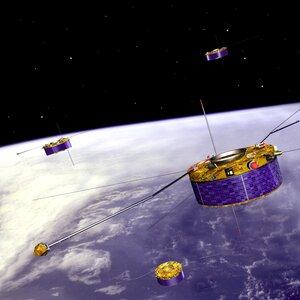
Qualification model
Satellite prototype used to confirm the design and performance of the final flight model.
Quantum (theory, mechanics)
Theory of physics that explains the behaviour of nature and its forces on a very small, subatomic scale. It states that physical quantities can only have discrete values (this is quantization). According to quantum mechanics photons or electrons may be considered as particles but they can also be diffracted like waves (this is referred to as wave-particle duality). This quantum theory was proposed by Max Planck in 1900. Quantum mechanics is the more formal mathematical description of his theory which was developed in the 1920's. It also incorporates the uncertainty principle, which states that you cannot measure a particle's position and velocity at the same time. The more accurately you know its position, the less accurately you know its velocity and vice versa.
Quark
An elementary particle which is believed to be the fundamental structural unit from which all other particles are made. There are six quarks: up, down, strange, charm, top and bottom. A proton is made up of one down quark and two up quarks.
Quasar
Quasi-stellar extragalactic object.
Quick-look analysis
Initial examination of scientific data before further processing and investigation.
R
Radiation
Used as a synonym for electromagnetic radiation.
Radiation belt (van Allen)
Two doughnut-shaped belts of charged particles interacting with Earth's magnetic field. They are made up of electrons, protons and heavier atomic ions originating from the solar wind. These particles get trapped in the magnetic field of the Earth. The belts were discovered by James van Allen in 1958 and were named in his honour. The lower van Allen belt extends from 800-6000 km above the surface of the Earth while the upper belt lies between 25 000 to 36 000 km above the equator.
Radio waves
Form of electromagnetic radiation with wavelengths ranging from millimetres to hundreds of kilometres.
Radioactivity
Spontaneous decay of atomic nuclei. An unstable nucleus may decay to one or more lighter nuclei. During the process radiation is emitted. There are three types of radioactive emissions: alpha particles (nuclei of helium), beta-rays (fast electrons) and gamma rays (high-energy photons). In the Universe radioactive atoms are formed in supernova explosions.
Reboost
To boost a satellite back into its original orbit after the orbit has decayed because of atmospheric drag.
Recombination era
The time when matter and radiation first separated. The Universe became 'transparent'; the cosmic microwave background was emitted. The 'decoupling' between matter and radiation happened because the Universe was cool enough already to allow protons to capture one electron and form a neutral atom of hydrogen: the electrons, charged particles that interact strongly with light, were not free anymore, and light could propagate. This happened some 300 000 years after the Big Bang.
Red Giant
An old star that has used up all the hydrogen in its nucleus (see Nucleosynthesis) and uses instead other elements as fuel to keep shining. The Sun will become a red giant in the future. These stars can be 25 times as big as the Sun, and hundreds of times brighter.
Redshift
When a distant object moves away from the observer the lines in its spectrum are shifted to longer (redder) wavelengths. This is because of the apparent stretching of the wave of light due to the recession of the object: as a result of this stretching the wave 'lengthens' and thus shifts towards the red side of the electromagnetic spectrum. The redshift of an astronomical object is an indication of the speed at which this object is receding. This data, combined with the Hubble Constant, will lead to an estimate of the distance of the object. (See Hubble Law for explanation.) The redshift of an object is symbolised by 'z'.
Reduction
A chemical reaction in which electrons are gained, or the chemical addition of hydrogen takes place.
Reflecting telescope
Telescope that uses mirrors to collect and focus incoming light.
Reflector
A telescope that uses a mirror – instead of a lens – to collect and focus the light coming from astronomical objects. The term 'reflector' is also used for the mirror itself.
Refracting telescope
Telescope that uses lenses to collect and focus light.
Replication
Process by which multiple copies of an original element are reproduced, all with identical characteristics.
Resolution (angular, spectral)
Ability to discriminate fine detail in an image, a spectrum or data. The angular resolution of a telescope is the smallest angle between two point objects that produces distinct images. In a spectrum, the resolution determines how well closely spaced features in the wavelength spectrum can be detected.
Retrograde
The motion of a planet or other Solar System body in a clockwise direction. Most Solar System bodies orbit or rotate about their axes in an anti-clockwise direction when looked at from the north pole of the body or the Sun.
Revolution
A rotation through a full circle, or 360 degrees.
Rings (Saturn's)
A series of rings surrounding Saturn, composed of dust and solid fragments and distributed in the equatorial plane of the planet at several distances. The rings are just a few hundred meters high and can not collapse into a satellite, because they are located inside the Roche limit.
Ritchey-Chretien
A modern optical design for two-mirror reflecting telescopes. It is a derivative of the Cassegrain concept in which the primary mirror has a hyperbolic cross-section.
Robot
A machine, often computer controlled, that is capable of performing complex tasks automatically.
Roche limit
The minimum distance at which an orbiting satellite is not destroyed by tidal forces.
Rocket
Commonly used term for a launch vehicle.
Rotation
The action of moving in a circle around an axis or fixed point.
Rover
A small remote-controlled vehicle for exploring the terrain close to a lander situated on a planetary surface.