• → European Space Agency

      • Space for Europe
      • Space News
      • Space in Images
      • Space in Videos
    • About Us

      • Welcome to ESA
      • DG's News and Views
      • For Member State Delegations
      • Business with ESA
      • ESA Exhibitions
      • ESA Publications
      • Careers at ESA
    • Our Activities

      • Space News
      • Observing the Earth
      • Human Spaceflight
      • Launchers
      • Navigation
      • Space Science
      • Space Engineering
      • Operations
      • Technology
      • Telecommunications & Integrated Applications
    • For Public

    • For Media

    • For Educators

    • For Kids

    • ESA

    • Rosetta

    • ESA Science

    • About Rosetta

      • Rosetta at a glance
      • Europe's comet chaser
      • Why 'Rosetta'?
    • About the spacecraft

      • The Rosetta orbiter
      • Orbiter: Instruments
      • The Rosetta lander
      • Lander: Instruments
    • About the journey

      • The long trek
      • Debris of the Solar System: Asteroids
      • Asteroid (2867) Steins: a portrait
      • Life and survival in deep space
      • Long-distance communication
      • The Rosetta ground segment
    • About the arrival

      • Comets - an introduction
      • Comet 67P/Churyumov- Gerasimenko
      • Comet rendezvous
      • Giotto - ESA's first comet mission
    • Meet the team
    • Mission Manager
    • Project Scientist
    • Multimedia
    • VideoTalk
    • 3D Flash 'model'
    • Rosetta images
    • Rosetta videos
    • Rosetta Animations
    • Rosetta wallpaper
    • Life of a comet
    • Services
    • Frequently asked questions
    • Comments

    ESA > Our Activities > Space Science > Rosetta

    Comet rendezvous

    Rosetta: Europe’s comet chaser

    The most difficult phase of the Rosetta mission is the final rendezvous with the fast-moving comet. After the braking manoeuvre in May 2014, the priority will be to edge closer to the nucleus.

    Since this takes place before Rosetta's cameras have imaged the comet, accurate calculations of Comet 67P/Churyumov-Gerasimenko's orbit, based on ground-based observations, are essential.

    Comet approach (January – May 2014)

    Comet approach
    Comet approach

    The spacecraft is re-activated prior to the comet rendezvous manoeuvre, during which the thrusters fire for several hours to slow the relative drift rate of the spacecraft and comet to about 25 metres per second.

    As Rosetta drifts towards the heart of the comet, the mission team will try to avoid any comet dust and achieve good comet illumination conditions. The first camera images will dramatically improve calculations of the comet’s position and orbit, as well as its size, shape and rotation.

    The relative speeds of the spacecraft and comet will gradually be reduced, slowing to 2 metres per second after about 90 days.


    Comet mapping and characterisation (August 2014)

    Artist view of the Rosetta lander
    Rosetta’s Philae lander on comet nucleus

    Less than 200 kilometres from the nucleus, images from Rosetta show the comet’s spin-axis orientation, angular velocity, major landmarks and other basic characteristics.

    Eventually, the spacecraft is inserted into orbit around the nucleus at a distance of about 25 kilometres. Their relative speed is now down to a few centimetres per second.

    The orbiter starts to map the nucleus in great detail. Eventually, five potential landing sites are selected for close observation.

    Landing on the comet (November 2014)

    Once a suitable landing site is chosen, the lander is released from a height of about one kilometre. Touchdown takes place at walking speed — less than one metre per second.

    Once it is anchored to the nucleus, the lander sends back high-resolution pictures and other information on the nature of the comet’s ices and organic crust.

    The data are relayed to the orbiter, which stores them for transmission back to Earth at the next the period of contact with a ground station.

    Around the Sun (November 2014 – December 2015)

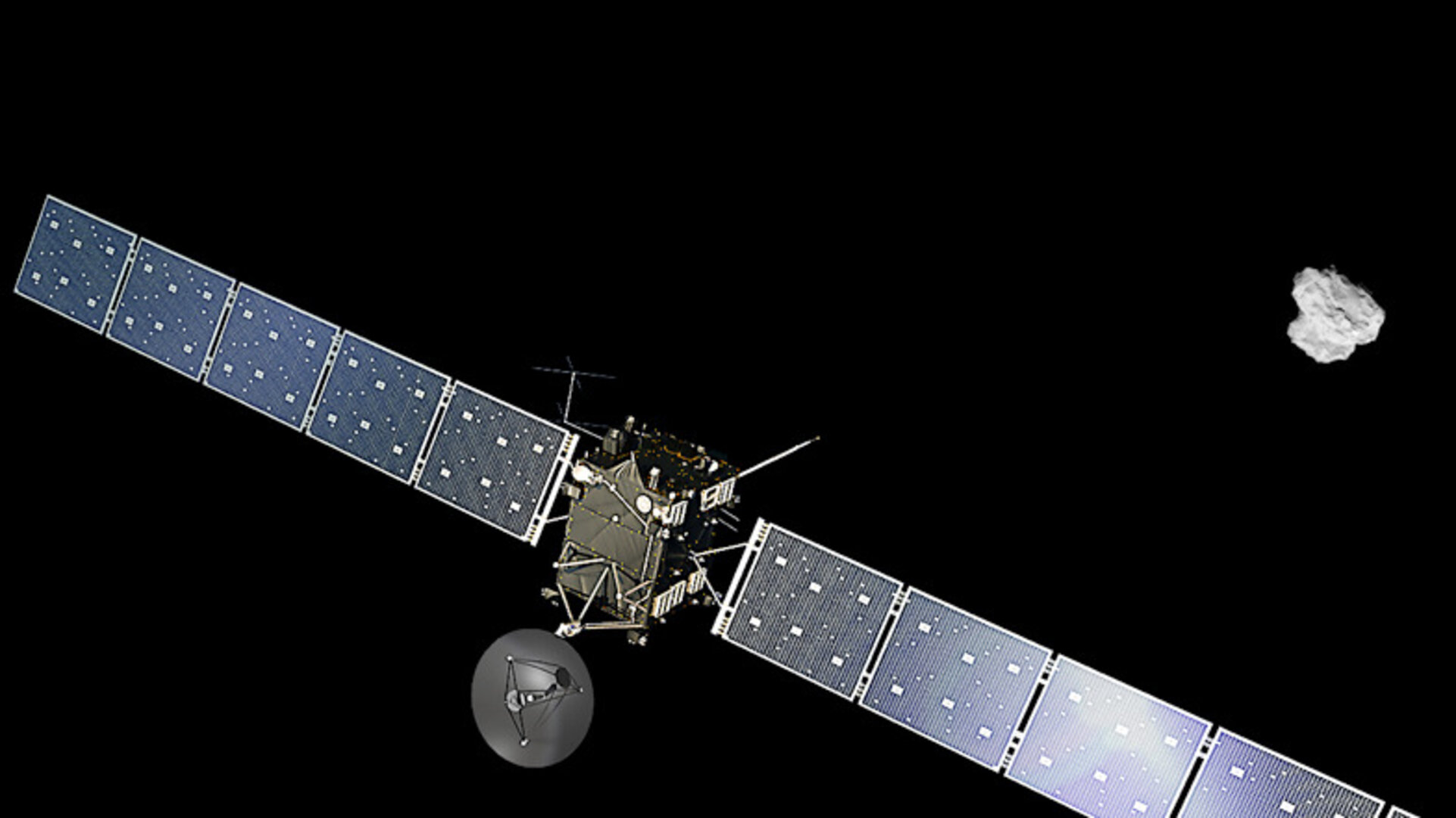
    Rosetta spacecraft
    Rosetta orbiting Comet 67P/Churyumov-Gerasimenko

    The orbiter continues to orbit Comet 67P/Churyumov-Gerasimenko, observing what happens as the icy nucleus approaches the Sun and then travels away from it.

    The mission ends in December 2015. Rosetta will once again pass close to Earth’s orbit, more than 4000 days after its adventure began.

    Last update: 22 October 2004

    Rate this

    Views

    Share

    • Currently 0 out of 5 Stars.
    • 1
    • 2
    • 3
    • 4
    • 5
    Rating: 0/5 (0 votes cast)

    Thank you for rating!

    You have already rated this page, you can only rate it once!

    Your rating has been changed, thanks for rating!

    118
    facebook
    twitter
    reddit
    google plus
    digg
    tumbler
    digg
    blogger
    myspace
    • More about...
    • Rosetta
      • Rosetta factsheet
      • Rosetta press kit
      • Related articles
        • Comets - an introduction
          • History of cometary missions
            • Accidental space scientist: An interview with Gerhard Schwehm
              • Hubble assists Rosetta comet mission
                • Why 'Rosetta'?

    Connect with us

    • RSS
    • Youtube
    • Twitter
    • Flickr
    • Google Buzz
    • Subscribe
    • App Store
    • LATEST ARTICLES
    • · CryoSat hits land
    • · Ariane 5 completes seven launches …
    • · Measuring skull pressure without t…
    • · Malargüe station inauguration
    • · The solar wind is swirly
    • FAQ

    • Jobs at ESA

    • Site Map

    • Contacts

    • Terms and conditions