• → European Space Agency

      • Space for Europe
      • Space News
      • Space in Images
      • Space in Videos
    • About Us

      • Welcome to ESA
      • DG's News and Views
      • For Member State Delegations
      • Business with ESA
      • ESA Exhibitions
      • ESA Publications
      • Careers at ESA
    • Our Activities

      • Space News
      • Observing the Earth
      • Human Spaceflight
      • Launchers
      • Navigation
      • Space Science
      • Space Engineering
      • Operations
      • Technology
      • Telecommunications & Integrated Applications
    • For Public

    • For Media

    • For Educators

    • For Kids

    • ESA

    • Rosetta

    • ESA Science

    • About Rosetta

      • Rosetta at a glance
      • Europe's comet chaser
      • Why 'Rosetta'?
    • About the spacecraft

      • The Rosetta orbiter
      • Orbiter: Instruments
      • The Rosetta lander
      • Lander: Instruments
    • About the journey

      • The long trek
      • Debris of the Solar System: Asteroids
      • Asteroid (2867) Steins: a portrait
      • Life and survival in deep space
      • Long-distance communication
      • The Rosetta ground segment
    • About the arrival

      • Comets - an introduction
      • Comet 67P/Churyumov- Gerasimenko
      • Comet rendezvous
      • Giotto - ESA's first comet mission
    • Meet the team
    • Mission Manager
    • Project Scientist
    • Multimedia
    • VideoTalk
    • 3D Flash 'model'
    • Rosetta images
    • Rosetta videos
    • Rosetta Animations
    • Rosetta wallpaper
    • Life of a comet
    • Services
    • Frequently asked questions
    • Comments

    ESA > Our Activities > Space Science > Rosetta

    Comets - an introduction

    Giotto's art shows a comet in the background
    Giotto's art shows a comet in the background

    Comets are the most primitive objects in the Solar System. Many scientists think that they have kept a record of the physical and chemical processes that occurred during the early stages of the evolution of our Sun and Solar System.

    The abundance of volatile material in comets makes them particularly important and extraordinary objects. This characteristic demonstrates that comets were formed at large distances from the Sun and have been preserved at low temperatures since their formation. Cometary material therefore represents the closest we can get to the conditions that occurred when the Sun and our Solar System were born.

    Our knowledge of comets and asteroids has dramatically improved over the last 20 years. The major milestones were undoubtedly the first fly-bys of Comet Halley by ESA's Giotto and the Russian Vega probes in 1986. In 1991, NASA's Galileo spacecraft made the first near encounter with a main-belt asteroid, Gaspra, on its way to Jupiter.


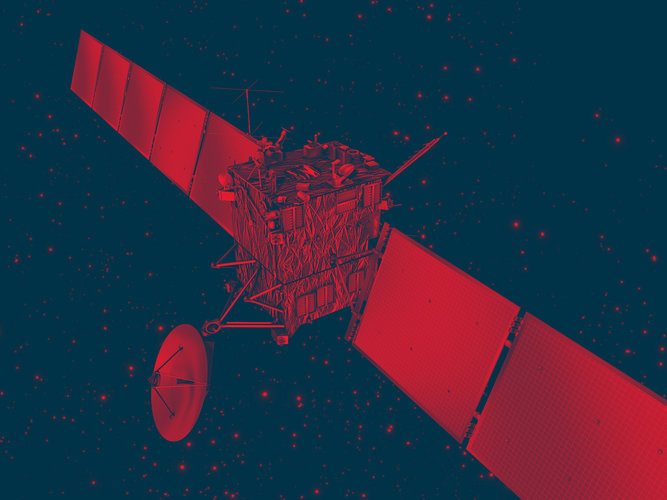
    Rosetta: ESA's comet chaser
    Rosetta: ESA's comet chaser

    During the same period, telescope observations from the ground or in Earth orbit (for instance from the ESA/NASA SOHO and Hubble Space Telescope missions) have increased. They form the basis for understanding these small bodies, since we can now compare observations of a very large variety of objects, and can undertake wider investigations of cometary activity.

    From this wealth of new information, it is becoming apparent that there is no clear boundary between asteroids and comets. Indeed, the outermost asteroids show similarities with the cometary nuclei observed far from the Sun. The most distant 'asteroid', Chiron, whose orbit is outside that of Saturn, is considered to be a giant cometary nucleus. Furthermore, short-period comets (comets with smaller and faster orbits) should ultimately evolve into asteroids after the depletion of their volatile components.

    A better understanding of the relationship between asteroids and comets throughout the Solar System is thus an essential step in unravelling the first stages of the formation of our Sun and its neighbourhood.

    ESA's Rosetta mission has been designed specifically to achieve important scientific goals by making investigations actually on and around a comet itself. The lander will provide information on the chemical and physical properties of a selected area of comet surface.

    The main spacecraft will perform sophisticated analyses on the dust grains and the gas flowing out from the nucleus. It will remain for most of the mission within a few tens of kilometres of the nucleus, where the analysed dust and gas is likely to be very similar to the surface material, and where it can be traced back to specific active regions on the comet surface. The physics of the outer coma and the interaction with the solar wind will also be studied.

    Last update: 9 November 2007

    Rate this

    Views

    Share

    • Currently 0 out of 5 Stars.
    • 1
    • 2
    • 3
    • 4
    • 5
    Rating: 0/5 (0 votes cast)

    Thank you for rating!

    You have already rated this page, you can only rate it once!

    Your rating has been changed, thanks for rating!

    39
    facebook
    twitter
    reddit
    google plus
    digg
    tumbler
    digg
    blogger
    myspace
    • ESA's comet chaser: Rosetta
    • More about...
      • Rosetta at a glance
      • Rosetta press kit
      • Related articles
        • Rosetta's journey
          • History of cometary missions
            • Why 'Rosetta'?
              • Comets - an introduction
                • Life of a comet
                  • How many comets are there?
                    • Where life began
                    • Related links
                    • Arianespace
                    • Astrium
                    • DLR

    Connect with us

    • RSS
    • Youtube
    • Twitter
    • Flickr
    • Google Buzz
    • Subscribe
    • App Store
    • LATEST ARTICLES
    • · CryoSat hits land
    • · Ariane 5 completes seven launches …
    • · Measuring skull pressure without t…
    • · Malargüe station inauguration
    • · The solar wind is swirly
    • FAQ

    • Jobs at ESA

    • Site Map

    • Contacts

    • Terms and conditions