Rosetta's frequently asked questions
Why is the mission called Rosetta?
The mission is named after the Rosetta Stone, a slab of volcanic basalt found near the Egyptian town of Rashid (Rosetta) in 1799. The stone revolutionised our understanding of the past. By comparing the three carved inscriptions on the stone (written in two forms of Egyptian and Greek), historians were able to decipher the mysterious hieroglyphics – the written language of ancient Egypt. As a result of this breakthrough, scholars were able to piece together the history of a lost culture.
The Rosetta Stone provided the key to an ancient civilisation. ESA’s Rosetta mission will allow scientists to unlock the mysteries of the oldest building blocks of our Solar System: comets.
When was the mission approved?
The Rosetta Mission was approved as a Cornerstone Mission in ESA's first long-term science programme (Horizon 2000) in November 1993.
What are the mission’s objectives?
Rosetta's prime objective is to help understand the origin and evolution of the Solar System. The comet’s composition reflects the composition of the pre-solar nebula out of which the Sun and the planets of the Solar System formed, more than 4.6 billion years ago. Therefore, an in-depth analysis of comet 67P/Churyumov-Gerasimenko by Rosetta and its lander will provide essential information to understand how the Solar System formed.
There is convincing evidence that comets played a key role in the evolution of the planets, because cometary impacts are known to have been much more common in the early Solar System than today. Comets, for example, probably brought much of the water in today's oceans. They could even have provided the complex organic molecules that may have played a crucial role in the evolution of life on Earth.
What makes the Rosetta mission so special?
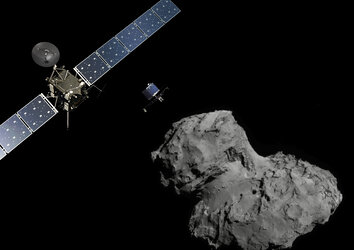
Rosetta will be undertaking several ‘firsts’ in space exploration. It will be the first mission to orbit and land on a comet. That makes Rosetta one of the most complex and ambitious missions ever undertaken. Scientists had to plan in advance, in the greatest possible detail, a ten year trip through the Solar System. Approaching, orbiting, and landing on a comet require delicate and spectacular manoeuvres. The comet, 67P/Churyumov-Gerasimenko, is a relatively small object, about 4 kilometres in diameter, moving at a speed as great as 135,000 kilometres per hour. We know very little about its actual surface properties – only when we get there will we be able to explore the surface in such detail that we can choose a safe landing scenario. Rosetta is very special because of the unique science it will perform. No other previous mission has had Rosetta’s potential to look back to the infant Solar System and investigate the role comets may have played in the beginnings of life on Earth.
Rosetta will be the first spacecraft to witness, at close proximity, how a comet changes as it approaches the increasing intensity of the Sun’s radiation. The comet develops the so-called ‘coma’ (essentially the comet’s atmosphere) and the two characteristic ion and dust tails. Rosetta’s lander will obtain the first images from a comet’s surface and make the first in-situ subsurface analysis of its composition.
It will also be the first mission to investigate a comet’s nucleus and environment over an extended period of time.
How did Rosetta reach comet 67P/Churyumov-Gerasimenko, and how long did it take?
Comet 67P/Churyumov-Gerasimenko loops around the Sun between the orbits of Jupiter and Earth, that is, between about 800 million and 186 million kilometres from the Sun. But rendezvousing with the comet required travelling a cumulative distance of over 6.4 billion kilometres. As no launcher was capable of directly injecting Rosetta into such an orbit, gravity assists were needed from four planetary flybys – one of Mars (2007) and three of Earth (2005, 2007 and 2009) – a long circuitous trip that took ten years to complete.
Why is it so important to study comets?
Comets are of great interest to scientists because, to our knowledge, they are the oldest, most primitive bodies in the Solar System, preserving the earliest record of material from the nebula out of which our Sun and planets were formed. Planets have gone through chemical transformations, but comets have remained almost unchanged. Furthermore, comets brought ‘volatile’ light elements to the planets and likely played an important role in forming oceans and atmospheres. Comets also carry complex organic molecules that may have been involved in the origin of life on Earth.
What do we presently know about how the Solar System formed?
The Solar System formed about 5 billion years ago when a cloud of gas and dust – called the ‘pre-solar nebula’ – started to collapse due to gravitational forces. A disc of leftover material made of the same gas and dust present in the primordial cloud formed around the still-forming Sun. After the Sun ‘ignited’ and began its life as star, most of the particles in this disc collided and stuck to one another, growing in size until they became the planets and the other Solar System bodies.
However, it took some time before the Solar System became the way it is now. About 4.5 billion years ago, it was still 'under construction', and interplanetary space was littered with conglomerates of dust particles. Many of these chunks hit the planets and were destroyed in the collision, but thousands of millions of them survived – they are the asteroids and comets we know today.
How will Rosetta be able to gauge the contribution comets made to the beginnings of life on Earth?
Previous studies by ESA’s Giotto spacecraft and ground-based observatories have shown that comets contain complex organic molecules. These are compounds that are rich in carbon, hydrogen, oxygen, and nitrogen. Intriguingly, these are the elements that make up nucleic acids and amino acids, essential ingredients for life as we know it. Did life on Earth begin with the help of comet seeding? Although Rosetta may not give us a definitive answer, it will provide a wealth of information. For example, the mass spectrometers on the orbiter and the lander will analyse, more precisely than ever before, the kind of organic molecules present in the comet. Laboratory simulations of interstellar processes showed that such instruments can detect a variety of amino acids.
How will the mission determine whether comets provided some of the water present in today's oceans?
Rosetta will investigate this by analysing the isotopic abundances in the cometary ices. The isotopes of a certain chemical element are atoms of the same kind that differ slightly in weight. Deuterium, for example, is an isotope of hydrogen; it is also heavier than hydrogen. All the deuterium and hydrogen in the Universe was made just after the Big Bang, about 13.7 billion years ago, fixing the overall ratio between the two kinds of atoms. However, the ratio seen in water can vary from location to location. The chemical reactions involved in making ice in space lead to a higher or lower chance of a deuterium atom replacing one of the two hydrogen atoms in a water molecule, depending on the particular environmental conditions. Thus, by comparing the deuterium to hydrogen ratio found in the water in Earth's oceans with that in extraterrestrial objects, we can try to identify the origin of Earth’s water. For example, if the hydrogen-deuterium ratio in the ocean water is similar to that in the cometary ice, it will support the theory that a fraction of the Earth's water has its origin in space. ESA’s Herschel mission has already found a very similar deuterium-to-hydrogen ratio in comet Hartley-2.
How long will the Rosetta spacecraft operate?
Rosetta’s planned lifetime is about 12 years. The nominal mission ends in December 2015, after the comet reaches its closest point to the Sun (in August 2015) and starts heading back towards the outer Solar System.
How long will the lander operate on the comet nucleus?
The Rosetta lander, called Philae, will touch down on the comet's surface on 12 November 2014. The science observations will start immediately. During the first 2.5 days the first series of scientific measurements will be completed. During this phase the lander will operate on primary battery power. In a second phase that may last up to three months, a secondary set of observations will be conducted, using backup batteries that will be recharged by the energy from the solar cells on the lander. However, no one knows precisely how long the lander will survive on the comet.
Could activity on the comet's surface damage or destroy the lander?
Survival of the lander depends on a number of factors, such as power supply, temperature, or surface activity on the comet. For example, dust may cover the solar panels, preventing the battery from recharging. In any case, by March 2015, when the comet is closer to the Sun, it is likely that the lander will become too hot to operate.
What scientific instruments are on board the spacecraft and what will they do?
Rosetta's goal is to examine the comet in great detail. The instruments on the Rosetta orbiter include several cameras, spectrometers, a number of sensors, and experiments that work at different wavelengths – infrared, ultraviolet, microwave, and radio. They will provide, among other things, very high-resolution images and information about the shape, density, temperature, and chemical composition of the comet. Rosetta’s instruments will analyse the gases and dust grains in the so-called ‘coma' that forms when the comet becomes active, as well as the interaction with the solar wind.
What scientific instruments are on board the lander and what function will they perform?
The 10 instruments on board the lander will do an on-the-spot analysis of the composition and structure of the comet’s surface and subsurface material. A drilling system will obtain samples down to 23 cm below the surface and will feed these to the spectrometers for analysis, such as to determine the chemical composition. Other instruments will measure properties such as near-surface strength, density, texture, porosity, ice phases and thermal properties. Microscopic studies of individual grains will tell us about the texture. In addition, instruments on the lander will study how the comet changes during the day-night cycle, and while it approaches the Sun.
How were the instruments selected?
The most important factors in the selection of each instrument were their expected scientific performance and their technical feasibility. How the instruments fitted together was another consideration, as well as the experience of the team proposing the instrument. This selection was done on the basis of the so-called 'Announcement of Opportunity' (AO) issued by ESA to the scientific community, which is basically an open competition. This AO defines the mission scientific objectives and requirements, and the scientific community had to be compliant with these when submitting their proposals.
How does Rosetta fit into the overall scheme of cometary exploration?
Europe has been a pioneer in exploring comets and asteroids. In 1986, ESA’s Giotto probe flew within 600 kilometres of the comet Halley, closer than any previous spacecraft, and sent back detailed images and data showing, among other things, that comets contain complex organic molecules. Giotto continued its successful journey and in 1992 flew within 200 km of the comet Grigg-Skjellerup, detecting its nucleus. The mission was the first to observe a comet nucleus and confirm theories suggesting that comets were not mere rubble piles or conglomerates of small fragments.
Giotto was part of the five-spacecraft Halley Armada, which also included Russia’s VEGA 1 and 2 spacecraft and two Japanese spacecraft, Susei and Sagigake. Like Giotto, these probes also visited Halley in 1986.
Among other comet missions were a trio of NASA probes: Deep Space 1, which flew by the comet Borelly in 2001; Stardust, which returned samples from the coma of Wild 2 in 2006 and later flew by Tempel 1; and Deep Impact, which in 2005 shot a massive block of copper into the nucleus of Tempel 1 before going on to fly by Hartley 2 and image the comet ISON. Another NASA mission, Contour, launched in Summer 2002, failed when it was incorrectly inserted into its interplanetary trajectory.
Missions have also visited asteroids. In 2005, Japan’s Hayabusa rendezvoused with and landed on the asteroid Itokawa. Six years later, another NASA mission, Dawn, explored the asteroid Vesta. Dawn is now en route to dwarf planet Ceres, which is the largest object in the Asteroid Belt.
What was known about the comet before Rosetta arrived there?
Comet 67P/Churyumov-Gerasimenko orbits the Sun once every 6.6 years. This makes it a short-period comet.
Ground-based telescopes have observed 67P/Churyumov-Gerasimenko during almost all its appearances since its discovery in 1969. To acquire as much information as possible about Rosetta’s target comet, ESA implemented a rigorous ground and space-based observation programme of 67P/Churyumov-Gerasimenko. These observations provided a fairly reliable estimate of the comet’s size – about 4 kilometres in diameter.
Where was 67P/Churyumov-Gerasimenko at the time of the rendezvous?
Rosetta met 67P/Churyumov-Gerasimenko on 6 August 2014 when it was still in the cold regions of the Solar System, 539 million kilometres from the Sun, when the comet and Rosetta were on their return journey back into the inner Solar System.
Was the comet active at the time of rendezvous?
As we expected, the comet was only showing minimal signs of activity at the time of rendezvous.
When comets get close to the Sun, the Sun’s heat 'activates' them. The frozen gases on and below the surface sublimate – they pass directly from the solid to the gaseous state – and the outflowing gas drags small dust grains with it into surrounding space. This creates an atmosphere around the nucleus, known as the coma, and generates a dust tail that streams out behind the comet along its orbit. Rosetta will therefore become the first spacecraft to witness at close quarters the development of a comet's coma and subsequent tails.
When does 67P/Churyumov-Gerasimenko come closest to the Sun?
Comet 67P/Churyumov-Gerasimenko orbits the Sun once every ~6.5 years. The most recent perihelion occurred on 13 August 2015, with the comet (and Rosetta) passing within 186 million kilometres from the Sun (between the orbits of Earth and Mars).
What is the gravity on 67P/Churyumov-Gerasimenko's surface, compared with that on Earth?
Comet 67P/Churyumov-Gerasimenko is so small that its gravitational pull is several hundred thousand times weaker than on Earth. For this reason, the Rosetta lander will touch down at no more than a walking pace. It will need a harpoon to safely anchor it to the comet’s surface and prevent it from bouncing back into space.
Why is the comet called 67P/Churyumov-Gerasimenko?
67P/Churyumov-Gerasimenko is named after its discoverers, Klim Churyumov and Svetlana Gerasimenko, astronomers from Kiev who “spotted” the comet for the first time in 1969 on a photographic plate. The 'P' identifies short-period comets with a well-established orbit around the Sun and that take less than 200 years to complete a solar revolution. The number 67 refers to Churyumov-Gerasimenko's position in the list of catalogued periodic comets. The most famous, Halley, is designated 1P.
How many comets are there in the Solar System?
There are billions of comets in our Solar System, which are typically located in one of two regions. The most distant repository of comets is the Oort cloud, at the edge of the Solar System, 100,000 times more distant from the Sun than the Earth, and which is estimated to contain about 12 billion comets. Closer in, just beyond the orbit of Neptune, is the Kuiper belt, which also contains billions of comets and extends from 30 to 50 times the distance equivalent to the Sun-Earth separation (150 million km, or 1 AU).
Some comets escape from these regions and journey into the inner Solar System. Every year many new comets are discovered in this region, often ‘sungrazers’ spotted by ESA/NASA’s SOHO spacecraft. Sungrazers travel very close to the Sun, and are sometimes partially or completely destroyed in the encounter. Comet ISON is a well-known example of a sungrazing comet.
What is the difference between asteroids and comets?
Comets are typically nicknamed 'dirty ice-balls', whereas asteroids, or minor planets, are known, in very simple terms, as ‘rocks in space’. The size of asteroids typically ranges from a metre to several hundred kilometres across. One of the main differences is that asteroids do not usually contain ‘volatiles’ (substances that sublimate i.e. when heated they pass directly from the solid to the gaseous state). Therefore asteroids do not develop a tail or a coma when they approach the Sun. However, a recent class of object has been discovered in the main asteroid belt that are asteroids behaving like comets, sometimes suddenly sporting a dust tail. These are termed ‘main belt comets’ There is also good evidence that some asteroids are 'dead comets', comets that have lost their volatile materials after many approaches to the Sun.
Who are the Rosetta mission contractors?
Rosetta’s industrial team involves more than 50 contractors from 14 European countries and the United States. The prime spacecraft contractor – the company leading the entire industrial team – is Astrium Germany. Major subcontractors are Astrium UK (spacecraft platform), Astrium France (spacecraft avionics) and Alenia Spazio (assembly, integration and verification).
Who built Rosetta’s instrument and lander package?
The orbiter's scientific payload was provided by scientific consortia from institutes across Europe and the United States.
The lander is provided by a European consortium under the leadership of the German Aerospace Research Institute (DLR). Other members of the consortium are ESA and institutes from Austria, Finland, France, Germany, Hungary, Ireland, Italy, and the United Kingdom.
Was new technology developed for Rosetta and can it be reused for other ESA missions?
The solar cells in Rosetta's solar panels are based on a completely new technology, so-called Low-intensity Low Temperature Cells. Thanks to them, Rosetta is the first space mission to journey beyond the main asteroid belt relying solely on solar cells for power generation. Previous deep-space missions used nuclear RTGs (Radio isotope thermal generators). The new solar cells allow Rosetta to operate over 800 million kilometres from the Sun, where levels of sunlight are only 4% those on Earth. The technology will be available for future deep-space flights, such as ESA’s upcoming Jupiter Icy Moons Explorer.
Systems that control the temperature inside the spacecraft are another example of technological spinoffs from the Rosetta mission. When a spacecraft is near the Sun, overheating is a problem, and can be prevented by using radiators. But in the outer Solar System, the problem is keeping the spacecraft and its subsystems warm. The system devised for Rosetta employs several new techniques, including the installation of louvres over the radiators, to keep spacecraft hardware at proper operating temperatures.
Rosetta also includes a number of highly innovative subsystems, some of which have been reused in other ESA missions, including Mars and Venus Express.
How many people are involved in the Rosetta programme, and how many jobs has it created?
About 2,000 people from industry, ESA and scientific institutions were involved in Rosetta's development. It is difficult to establish exactly how many new jobs were created, but Rosetta has certainly helped contribute to the development of the space sector both from the industrial and the scientific point of view.
Who will obtain data from Rosetta, and how will it be distributed?
Rosetta's Science Ground Segment will be responsible for collecting and distributing the scientific data. The unit will be based at the European Space Operations Centre (ESOC) in Darmstadt, Germany, and at the European Space Astronomy Centre (ESAC) in Villanueva de la Cañada, Madrid, Spain. It will be responsible for the collection of the scientific data received from the spacecraft and its distribution to the principal investigators.
The principal investigators head up the teams building the Rosetta instruments and will have the exclusive right to work with the data for six months. After this period, the data will be stored in ESA’s Planetary Science Archive and made freely available to the world's scientific community.
How big is the spacecraft?
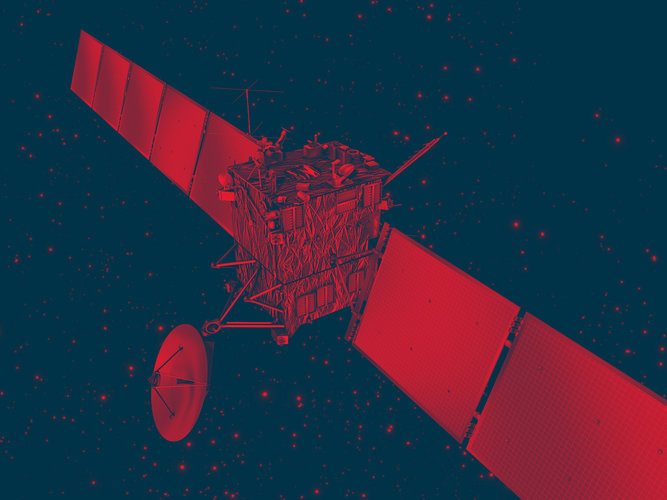
The spacecraft dimensions are 2.8 x 2.1 x 2.0 metres. There are two 14-metre-long solar panels with a total area of 64 square metres. From tip to tip, the spacecraft spans 32 metres.
Rosetta's total launch mass is 3,000 kilograms. The spacecraft carries 1,670 kilograms of propellant and the lander weighs 100 kilograms.
How will Rosetta be powered?
The spacecraft relies entirely on the energy provided by its innovative solar panels for all onboard instruments and subsystems.
What challenges did Rosetta face during its long trip through the Solar System?
Ensuring that the spacecraft could survive the hazards of travelling through deep space for more than 10 years, from the benign environment of near-Earth space to the frigid regions beyond the asteroid belt, was one of the principal challenges of the mission. Temperature control was particularly critical, and the spacecraft was put through stringent pre-launch tests in ESA’s environmental test facilities in the Netherlands to confirm its endurance. These tests involved heating the outside surfaces to more than 150°C and then cooling them to -180°C without damaging the instruments.
Is Rosetta pre-programmed or are commands sent from the ground?
Rosetta is operated from the ground. It was impossible to programme manoeuvres for the whole mission before the launch because this would have entailed adjustments at each stage of the journey. Ground commands are sent periodically to readjust the spacecraft’s trajectory. These take up to 50 minutes to reach the spacecraft, when it is farthest from the Earth.
How does the spacecraft deal with this long time lag?
To compensate for the delay, Rosetta is provided with built-in intelligence to look after itself. This is done by its on-board computers, whose tasks include data management and attitude and orbit control. In the event of problems during the lengthy cruise, experts added backup systems to ensure that the spacecraft could remain operational during critical mission phases. For example, to avoid losing power, the spacecraft automatically positions itself with the solar panels facing the Sun.
Why was it necessary to keep Rosetta in hibernation for 31 months?
To limit its consumption of power and fuel, and to minimise operating costs. During hibernation it was spinning once per minute and faced the Sun, so that its solar panels could receive as much sunlight as possible. Almost all of the electrical systems were switched off, with the exception of the radio receivers, command decoders and power supply.
How far did Rosetta get from the Earth and when did it reach this point?
In mid 2012 Rosetta recorded its maximum distance from the Sun and Earth – about 800 million kilometres and 1 billion kilometres, respectively.
What will happen with Rosetta once the mission is finished, and is an extension envisaged?
Rosetta's nominal mission will end in December 2015 after a total lifetime of 12 years. There could be a six-month extension provided there is fuel remaining, nominal activities are completed by the end of 2015 and additional funds are made available. An extended mission would permit scientists to study additional aspects of comet behaviour, including some that might entail higher risk. A decision on this will be taken in late 2014.
What can the lander tell us about comets that the orbiter cannot?
Using its complement of in-situ instruments, the lander will provide a nucleus-based cross-check for some of the orbiter’s remote measurements. It will also have the unique ability to drill down for samples from below the surface and analyse their mechanical properties on the spot. Furthermore, its camera system, especially the micro cameras, will be capable of imaging the landing site at a higher resolution than the high-resolution camera onboard the orbiter (which already has a resolution of 5 cm per pixel).
What is the difference in research significance between collecting samples from the comet’s tail (like Stardust did) and from the surface?
There are several distinct differences. First of all, samples collected from a comet’s coma do not contain volatiles and have already been transformed. The Stardust samples were slowed down by an aerogel (a kind of foam), causing them to heat up significantly from the sudden deceleration. As a result, the original properties of the volatiles were not preserved. But this was the only way they could be brought back to Earth and studied in a laboratory.
Samples studied by Rosetta’s lander will be fresh, containing volatiles that it will be possible to analyse in-situ (i.e. the samples will be heated in a controlled manner and the transformation analysed by lander instruments).
To summarise, Stardust collected processed material while Rosetta will allow us to analyse unprocessed fresh material still containing volatiles. The science performed by the two missions is thus complementary.
Will the orbiter be able to observe the comet from different angles?
Yes, Rosetta will orbit the nucleus in such a way that it can observe the comet from various angles and altitudes.
Will there be any possibility of adjusting the landing sequence once it is initiated?
No. Once the landing sequence has been defined (release speed, position for release etc.) and initiated, it will not be possible to adjust it. However, it should be recalled that the lander will be released at a height of about 22.5 kilometres from the centre of the comet and will touch down on the comet at walking speed, minimizing the risk of an incident.
What if the lander touches down on a very steep slope and drills itself into an awkward angle, or sinks into porous snow or some other soft material?
The lander is designed so that it can land on a slope of up to 30 degrees. The feet are equipped with large pads to allow the lander to touch down on a soft surface. If the surface is very soft, the lander’s feet may sink into it but sinking will eventually be stopped by the bulkiness of the lander’s body. In all scenarios, the lander is expected to be able to safely transmit its data.
Will the public be able to view high-resolution stereo images of the comet like they now see from Mars Express?
Rosetta will provide images with an even higher resolution than those from the HRSC camera on Mars Express. The difference, however, is that the HRSC was especially designed to take three-dimensional (stereo) images, while Rosetta will only be capable of building pseudo 3-D images by processing images from different viewing angles.
Did engineers have to make any changes to the Rosetta spacecraft or lander to adapt them to the new target comet?
A few minor modifications were made to the orbiter, including the addition of thermal blankets around the thrusters. The landing gear on the lander was modified to ensure a smooth touchdown on 67P/Churyumov-Gerasimenko, which has stronger gravity than the original target.
What happened to the spacecraft during the long launch delay?
The spacecraft remained in Kourou, French-Guiana and was kept in safe storage. The solar arrays and the High-Gain Antenna (HGA) were removed and the fuel was off-loaded. Various maintenance activities were carried out on the spacecraft and some instruments, and new software was uploaded to take into account the new target comet.
Does the Rosetta lander have a name?
Yes, the lander is called "Philae", the name of an island in the Nile region of Egypt. An obelisk found on Philae provided the French historian Jean-Francois Champollion with the final clues for deciphering the hieroglyphs on the Rosetta Stone – thus the mission name.
Were technical difficulties encountered during the development of the lander?
Yes, some problems arose during the design and development stage. The lander is really a mini-spacecraft and development of some systems, in particular the landing gear, proved to be more complicated than originally envisaged. Some of the lander experiments, notably the miniature gas analysers, were also difficult to develop and build, and one was eventually dropped.
ESA set up a special lander task force, in cooperation with lander consortium leader DLR, to resolve these problems. Project management was reinforced, the agency contributed some additional funding and more experts from industry were brought in e.g. from Astrium. In other words, ESA adopted a proactive strategy and the problems were sorted out fairly quickly.
What was ESA’s role in the lander?
As a member of the DLR-led lander consortrium, ESA contributed funding and manpower to the project.
Why is the lander described as a Rosetta experiment when it has ten instruments of its own?
Like the other Rosetta experiments, the lander has a single interface with the spacecraft. When the lander Announcement of Opportunity went out, it was agreed to consider the entire unit as a single instrument.
What is the total mission cost?
The total mission cost of Rosetta is close to 1.4 billion Euros of which the total Philae costs are 220 Million Euros (in 2014 economic conditions) including expenses for the one year launch delay. The mission cost covers development and construction of the spacecraft and all of its instruments, including the lander, together with launch and operations.
Though the total cost is high, this should be put in perspective. The figure is barely half the price of a modern submarine, or three Airbus 380 jumbo jets, and covers a period of almost 20 years, from the start of the project in 1996 through the end of the mission in 2015.
Why spend such a huge amount on public money on studying remote stones in space?
ESA’s task is to explore the unknown. In the case of Rosetta, scientists will be learning about comets, objects that have fascinated mankind for millennia. Comets are thought to be the most primitive objects in the Solar System, the building blocks from which the planets were made. So Rosetta will provide exciting new insights into how the planets (including Earth) were born and how life began.
It is important to consider that what may seem pure science ends up contributing to the store of human knowledge, and the advancement of knowledge always has relevance to everyday life, in the practical as well as the philosophical sense. Many technologies developed for space eventually lead to advances in other areas, though it is very difficult to predict when and how basic knowledge will result in practical benefits. If there had not been a need for particle physicists to share data, there would be no World Wide Web.
There are also direct spin-offs, like Rosetta’s advanced solar cell technology.
ESA is very careful to optimise the financial resources available in order to get the maximum profit, in terms of scientific results, technology and – last but not least – advances for European industry.
The educational fallout from major science endeavours should also not be underestimated. Missions like Rosetta are inspiring and fascinating, and help to get more young people interested in science, including many who may eventually choose a scientific career.
Previous missions like Giotto, Stardust and Deep Impact have already observed comets at close quarters. Why Rosetta?
Rosetta is a much more ambitious and advanced mission than Giotto or any of the previous NASA comet explorers. Its observation phase will last much longer and will not be limited to “snap-shots” from flybys.
Giotto obtained a mass of new information but its period of observation was limited to two short-lived flybys. Stardust captured some excellent black and white images and gathered samples of dust from the comet’s coma. However, it was not designed to provide information on the nature of the nucleus. Deep Impact filled in this missing gap but its instrument package included only cameras and a single infrared spectrometer, so most analysis of the comet’s composition had to be done from the ground.
Unlike these missions, Rosetta will include both an orbiter and a lander and be capable of investigating both the nucleus and the coma over a long period of time. It carries a much more advanced payload than any of its predecessors. The suite of eleven experiments on the orbiter will observe all aspects of the comet from close range over more than a year as it moves along its orbit towards the inner Solar System, permitting scientists to study the composition of the coma and nucleus in great detail. For example, they will be able to examine parent molecules on the comet’s surface that originated from the nucleus that have not yet been modified by the space environment, and survey the complex physical and chemical changes in the nucleus as it is warmed by the Sun.
The ten experiments on the lander, including spectrometers, high-resolution cameras and drill, will permit a more detailed comet investigation than has ever been done before.
Why was 67P/Churyumov-Gerasimenko selected as the target comet instead of Wirtanen?
Both 46P/Wirtanen and 67P/Churyumov-Gerasimenko are periodic comets with fairly similar orbits. This means that their return dates and orbits can be predicted with great accuracy. This enabled us to plan the Rosetta rendezvous mission with Wirtanen years in advance.
However, when we were unable to launch in January 2003, we had to weigh the various mission options, bearing in mind the trajectory, amount of fuel and energy required. We had to look for a comet that would be available when we wanted to launch Rosetta and several periodic comets – including Wirtanen – were identified as possible targets. The targets were selected on the basis of three main criteria: scientific return, technical risk to the spacecraft, and funding.
We eventually opted for 67P/Churyumov-Gerasimenko, which Rosetta could reach with the same version of the Ariane 5 rocket . The other options, including a launch to Wirtanen in 2004, would have required a more powerful launch vehicle, either an Ariane 5 ECA or a Proton.
Comet 67P/Churyumov-Gerasimenko is a larger comet than 46P/Wirtanen, with a nucleus about four kilometres across. It is also much more active when approaching the Sun, creating a greater dust hazard.
There were no major changes to the overall mission profile, although the rendezvous with the comet will now take place in 2014, two years later than planned. The revised mission also required three Earth flybys, instead of two initially foreseen.
When was the launch, and why the long launch delay?
Rosetta was launched on 2 March 2004 atop an Ariane 5 G+ rocket. It had initially been planned to send the probe into orbit in January 2003. However, the Ariane 5 was grounded following the inaugural failure of Arianespace’s new high payload Ariane 5 ECA, on 11 Dec 2002, depriving Rosetta of its launch opportunity to the comet Wirtanen.
What happened after Rosetta woke up from its long hibernation?
Rosetta entered deep space hibernation on 8 June 2011, waking up 31 months later on 20 January 2014, at 18:18 GMT.
At this stage, Rosetta was still 9 million km from its target. From February to April, engineers performed a checkout of the orbiter, the lander, and their respective payloads. The first images of the comet were taken at the end of March, from a distance of 5 million km. Between May and August a series of ten critical manoeuvres were executed to match the spacecraft’s velocity and trajectory with that of the comet. The spacecraft arrived at a distance of 100 km from the comet on 6 August 2014.
An extensive mapping and data-collection campaign took place over the following six weeks to determine a suitable landing site for the mission’s lander, Philae. At the same time, Rosetta moved to within 30 km of the comet, and later to 10 km for closer observation. A landing site located on the comet’s smaller lobe was selected, identified as ‘Site J’.
Landing is scheduled for 12 November. It will take about seven hours for Philae to descend to the surface of the comet, during which it will take images and make measurements of the comet’s environment. After touchdown, the initial battery lifetime of the lander is expected to be about 64 hours. Science measurements will include high-resolution images of the comet, in-situ measurements and extraction and analysis of subsurface samples. Solar illumination conditions and the amount of dust settling on the lander’s solar panels will determine the length of the long term science phase.
Meanwhile Rosetta continues its science mission, following the comet through its closest approach to the Sun on 13 August 2015, and beyond.
What were the critical remaining risks at this stage of the mission?
The primary risk involved the orbiter’s thrusters, which have to perform at lower pressure than planned because of a Reaction Control System leak that occurred in September 2006. Engineers were also concerned about the reaction wheels themselves, which have exhibited some noise. However, contingency testing has demonstrated that the system can be operated in a more efficient operating mode, reducing the wear. Moreover, new software has been developed to allow operation in hybrid mode, which would permit the spacecraft to operate with just two wheels.
All previous deep space probes have used RTGs [Radio-isotope Thermoelectric Generator]. Why did ESA choose not to use them for Rosetta?
ESA has not developed RTG (i.e. nuclear) technology, so the agency decided to develop solar cells that could fill the same function.
The Rosetta spacecraft is scheduled to last for almost 12 years, much of it spent in hibernation. What measures were taken to ensure that it can survive and operate properly under these conditions?
The spacecraft was thoroughly tested to ensure that it can survive long periods of hibernation and carries multiple computers that provide a sophisticated failure recognition and recovery capability. The data management system is highly autonomous with two independent computers, each comprising two separate interchangeable components.
We can upload new enhanced software at any time over the 12-year mission, and the software for each computer is interchangeable. This means that both the Data Management System and the Attitude and Orbit Control subsystem can be run on all processors. If the spacecraft is in serious trouble, it automatically goes into safe mode – with its solar arrays pointing at the Sun.
How will the mission teams – operations, scientists, management etc – be kept together and able to operate efficiently during such a long mission?
We won’t be able to keep the various teams together throughout the mission, so we are creating a database that contains complete information about the spacecraft. This will be available to ensure that the replacement staff has the necessary information about the mission.
The first eight months of the mission involved intensive activity that enabled everyone to become familiar with the spacecraft’s behaviour. Since then we have conducted regular training and communication activities, roughly once every 6-12 months. We also ensured adequate training before each manoeuvre.
A number of younger people have gradually been drafted into the instrument teams, including several principal scientific investigators, to ensure that the necessary “know-how” is passed on to new recruits.
Giotto was sent spinning and nearly destroyed by a dust particle, and other missions like Stardust also encountered considerable high-speed dust. What is to prevent the same thing happening to Rosetta?
Rosetta has very little shielding against dust. However, the relative velocities of the dust particles during the Giotto and Stardust encounters were much higher than will be the case with 67P/Churyumov-Gerasimenko. Giotto flew past Comet Halley at about 70 km/s, and Stardust’s flyby speed was about 6 km/s. In contrast, Rosetta will be orbiting very slowly around the nucleus and the relative velocity of the dust from 67P/Churyumov-Gerasimenko will be much lower.
Given the length of the journey, how could you be sure that the spacecraft/comet rendezvous would take place as planned?
Sophisticated and reliable computer models provided a high precision interplanetary trajectory for the comet rendezvous, and everything necessary was done to ensure that the mission proceeded as planned. When Rosetta neared the comet, we used optical navigation techniques, so it was practically impossible to miss the target.
No spacecraft has ever soft-landed on a comet. What are the risks during such a landing and how are they being minimised?
We have some idea of the risks, but no one knows for sure. This is one of the fascinating aspects of the mission. The density and surface roughness of the nucleus are not really known and its gravity is extremely low. We have tried to compensate for these factors in the design of the lander. There will be two harpoons to anchor it to the surface so that it can be reeled in like a fish on a line. There are also ice screws in each foot, which can be rotated to help to secure the spacecraft on the surface. The lander is also designed to stay upright on a slope of up to 30 degrees.
We will try to ensure an adequate margin of safety by mapping the surface of the nucleus at high resolution (a few cm) during the long orbital observation phase so that we know the size, density, surface roughness and other properties of the nucleus. This will enable us to select a suitable landing site.
Under which circumstances would the mission be considered a failure?
Obviously we are hoping and expecting that the lander will succeed in sending back the first images and in-situ measurements ever obtained from a comet nucleus. However, if it fails, the primary science mission can still continue – the most important, long-term scientific investigations will be done by the eleven experiments on the orbiter. These will enable us to map and characterise the nucleus in unprecedented detail, as well as enable us to gain remarkable new insights into the processes taking place, as the nucleus is warmed by the Sun and becomes increasingly active.
An error was detected in the Huygens probe after it was launched. What measures have you taken to ensure that all systems are properly tested and no similar errors slip through the net for Rosetta?
We have carried out end-to-end tests in order to validate the entire system, especially the lander. And although it is impossible to cater for all eventualities during such a long and complex mission these tests give us considerable confidence in the systems and spacecraft architecture developed for Rosetta.
Beagle 2 was lost at the outset of the Mars Express mission. What lessons were learned from that experience?
Rosetta has some similarities to Mars Express/Beagle 2, in particular the fact that it involves both an orbiter and a lander. As Mars Express has demonstrated, ESA has a successful record of delivering and operating spacecraft in deep space.
However, the Rosetta lander mission differs from Beagle 2 in a number of very important aspects. Beagle 2 followed an “uncontrolled” ballistic trajectory, which meant that it had to be protected by a heatshield against very high temperatures during descent. It also featured a complex landing system, including a parachute and airbags to cushion the impact on touchdown.
The Rosetta lander will not be deployed until the orbiter has mapped the surface of the comet’s nucleus in high resolution and a safe landing site has been chosen. It will be released about 22.5 km from the comet centre (about 20.5 km from the surface) and descent will be very slow and controlled, with a touchdown speed of perhaps one metre per second (less than walking speed).
And since the comet has no atmosphere, the lander will not require a heatshield, parachute or airbag, and there will be no concern about bad weather or high velocity winds.
Since this will be the first time that a soft landing on a comet has ever been attempted, there is always the possibility that some unexpected event may occur. However, the landing procedures have undergone thorough testing on Earth and every precaution has been taken to ensure that the lander remains upright and is able to anchor itself to the surface. The lander will be in communication with the orbiter (and Earth) through most of the descent. However, due to the communication time lag, it will not be possible to intervene in real time during the descent phase.
Were any scientific measurements undertaken during the flybys of Earth and Mars?
Yes, there were some observations during all four flybys. The imaging and plasma instruments were switched on – mainly for calibration – during the Earth flybys. The same instruments (VIRTIS, ALICE and OSIRIS) were turned on for scientific studies during at least a part of the Mars encounter, and the microwave instrument (MIRO) was used to sound the martian atmosphere.
Quite a few asteroids have now been observed at close range by various spacecraft. Why was an asteroid flyby included in the Rosetta mission?
There are still many things we do not know about asteroids, including their differing origins and composition, so we like to take advantage of every opportunity to study them. Rosetta flew by two asteroids in the main asteroid belt – 2867 Steins (in 2008) and 21 Lutetia (in 2010). It also observed an asteroid fragment, P/2010 A2 in 2010, in conjunction with the Hubble Space Telescope.
The Lutetia flyby showed the asteroid to have surprisingly high density and an unusual surface composition previously thought to exist only on large asteroids like Vesta. Steins is the first body in the main asteroid belt found to exhibit a loosely bound rubble-pile structure, and the first E-type asteroid to be observed close-up.
In addition to its scientific value, such information will be of considerable practical use. For example, it will contribute to ESA’s Space Situational programme, which is intended among other things to detect asteroids that pass dangerously close to Earth and help prepare countermeasures to prevent a possible collision.
What part, if any, is NASA playing in the Rosetta mission?
NASA is involved in four experiments – MIRO, ALICE, IES (part of IES-RPC) and part of ROSINA. NASA scientists are principal investigators on two of these (MIRO and ALICE). The MIRO (Microwave Instrument for the Rosetta Orbiter) instrument will be used to determine the comet’s abundance of some major gas species, surface outgassing rate and sub-surface temperature. It was also employed to measure the sub-surface temperatures of asteroids visited by Rosetta and to search for gas around them.
ALICE is an ultraviolet imaging spectrometer that will analyse gases in the coma and tail and measure the comet’s production rates of water, carbon monoxide and carbon dioxide. It will also provide information on the surface composition of the nucleus.
In addition, NASA’s Deep Space Network will provide communications and navigation backup during the mission.
Rosetta was originally going to be a sample return mission. Why was that scrapped?
The main reason was cost. NASA was involved during the early mission definition phase, but then pulled out, making sample return too ambitious for ESA to do alone. Although there is obviously no substitute for retrieving an actual sample for analysis back on Earth, Rosetta’sin situexploration is the next best thing. Moreover, Rosetta will permit scientists to study the evolution of the comet’s nucleus at close quarters, which a return mission could not do. And a sample return mission would not be able to carry as many instruments.
Rosetta was originally supposed to carry a British experiment called Berenice. Why was that experiment removed from the payload?
Britain initially intended to provide two gas analysers – one on the lander and one on the orbiter. This was a very ambitious commitment, particularly since these are very complex instruments. The development programme ran into technical difficulties and in the summer of 2000 it became clear that the UK team did not have the time or the resources to make both instruments. So it was decided to develop only the Ptolemy instrument on the lander.
When Galileo was subjected to a long launch postponement, unexpected problems arose after launch. What precautions were taken to prevent a similar event from happening to Rosetta?
All necessary steps were taken to prevent the launch delay from impacting on the mission. Rosetta was stored in a clean room at Kourou from the moment the decision was made to postpone the launch. We also took the precaution of removing some of the major hardware items, notably the High Gain Antenna (HGA), solar arrays and five of the instruments on the orbiter. Updated software was installed and all flight systems testing revalidated.
Is the spacecraft insured?
No, it is not ESA policy to insure science missions.