• → European Space Agency

      • Space for Europe
      • Space News
      • Space in Images
      • Space in Videos
    • About Us

      • Welcome to ESA
      • DG's News and Views
      • For Member State Delegations
      • Business with ESA
      • ESA Exhibitions
      • ESA Publications
      • Careers at ESA
    • Our Activities

      • Space News
      • Observing the Earth
      • Human Spaceflight
      • Launchers
      • Navigation
      • Space Science
      • Space Engineering
      • Operations
      • Technology
      • Telecommunications & Integrated Applications
    • For Public

    • For Media

    • For Educators

    • For Kids

    • ESA

    • Rosetta

    • ESA Science

    • About Rosetta

      • Rosetta at a glance
      • Europe's comet chaser
      • Why 'Rosetta'?
    • About the spacecraft

      • The Rosetta orbiter
      • Orbiter: Instruments
      • The Rosetta lander
      • Lander: Instruments
    • About the journey

      • The long trek
      • Debris of the Solar System: Asteroids
      • Asteroid (2867) Steins: a portrait
      • Life and survival in deep space
      • Long-distance communication
      • The Rosetta ground segment
    • About the arrival

      • Comets - an introduction
      • Comet 67P/Churyumov- Gerasimenko
      • Comet rendezvous
      • Giotto - ESA's first comet mission
    • Meet the team
    • Mission Manager
    • Project Scientist
    • Multimedia
    • VideoTalk
    • 3D Flash 'model'
    • Rosetta images
    • Rosetta videos
    • Rosetta Animations
    • Rosetta wallpaper
    • Life of a comet
    • Services
    • Frequently asked questions
    • Comments

    ESA > Our Activities > Space Science > Rosetta

    Where life began

    Amino acids
    Did the main ingredients for life come from outer space?

    How life began on Earth is one of the most fascinating problems in modern science. Scientists are piecing together the evidence, and are showing increasing interest in the composition of comets.

    These icy leftovers from the formation of the planets may hold the key to unlocking the mysteries of life’s beginning. ESA’s comet chaser Rosetta is leading the quest to find out.

    It seems highly unlikely that life in the form of biological cells began in comets. However, there is now very good evidence that some of the so-called chemical ‘building blocks’ of life – organic molecules – can be found in comets.

    These chemicals can be seen using techniques such spectroscopy, in which light from the comet is split into a rainbow of colours and analysed for the dark lines that the chemicals create. More importantly, it will be possible to carry out another technique called mass spectrometry with instruments on both Rosetta orbiter and lander. This will give even more accurate details of the comet’s chemical composition.


    The nucleus of Comet Halley
    The nucleus of Comet Halley

    Early spectroscopic studies of comet tails, by British astronomer Sir William Huggins, showed that these organic molecules included the highly noxious gas, cyanide. This knowledge caused a panic when, in 1910, the Earth was expected to pass through the tail of Comet Halley. Newspapers ran stories of mass asphyxiation from space.

    Life on the satellite of a giant planet
    Life could arise in a wide variety of environments, for example on the satellite of a giant planet

    In the event, Earth missed the tail and even if it had passed through, the gases in a comet’s tail are so rarefied that no ill effects would have been felt. The Earth had, in fact, passed through a comet’s tail in 1861 without disaster.

    Things are very different now. Some scientists believe that, far from inhibiting life, comets may have played a leading role in creating it.

    Comets colliding with the early Earth may have seeded our world with the chemicals necessary for life to begin. The icy nature of the comets almost certainly contributed to the quota of water that now exists in Earth’s oceans.

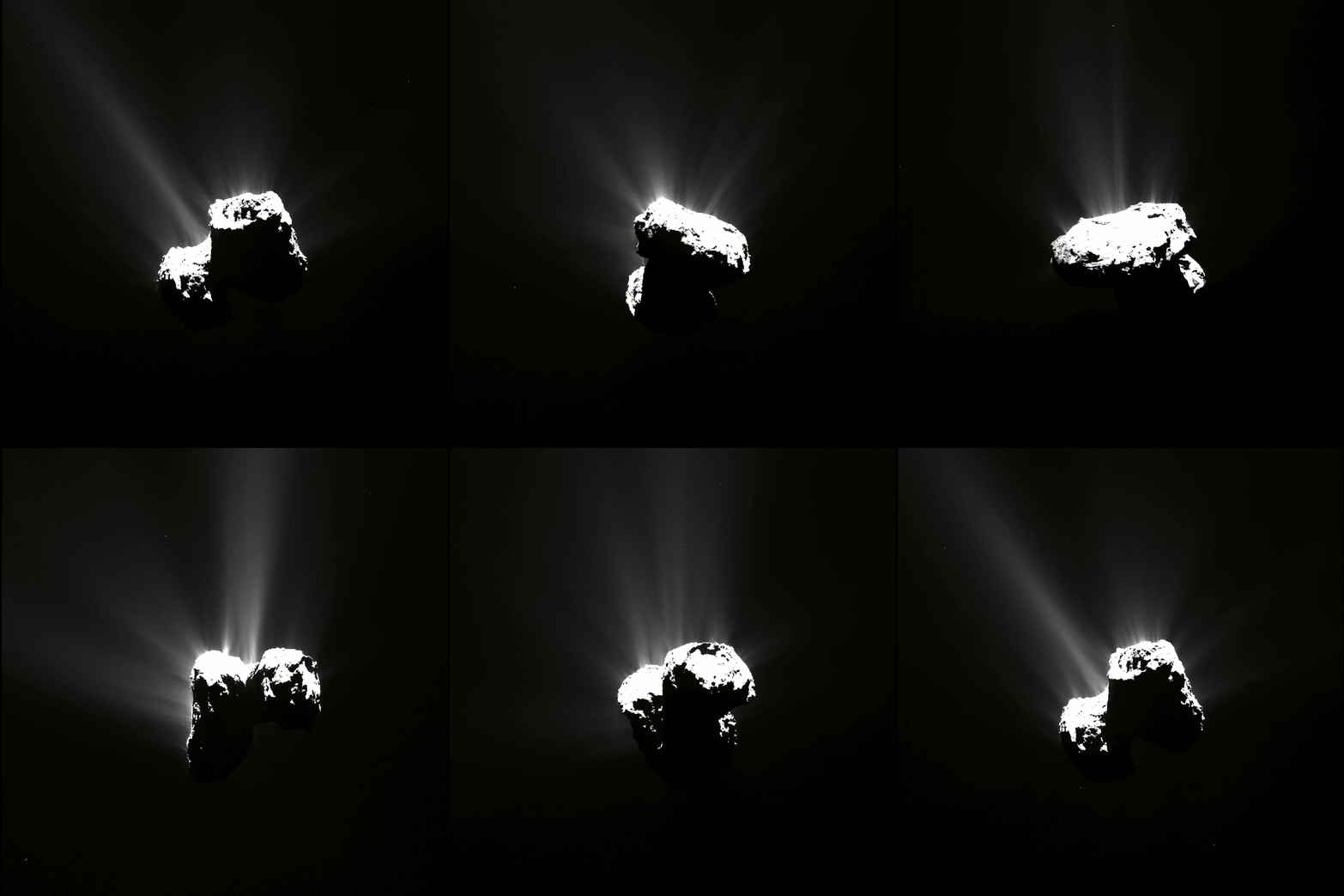
    Comet 67P/Churyumov-Gerasimenko
    Comet 67P/Churyumov-Gerasimenko

    By studying Comet 67P/Churyumov-Gerasimenko in situ, Rosetta will produce a full inventory of organic chemicals in the comet, thereby investigating the role of comets in the origin of life on Earth.

    In particular, it will search for a collection of molecules known as ‘left-handed’ amino acids. These are the 'bricks' with which all proteins on Earth are built.

    During tests of some of Rosetta’s instruments, it was demonstrated that they will be capable of detecting these amino acids. Rosetta will try to determine the ratio of right- and left-handed amino acids in the most primitive bodies in the Solar System to see if, as some astrobiologists believe, left-handed amino acids did originally come from space.

    Last update: 9 November 2007

    Rate this

    Views

    Share

    • Currently 0 out of 5 Stars.
    • 1
    • 2
    • 3
    • 4
    • 5
    Rating: 0/5 (0 votes cast)

    Thank you for rating!

    You have already rated this page, you can only rate it once!

    Your rating has been changed, thanks for rating!

    14
    facebook
    twitter
    reddit
    google plus
    digg
    tumbler
    digg
    blogger
    myspace
    • More about...
      • Rosetta at a glance
      • Rosetta press kit
        • Rosetta's journey
        • Related articles
          • History of cometary missions
            • Why 'Rosetta'?
              • Comets - an introduction
                • Life of a comet
                  • How many comets are there?
                    • Where life began
                    • Related links
                    • ESA Science - Rosetta
                    • Arianespace
                    • Astrium
                    • DLR

    Connect with us

    • RSS
    • Youtube
    • Twitter
    • Flickr
    • Google Buzz
    • Subscribe
    • App Store
    • LATEST ARTICLES
    • · CryoSat hits land
    • · Ariane 5 completes seven launches …
    • · Measuring skull pressure without t…
    • · Malargüe station inauguration
    • · The solar wind is swirly
    • FAQ

    • Jobs at ESA

    • Site Map

    • Contacts

    • Terms and conditions