• → European Space Agency

      • Space for Europe
      • Space News
      • Space in Images
      • Space in Videos
    • About Us

      • Welcome to ESA
      • DG's News and Views
      • For Member State Delegations
      • Business with ESA
      • ESA Exhibitions
      • ESA Publications
      • Careers at ESA
    • Our Activities

      • Space News
      • Observing the Earth
      • Human Spaceflight
      • Launchers
      • Navigation
      • Space Science
      • Space Engineering
      • Operations
      • Technology
      • Telecommunications & Integrated Applications
    • For Public

    • For Media

    • For Educators

    • For Kids

    • ESA

    • Rosetta

    • ESA Science

    • About Rosetta

      • Rosetta at a glance
      • Europe's comet chaser
      • Why 'Rosetta'?
    • About the spacecraft

      • The Rosetta orbiter
      • Orbiter: Instruments
      • The Rosetta lander
      • Lander: Instruments
    • About the journey

      • The long trek
      • Debris of the Solar System: Asteroids
      • Asteroid (2867) Steins: a portrait
      • Life and survival in deep space
      • Long-distance communication
      • The Rosetta ground segment
    • About the arrival

      • Comets - an introduction
      • Comet 67P/Churyumov- Gerasimenko
      • Comet rendezvous
      • Giotto - ESA's first comet mission
    • Meet the team
    • Mission Manager
    • Project Scientist
    • Multimedia
    • VideoTalk
    • 3D Flash 'model'
    • Rosetta images
    • Rosetta videos
    • Rosetta Animations
    • Rosetta wallpaper
    • Life of a comet
    • Services
    • Frequently asked questions
    • Comments

    ESA > Our Activities > Space Science > Rosetta

    Why 'Rosetta'?

    The Rosetta Stone, discovered in 1799

    The European Space Agency's unprecedented mission of cometary exploration is named after the famous 'Rosetta Stone'. This slab of volcanic basalt - now in the British Museum in London – was the key to unravelling the civilisation of ancient Egypt.

    French soldiers discovered the unique Stone in 1799, as they prepared to demolish a wall near the village of Rashid (Rosetta) in Egypt's Nile delta. The carved inscriptions on the Stone included hieroglyphics – the written language of ancient Egypt – and Greek, which was readily understood. After the French surrender in 1801, the 762-kilogram stone was handed over to the British.

    By comparing the inscriptions on the stone, historians were able to begin deciphering the mysterious carved figures. Most of the pioneering work was carried out by the English physician and physicist Thomas Young, and the French scholar Jean François Champollion. As a result of their breakthroughs, scholars were at last able to piece together the history of a long-lost culture.

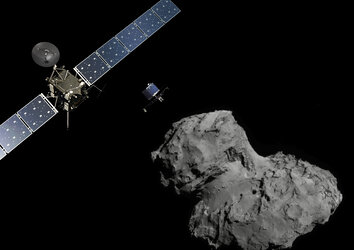
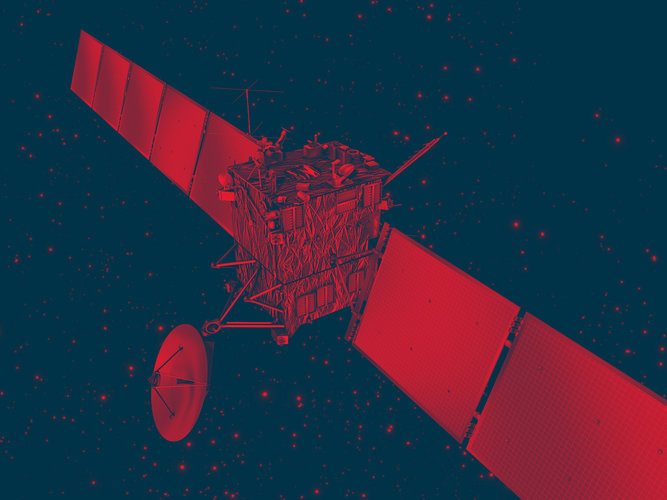
    Just as the Rosetta Stone provided the key to an ancient civilisation, so ESA's Rosetta spacecraft will unlock the mysteries of the oldest building blocks of our Solar System – the comets. As the worthy successor of Champollion and Young, Rosetta will allow scientists to look back 4600 million years to an epoch when no planets existed and only a vast swarm of asteroids and comets surrounded the Sun.
    Rate this

    Views

    Share

    • Currently 5 out of 5 Stars.
    • 1
    • 2
    • 3
    • 4
    • 5
    Rating: 5/5 (1 votes cast)

    Thank you for rating!

    You have already rated this page, you can only rate it once!

    Your rating has been changed, thanks for rating!

    100
    facebook
    twitter
    reddit
    google plus
    digg
    tumbler
    digg
    blogger
    myspace
    • More about...
      • Rosetta at a glance
      • Rosetta press kit
        • Rosetta's journey
        • Related articles
          • History of cometary missions
            • Why 'Rosetta'?
              • Comets - an introduction
                • Life of a comet
                  • How many comets are there?
                    • Where life began
                    • Related links
                    • ESA Science - Rosetta
                    • Arianespace
                    • Astrium
                    • DLR

    Connect with us

    • RSS
    • Youtube
    • Twitter
    • Flickr
    • Google Buzz
    • Subscribe
    • App Store
    • LATEST ARTICLES
    • · CryoSat hits land
    • · Ariane 5 completes seven launches …
    • · Measuring skull pressure without t…
    • · Malargüe station inauguration
    • · The solar wind is swirly
    • FAQ

    • Jobs at ESA

    • Site Map

    • Contacts

    • Terms and conditions