SMART-1 overview
Testing solar-electric propulsion and other deep-space technologies, and making lunar scientific investigations
Name: SMART stands for Small Missions for Advanced Research in Technology.
Launch date: 27 September 2003
Status: Mission ended through lunar impact on 3 September 2006.
Objective: To test a number of key technologies while performing an unprecedented scientific study of the Moon.
Mission: SMART-1 was the first of ESA’s Small Missions for Advanced Research in Technology. It travelled to the Moon using solar-electric propulsion and carrying a battery of miniaturised instruments.
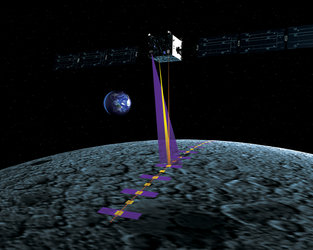
As well as testing new technology, SMART-1 conducted the first comprehensive inventory of key chemical elements on the lunar surface. It also investigated the theory that the Moon was formed following the violent collision of a smaller planet with Earth, four and a half thousand million years ago.
Europe's first mission to the Moon, SMART-1 arrived in lunar orbit on 15 November 2004. After completing its lunar science operations, its mission ended through lunar impact on 3 September 2006.
What's special?

- SMART-1 was the first European spacecraft to travel to and orbit around the Moon.
- It was only the second time that ion propulsion had been used as a mission's primary propulsion system (the first was NASA's Deep Space 1 probe launched in October 1998).
- SMART-1 looked for water (in the form of ice) on the Moon.
- To save precious xenon fuel, SMART-1 used 'celestial mechanics', that is, techniques such as making use of 'lunar resonances' and fly-bys.
Spacecraft
SMART-1 was a cubic, three-axis stabilised, spacecraft. Its solar panels were able to rotate so that they always kept in an optimum configuration with the Sun. The design was low-cost and emphasised miniaturisation wherever possible, especially for its payload.
It had a total mass of 367 kg, including 19 kg of payload. With its solar panels deployed, SMART-1 measured about 14 m across.
Journey
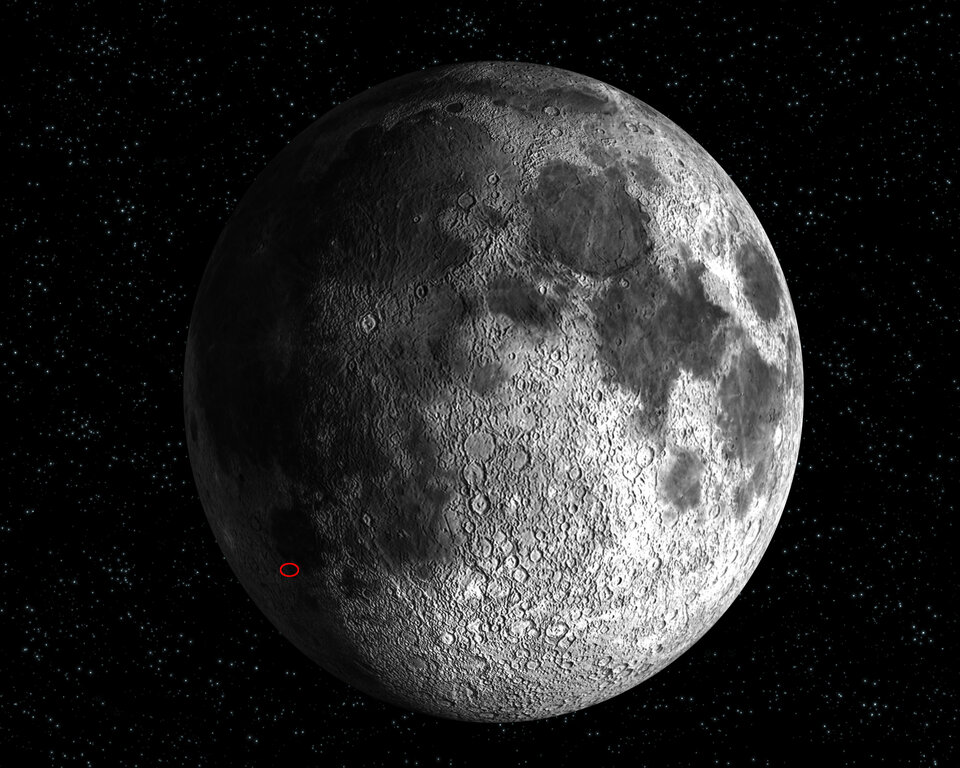
SMART-1’s voyage to the Moon was neither quick nor direct. After launch, SMART-1 went into an elliptical orbit around the Earth, typically used by telecommunications satellites. In this orbit the spacecraft fired its ion engine, gradually expanding its elliptical orbit and spiralling out in direction of the Moon’s orbital plane. Month after month, this brought it closer to the Moon, which orbits at between 350 000 and 400 000 kilometres from Earth. As SMART-1 neared the Moon, it began to use the gravity of the Moon to nudge it into a position where it was eventually captured by the Moon’s gravitational field in mid November 2004.
This complicated and slow journey was necessary because ion engines do not provide the instant power that chemical rockets do. However, because they are more efficient and require little fuel, ion engines are more flexible and allow space probes to reach places where chemical rockets would not be able to go. ESA invested in this technology to help with the development of missions to Mercury and the Sun.
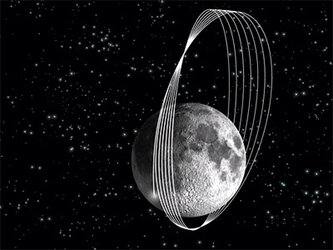
After being captured by the Moon, SMART-1 looped over the north and south poles, in an elliptical orbit whose height ranges from 300 to 3 000 km. During its scientific mission, it used the ion engine to gradually lower its highest altitude.
SMART-1's cruise phase from Earth to the Moon took around 13 months. The science operations started in January 2005, for nominal mission duration of six months. In February 2005, ESA decided to extend the mission until 2006.
Partnerships
The prime contractor was the Swedish Space Corporation, Solna, Sweden. They led a consortium of more than 20 European industrial teams to construct SMART-1. In total, this mission involved around 180 people working directly in industry and several hundred more indirectly working on products which were been used in SMART-1.
There were also another 170 engineers and scientists involved from ESA and other scientific institutes.