• → European Space Agency

      • Space for Europe
      • Space News
      • Space in Images
      • Space in Videos
    • About Us

      • Welcome to ESA
      • DG's News and Views
      • For Member State Delegations
      • Business with ESA
      • ESA Exhibitions
      • ESA Publications
      • Careers at ESA
    • Our Activities

      • Space News
      • Observing the Earth
      • Human Spaceflight
      • Launchers
      • Navigation
      • Space Science
      • Space Engineering
      • Operations
      • Technology
      • Telecommunications & Integrated Applications
    • For Public

    • For Media

    • For Educators

    • For Kids

    • ESA

    • Space Science

    • Our Universe
    • About Space Science
    • ESA's 'Cosmic Vision'
    • Science missions
    • Mission navigator
    • Target groups
    • For Media
    • For Scientists
    • For Kids
    • Multimedia
    • Science images
    • Science videos
    • Animations
    • Downloads
    • Sounds from space
    • Resources
    • Reference section
    • Services
    • FAQs
    • Glossary
    • Help
    • Portal terms of use
    • Comments
    • Follow us
    • RSS feeds
    • ESA Sci on Twitter
    • ESA Space Science Images on Flickr
    • ESA 3D on Flickr

    ESA > Our Activities > Space Science

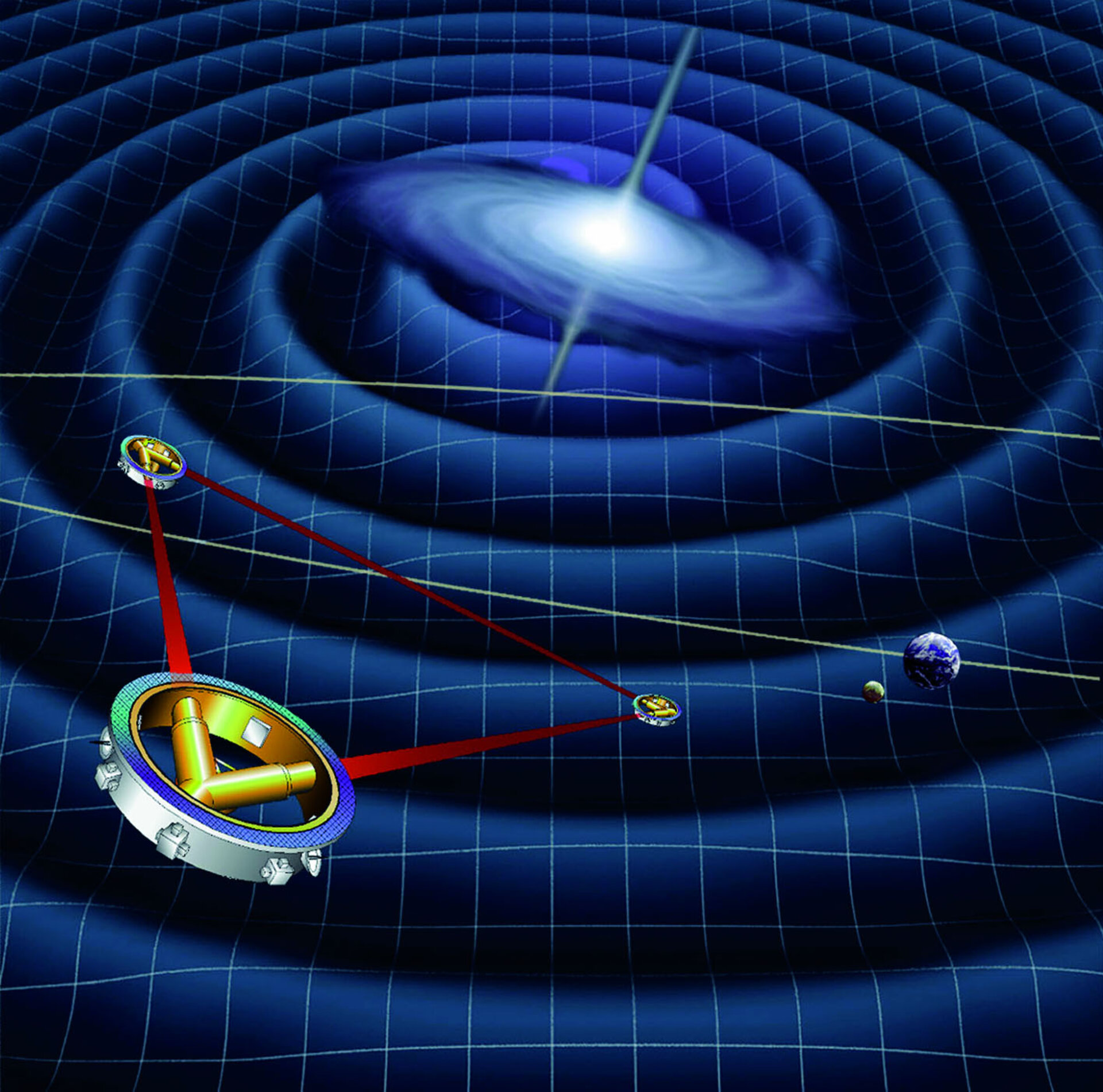
    Space-time as an elastic fabric

    Searching for gravitational waves with LISA

    The collision of distant black holes generates gravitational waves, or ripples in 'space-time'. Space-time can be thought of as a 'fabric' in which the objects of the Universe are embedded.

    Those objects - stars, planets, black holes - make space-time curve in upon itself, just as an elastic fabric holding a ball would do. The more massive the object, the deeper the curve - the same as in a fabric!

    This is, at least, what Albert Einstein wrote more than eight decades ago. Many of the predictions derived from his theory have been proven already, but not all. For example, Einstein predicted that if two very massive bodies moved, they would cause 'ripples' in the space-time continuum; moreover, those ripples would propagate at the speed of light, alternately stretching and squeezing space.

    These waves, called gravitational waves, have never been physically detected. The technology to do it has simply not been available, until now.

    ESA's mission LISA, scheduled for launch in 2012, aims to detect gravitational waves. It will be a new way to 'sense' the Universe. By perceiving the movement of very massive objects within a radius of thousands of millions of light-years, we will be able to detect some of the most amazing events in the Universe, such as the collision of two distant black holes.

    LISA Pathfinder, due for launch in 2007, will demonstrate the technology needed for LISA, one of ESA's future missions.

    Last update: 15 October 2004

    Rate this

    Views

    Share

    • Currently 0 out of 5 Stars.
    • 1
    • 2
    • 3
    • 4
    • 5
    Rating: 0/5 (0 votes cast)

    Thank you for rating!

    You have already rated this page, you can only rate it once!

    Your rating has been changed, thanks for rating!

    93
    Tweet

    Connect with us

    • RSS
    • Youtube
    • Twitter
    • Flickr
    • G+
    • Facebook
    • Livestream
    • Subscribe
    • App Store
    • ESA Science Twitter

    Follow ESA science

    • LATEST ARTICLES
    • · Rare merger reveals secrets of gal…
    • · Watching for hazards: ESA opens as…
    • · ESA astronaut Timothy Peake set fo…
    • · Space drives e-mobility
    • · Proba-V opens its eyes
    • FAQ

    • Jobs at ESA

    • Site Map

    • Contacts

    • Terms and conditions