• → European Space Agency

      • Space for Europe
      • Space News
      • Space in Images
      • Space in Videos
    • About Us

      • Welcome to ESA
      • DG's News and Views
      • For Member State Delegations
      • Business with ESA
      • ESA Exhibitions
      • ESA Publications
      • Careers at ESA
    • Our Activities

      • Space News
      • Observing the Earth
      • Human Spaceflight
      • Launchers
      • Navigation
      • Space Science
      • Space Engineering
      • Operations
      • Technology
      • Telecommunications & Integrated Applications
    • For Public

    • For Media

    • For Educators

    • For Kids

    • ESA

    • Space Science

    • Our Universe
    • About Space Science
    • ESA's 'Cosmic Vision'
    • Science missions
    • Mission navigator
    • Target groups
    • For Media
    • For Scientists
    • For Kids
    • Multimedia
    • Science images
    • Science videos
    • Animations
    • Downloads
    • Sounds from space
    • Resources
    • Reference section
    • Services
    • FAQs
    • Glossary
    • Help
    • Portal terms of use
    • Comments
    • Follow us
    • RSS feeds
    • ESA Sci on Twitter
    • ESA Space Science Images on Flickr
    • ESA 3D on Flickr

    ESA > Our Activities > Space Science

    Weighing the planet-forming disc around a nearby star

    Stars can be late parents

    30 January 2013

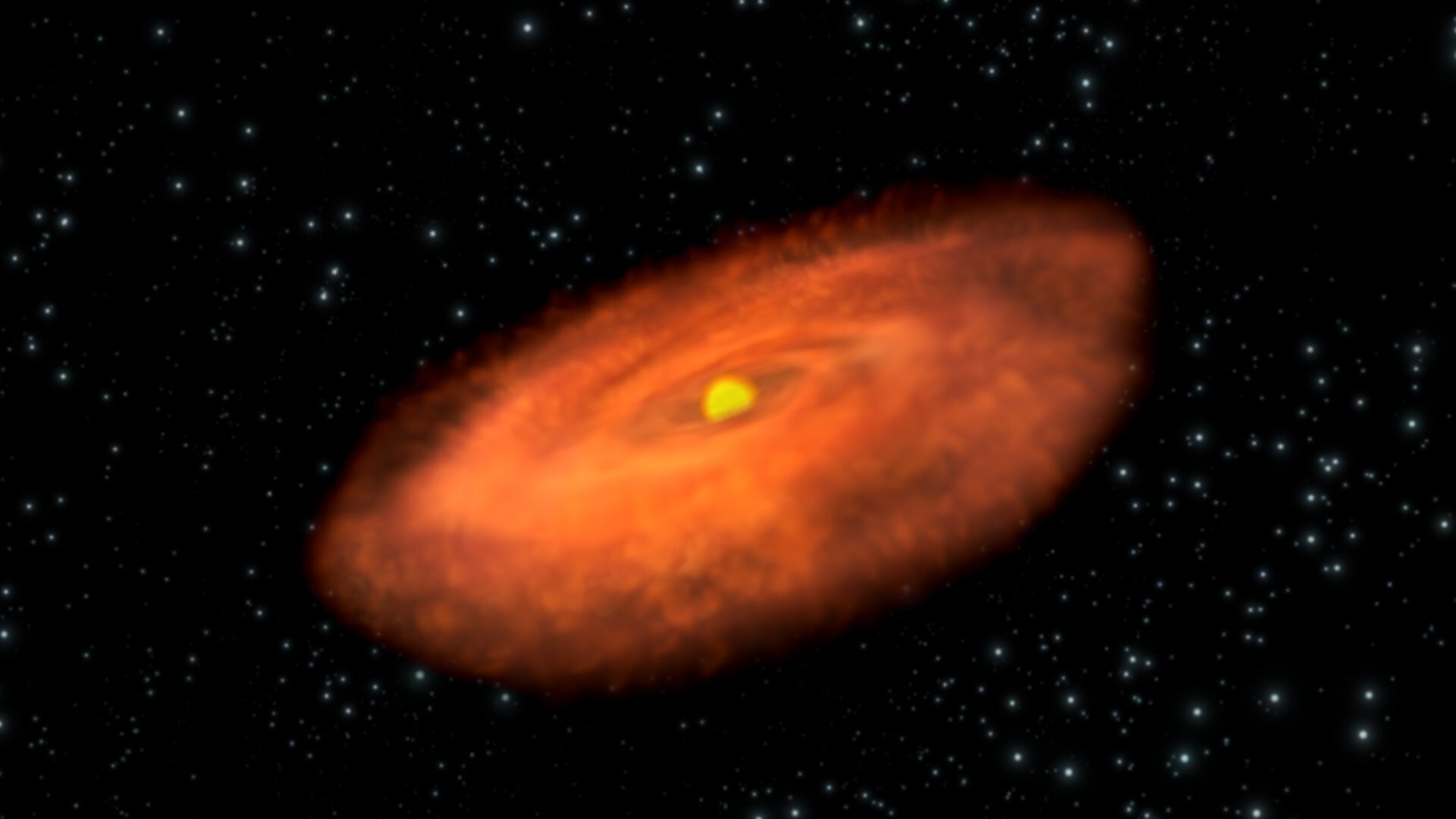
    Using the unique capabilities of ESA’s Herschel space observatory, astronomers have accurately ‘weighed’ a star’s disc, finding it still has enough mass to spawn 50 Jupiter-sized planets, several million years after most other stars have already given birth. 

    Proto-planetary discs contain all the raw ingredients for building planets. They are composed mainly of cold molecular hydrogen gas, which is highly transparent and essentially invisible.

    Usually, it is much easier to measure the emission from ‘contaminants’ such as the small fraction of dust mixed in the gas, or other gas constituents, to make estimates of the total disc mass.

    In the past, this technique has caused significant uncertainties in the estimations of molecular hydrogen mass, but thanks to the far-infrared wavelength capabilities and sensitivity of Herschel, astronomers have used a new, more accurate method, using a close relative of molecular hydrogen called hydrogen deuteride, or ‘heavy’ molecular hydrogen.

    Since the ratio of ‘normal’ and ‘heavy’ molecular hydrogen gas is extremely well known from measurements in our local solar neighbourhood, this approach provides a means to ‘weigh’ a star’s total disc mass with ten times higher accuracy than ever before.

    Using this technique, a substantial mass of gas was detected in a disc encircling TW Hydrae, a young star just 176 light-years away in the constellation of Hydra.

    “We did not expect to find so much gas around this 10-million-year-old star,” says Professor Edwin Bergin of the University of Michigan, lead author of the report published in Nature.

    “This star has significantly more mass than required to make our own Solar System and could make a much more exotic system with planets more massive than Jupiter.”

    Observing such a massive disc around TW Hydrae is unusual for stars of this age because, within a few million years, most material is typically incorporated into the central star or giant planets, or has been swept away by its strong stellar wind.

    “With a more refined mass, we can learn more about this system in terms of its planet-bearing potential and the availability of ingredients that might be able to support a planet with life,” adds Professor Bergin.

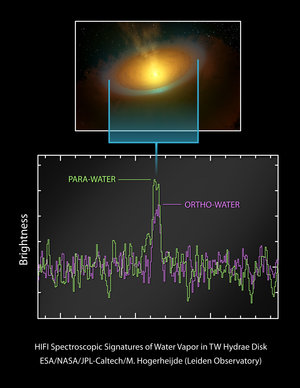
    Indeed, in a separate Herschel survey, scientists had already identified TW Hydrae as a star with a disc that contains enough water to fill the equivalent of several thousand Earth oceans.

    The new method of ‘weighing’ a disc means that the volume of materials available – including water – could have been underestimated, in this system and in others.

    A re-evaluation of the masses of discs around other stars of varying ages will provide more insight into the planet-building process.


    “There may be different outcomes regarding planet formation for systems of varying ages,” says co-author Professor Thomas Henning of the Max Planck Institute for Astronomy, Germany.  

    “Just as the ages at which people have children span a range, TW Hydrae seems to lie at the edge of that range for stars, showing that this particular system may have needed longer to form planets, and that it might be a late parent.”

    “The detection of heavy molecular hydrogen was made possible thanks to the new observing capabilities offered by Herschel, providing this leap forward in weighing the disc around this star,” adds Göran Pilbratt, ESA’s Herschel project scientist.

    Notes for Editors

    “An old disk that can still form a planetary system,” by E. Bergin et al, is published in Nature, 31 January 2013.

    The survey was conducted as part of an open time Herschel Programme using the Photoconductor Array Camera and Spectrometer (PACS), which operates in the wavelength range 55–210 microns.

    Herschel is an ESA space observatory with science instruments provided by European-led Principal Investigator consortia and with important participation from NASA. PACS was designed and built by a nationally funded consortium led by the Max Planck Institute for Extraterrestrial Physics (Garching, Germany); the consortium includes institutes from Belgium, Austria, France, Italy and Spain. 

    Rate this

    Views

    Share

    • Currently 4 out of 5 Stars.
    • 1
    • 2
    • 3
    • 4
    • 5
    Rating: 4/5 (2 votes cast)

    Thank you for rating!

    You have already rated this page, you can only rate it once!

    Your rating has been changed, thanks for rating!

    4993
    Tweet

    Related articles

    Taurus molecular cloud

    Large water reservoirs at the dawn of stellar birth09 October 2012

    Taurus molecular cloud

    Large water reservoirs at the dawn of stellar birth09 October 2012 ESA’s Herschel space observatory has discovered enough water vapour to fill Earth’s oceans more than 2000 times over, in a gas and dust cloud that is on the verge of collapsing into a new Sun-like star.

    Comet crystals found in a nearby planetary system03 October 2012

    Comet crystals found in a nearby planetary system03 October 2012 Pristine material that matches comets in our own Solar System have been found in a dust belt around the young star Beta Pictoris by ESA’s Herschel space observatory.

    Herschel’s image of Fomalhaut

    Herschel spots comet massacre around nearby star11 April 2012

    Herschel’s image of Fomalhaut

    Herschel spots comet massacre around nearby star11 April 2012 ESA’s Herschel Space Observatory has studied the dusty belt around the nearby star Fomalhaut. The dust appears to be coming from collisions that destroy up to thousands of icy comets every day.

    Herschel detects abundant water in planet-forming disc20 October 2011

    Herschel detects abundant water in planet-forming disc20 October 2011 ESA’s Herschel space observatory has found evidence of water vapour emanating from ice on dust grains in the disc around a young star, revealing a hidden ice reservoir the size of thousands of oceans.

    Comet Hartley 2 observed by ESA’s Herschel

    Did Earth's oceans come from comets?05 October 2011

    Comet Hartley 2 observed by ESA’s Herschel

    Did Earth's oceans come from comets?05 October 2011 ESA's Herschel infrared space observatory has found water in a comet with almost exactly the same composition as Earth's oceans. The discovery revives the idea that our planet's seas could once have been giant icebergs floating through space.

    • Herschel: ESA's giant infrared observatory
    • More about...
    • Herschel overview
    • Online Showcase of Herschel Images OSHI
      • Herschel operations
      • Herschel on YouTube
      • Inside Herschel
      • Herschel mission objectives
      • In depth
      • This article in depth
      • Herschel in depth
      • Herschel Science Centre
      • Related links
      • Herschel postcard gallery
      • The Milky Way Project

    Connect with us

    • RSS
    • Youtube
    • Twitter
    • Flickr
    • G+
    • Facebook
    • Livestream
    • Subscribe
    • App Store
    • ESA Science Twitter

    Follow ESA science

    • LATEST ARTICLES
    • · ESA astronaut Timothy Peake set fo…
    • · Space drives e-mobility
    • · Proba-V opens its eyes
    • · First new Galileo satellite arrive…
    • · Next destination: space
    • FAQ

    • Jobs at ESA

    • Site Map

    • Contacts

    • Terms and conditions