

Building and testing spacecraft
After a mission is adopted it moves into the implementation phase, during which detailed designs are prepared and engineering and qualification models (EM and QM) are built and tested before manufacturing the final flight model (FM) and its spares (FS).
| Phase 0 | Mission analysis and identification |
| Phase A | Feasibility |
| Phase B | Preliminary Definition |
| Phase C | Detailed Definition |
| Phase D | Qualification and Production |
| Phase E | Utilisation |
| Phase F | Disposal |
Design phase (Phase B-C)
During the preliminary definition phase the system requirements and interfaces are prepared, subsystem and instrument design are defined and reviewed and a preliminary mission schedule and cost at completion is outlined. After this phase is complete typically the mission is formally ‘adopted’ and more detailed designs are laid out (Phase B2 or C), including details of the spacecraft, payload, launcher and ground segment. At the end of this phase the mission moves from the ‘drawing board’ into the construction phase, first of the Engineering Model (pase C) and later of the Flight Model (phase D). The industrial prime contractor that will lead the development, manufacturing, integration and test of the spacecraft and its instruments, is selected after the mission adoption.
Development (Phase C)

During Phase C, two versions of the spacecraft are built: the Structural and Thermal Model (STM) and the Engineering Model (EM). These units are subjected to tough test conditions to replicate the conditions expected during launch, to verify that the satellite’s subsystems all work properly together and to ensure their compatibility with the launcher and its ground systems.
A Qualification Model may also be built in this phase to verify system performance with a good margin. It undergoes environmental testing, that includes thermal vacuum tests, where the satellite is placed inside a vacuum chamber with a sun simulator to reproduce the extreme variations in temperature experienced in space.
Vibration tests and acoustic tests replicate the conditions during launch. During vibration tests the spacecraft is progressively shaken at different strengths on a vibrating table, or 'the shaker'. The conditions created are up to 25% more severe than those expected at lift-off.
During acoustic tests, the spacecraft is placed in a reverberating chamber and subjected to very intense noise similar to that it would encounter during launch.
Qualification and production (Phase D)
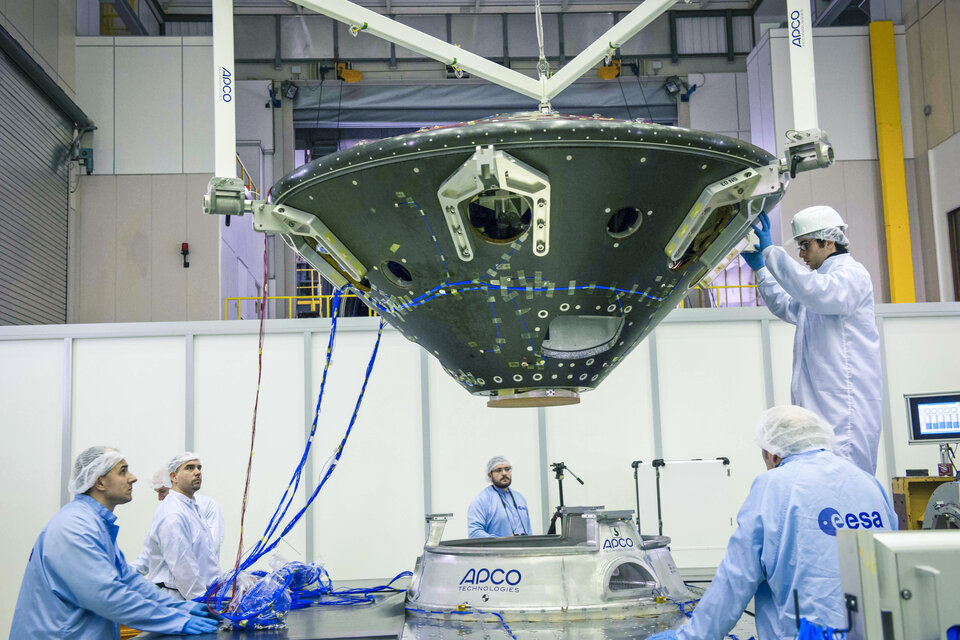
Once the design is proved beyond doubt and it passes the Critical Design Review, the Flight Model (FM) of the satellite is built (phase D). This is the one that will actually go into space.
Industry from all over Europe contribute with various elements, that are received and integrated by the prime contractor.
Again, the electrical systems are tested to ensure that electrical signals generated by one part of the spacecraft are received and understood by another, as well as communicate with the ground systems. The final tests also check the software, ensuring that it covers all operating modes and flight procedures, and that it can process information correctly. Navigation and and pointing are also tested.
Qualification and acceptance phases can take more than two years. Following the successful conclusion of the Flight Acceptance Review, the spacecraft is ready to be transported to the launch site.