• → European Space Agency

      • Space for Europe
      • Space News
      • Space in Images
      • Space in Videos
    • About Us

      • Welcome to ESA
      • DG's News and Views
      • For Member State Delegations
      • Business with ESA
      • ESA Exhibitions
      • ESA Publications
      • Careers at ESA
    • Our Activities

      • Space News
      • Observing the Earth
      • Human Spaceflight
      • Launchers
      • Navigation
      • Space Science
      • Space Engineering
      • Operations
      • Technology
      • Telecommunications & Integrated Applications
    • For Public

    • For Media

    • For Educators

    • For Kids

    • ESA

    • Venus Express

    • ESA Science

    • Europe goes to Venus

      • Tribute to the cryptic planet
      • Penetrating an impenetrable world
      • Past missions to Venus
    • About Venus Express

      • Venus Express mission facts
      • Venus Express objectives
      • The spacecraft
      • Orbiter instruments
      • The launcher
      • Operating Venus Express
    • About Venus

      • Venusian geography
      • The surface
      • Acid clouds and lightning
      • Greenhouse effect, clouds and winds
      • Venus compared to Earth
    • Meet the team

      • International collaboration
      • Project Manager: An interview with Don McCoy
      • Project Scientist: An interview with Håkan Svedhem
      • Launch Campaign Manager: An interview with Michael Witting
      • Spacecraft Operations Manager: An interview with Andrea Accomazzo
      • Venus Express Flight Control Team
      • Principal Investigators
    • Multimedia
    • Venus Express images
    • Venus Express videos
    • VideoTalk
    • 3D Flash 'model'
    • Build a model (pdf)
    • Wallpapers
    • Screensavers
    • Services
    • Comments

    ESA > Our Activities > Space Science > Venus Express

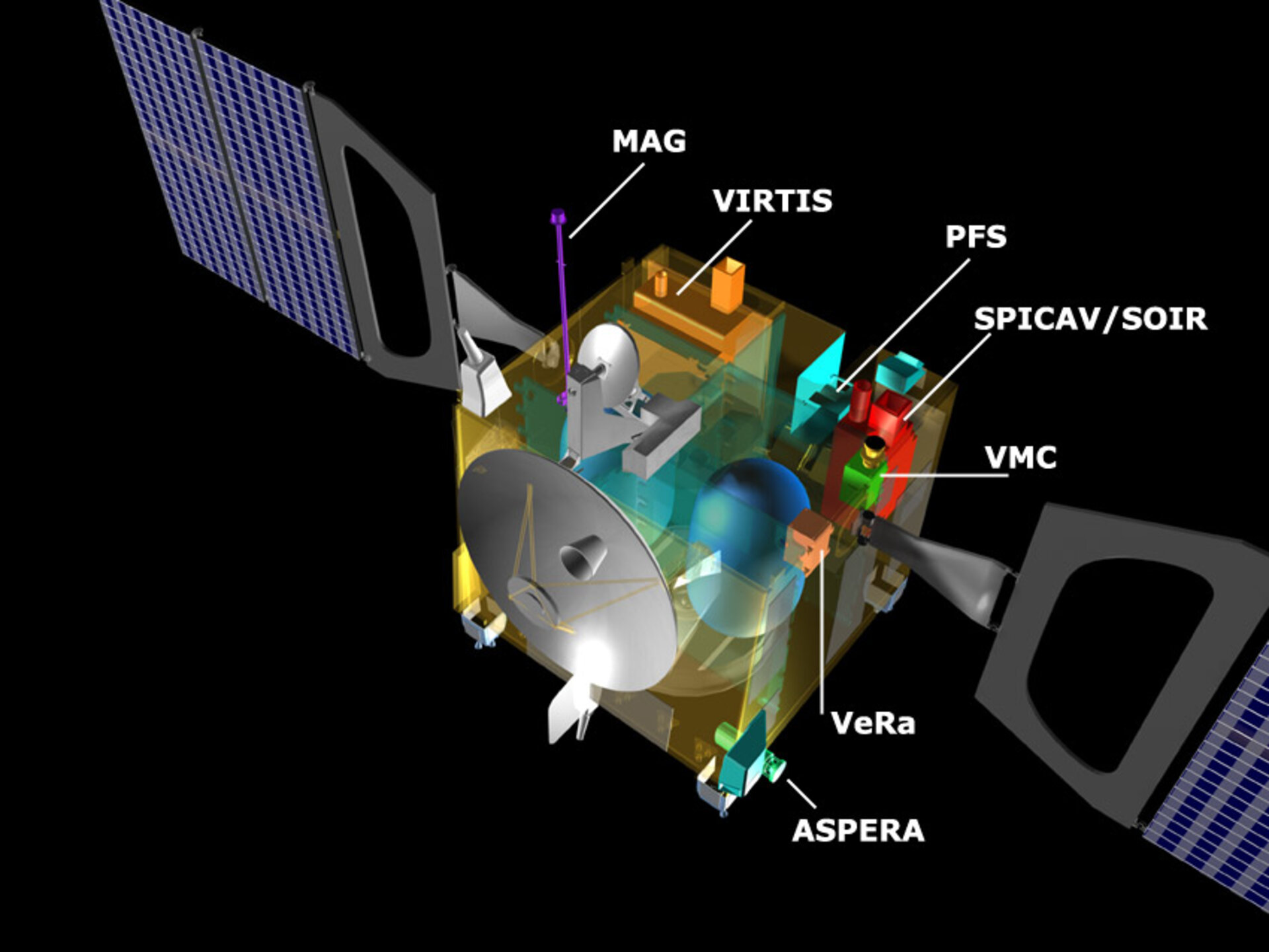
    Cutaway diagram showing size and location of instruments

    Venus Express orbiter instruments

    • ASPERA (Analyser of Space Plasma and Energetic Atoms)
    • MAG (Venus Express Magnetometer)
    • PFS (Planetary Fourier Spectrometer)
    • SPICAV/SOIR (Ultraviolet and Infrared Atmospheric Spectrometer)
    • VeRa (Venus Radio Science Experiment)
    • VIRTIS (Visible and Infrared Thermal Imaging Spectrometer)
    • VMC (Venus Monitoring Camera)

    Analyser of Space Plasma and Energetic Atoms (ASPERA)

    Led by Institute of Space Physics, Kiruna, Sweden

    ASPERA will investigate the interaction between the solar wind and the atmosphere of Venus by measuring outflowing particles from the planet’s atmosphere and the particles making up the solar wind. It will study how the molecules and ions escape the planet.

    Heritage: Mars Express


    Venus Express Magnetometer (MAG)

    Led by IWF, Graz, Austria

    Venus has no detectable internal magnetic field, and the field that exists around the planet is entirely due to the interaction between the solar wind and the atmosphere. The MAG magnetometer will study this process and will help in understanding the effect this has on Venus’s atmosphere, for instance the atmospheric escape process.

    Heritage: Newly developed for Venus Express (but reusing sensors design from the Rosetta lander)

    Planetary Fourier Spectrometer (PFS)

    Led by IFSI-INAF, Rome, Italy

    PFS will be able to measure the temperature of the atmosphere between altitudes of 55–100 kilometres at a very high resolution. It will also be able to measure the surface temperature and therefore be able to search for volcanic activity. In addition to its temperature measurements, PFS will be able to make composition measurements of the atmosphere.

    Heritage: Mars Express

    Ultraviolet and Infrared Atmospheric Spectrometer (SPICAV/SOIR)

    Led by Service d’Aeronomie du CNRS, Verriesres, France; Institute for Space Aeronomy, Belgium; IKI, Russia

    SPICAV assists in the analysis of Venus’s atmosphere. In particular, it will search for the small quantities of water expected to exist in the Venusian atmosphere. It will also look for sulphur compounds and molecular oxygen in the atmosphere. It will determine the density and temperature of the atmosphere at 80–180 kilometres altitude.

    Heritage: SPICAV inherited from Mars Express, new development for SOIR

    Venus Radio Science Experiment (VeRa)

    Led by Univ. der Bunderswehr, Munich, Germany

    VeRa uses the powerful radio link between the spacecraft and Earth to investigate the conditions prevalent in the ionosphere of Venus. Scientists will also use it to study the density, temperature, and pressure of the atmosphere from 35–40 km up to 100 km from the surface, and to determine roughness and electrical properties of the surface. It will also allow investigations of the conditions of the solar wind in the inner part of the Solar System.

    Heritage: Rosetta

    Ultraviolet/Visible/Near-Infrared mapping spectrometer (VIRTIS)

    Led by CNR-IASF, Rome, Italy, and Observatoire de Paris, France

    VIRTIS will be able to study the composition of the lower atmosphere between 40 kilometres altitude and the surface. It will track the clouds in both ultraviolet and infrared wavelengths and allow scientists to study atmospheric dynamics at different altitudes.

    Heritage: Rosetta

    Venus Monitoring Camera

    Led by MPS, Katlenburg-Lindau, Germany

    VMC is a wide-angle multi-channel camera that will be able to take images of the planet in the near infrared, ultraviolet and visible wavelengths. VMC will be able to make global images and will study the cloud dynamics and image the surface. In addition it will assist in the identification of phenomena seen by other instruments.

    Heritage: Newly developed for Venus Express (reusing parts of Mars Express’s High Resolution Stereo Camera)
    Rate this

    Views

    Share

    • Currently 0 out of 5 Stars.
    • 1
    • 2
    • 3
    • 4
    • 5
    Rating: 0/5 (0 votes cast)

    Thank you for rating!

    You have already rated this page, you can only rate it once!

    Your rating has been changed, thanks for rating!

    126
    facebook
    twitter
    reddit
    google plus
    digg
    tumbler
    digg
    blogger
    myspace
    • Looking at Venus
    • Launch replay
    • Venus Express launch
    • Related articles
      • Venus Express performs flawlessly, LEOP complete
        • Venus Express mission operations update
          • "Venus Express, give me a GO/NO GO for launch..."
            • Venus Express: ready for lift-off
              • Green light for Venus Express launcher fuelling
                • Venus Express countdown activities started
                  • Venus Express moved back to launch pad
                    • Venus Express set for transport to launcher assembly building
                      • Venus Express mated with upper-stage
                      • More about...
                      • Status reports
                      • Launch in detail
                        • Venus Express factsheet
                        • Related links
                        • Starsem - the Soyuz
                        • Venus Express operations
                        • Cebreros station webcam

    Connect with us

    • RSS
    • Youtube
    • Twitter
    • Flickr
    • Google Buzz
    • Subscribe
    • App Store
    • LATEST ARTICLES
    • · CryoSat hits land
    • · Ariane 5 completes seven launches …
    • · Measuring skull pressure without t…
    • · Malargüe station inauguration
    • · The solar wind is swirly
    • FAQ

    • Jobs at ESA

    • Site Map

    • Contacts

    • Terms and conditions